Summary
- The Great Sphinx is a 73-meter limestone monument on the Giza Plateau, most likely carved around 2500 BC, though scholars still debate whether it depicts Khafre, Khufu, or Djedefre.
- Its missing nose was deliberately removed, most likely in 1378 AD by a Sufi cleric named Muhammad Sa'im al-Dahr, not by Napoleon's cannon fire, which is a myth disproven by a 1737 drawing.
- Around 1400 BC, Pharaoh Thutmose IV's Dream Stele recorded a legend in which the Sphinx promised him the throne in exchange for clearing away sand burying its body.
- The Sphinx has been excavated and restored repeatedly across history, from Roman-era clearing under Nero to 20th-century repairs that included a since-permanent concrete collar around its neck.
- Real seismic surveys have found subsurface voids near the paws, but claims of a hidden "Hall of Records" or a construction date in 10,500 BC remain unsupported pseudoarchaeology.
The Great Sphinx is considered to be the embodiment of antiquity and mystery. It illuminates to this day the imagination of many poets, travelers, adventurers, and scientists over the millennia, and even today, its origin is still under debate. Great tales of mystery and wonder have been told about this incredible statue that showcased a whole different aspect of ancient Egyptian mythology, architecture, and artistic expression.
No monument in Egypt has generated more theories per visible surface than the Great Sphinx of Giza. Carved from a single ridge of bedrock more than four thousand years ago, it has lost its nose, misplaced its name, survived at least three burials under desert sand, and inspired everything from a pharaoh's fevered dream to a 1930s prophecy about a lost hall of records that never materialized. It remains the oldest known monumental sculpture in Egypt, and still, after two centuries of serious excavation, no inscription from its own time definitively says who built it or why.
This guide covers what the Sphinx actually is and how large it really measures, the competing theories over who built it and when, the true story behind its missing nose, the legendary dream that led a young pharaoh to dig it out of the sand, the long and sometimes destructive history of its excavation and restoration, and how to separate the site's real unanswered questions from the pseudoarchaeology that has attached itself to the monument over the last century.
What Is the Great Sphinx of Giza?
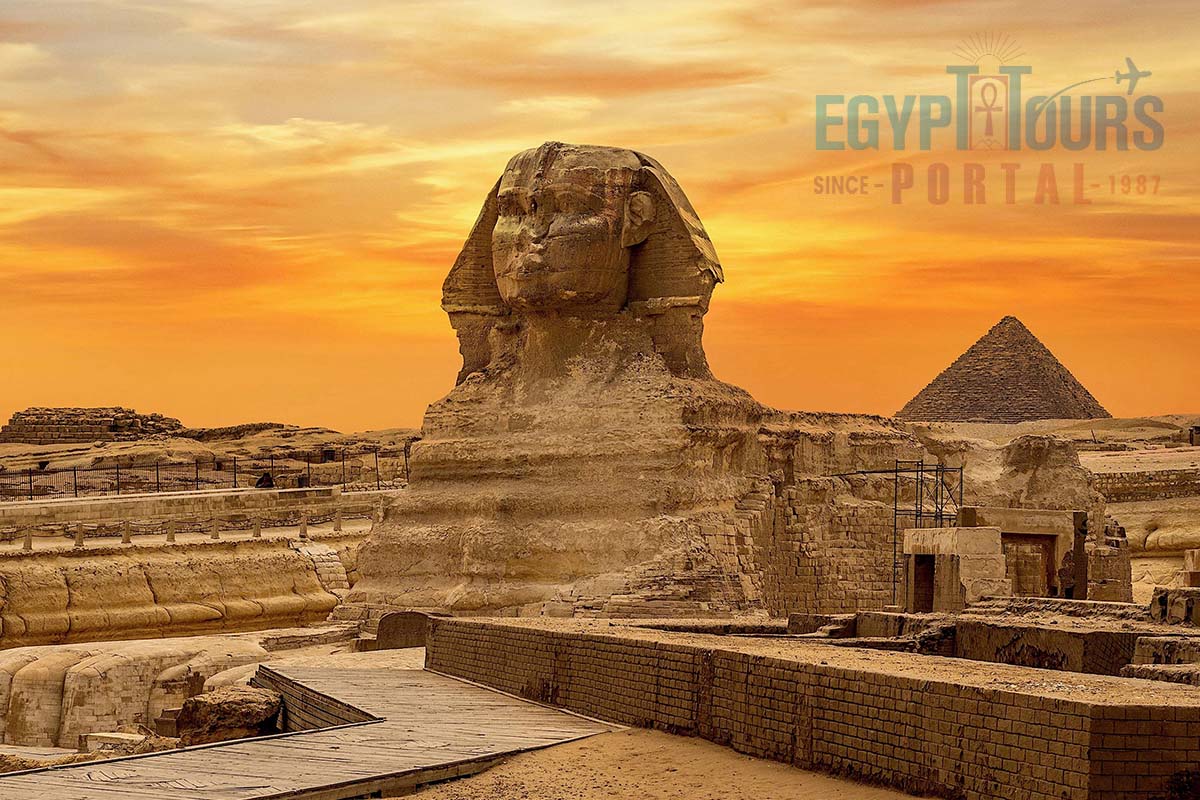
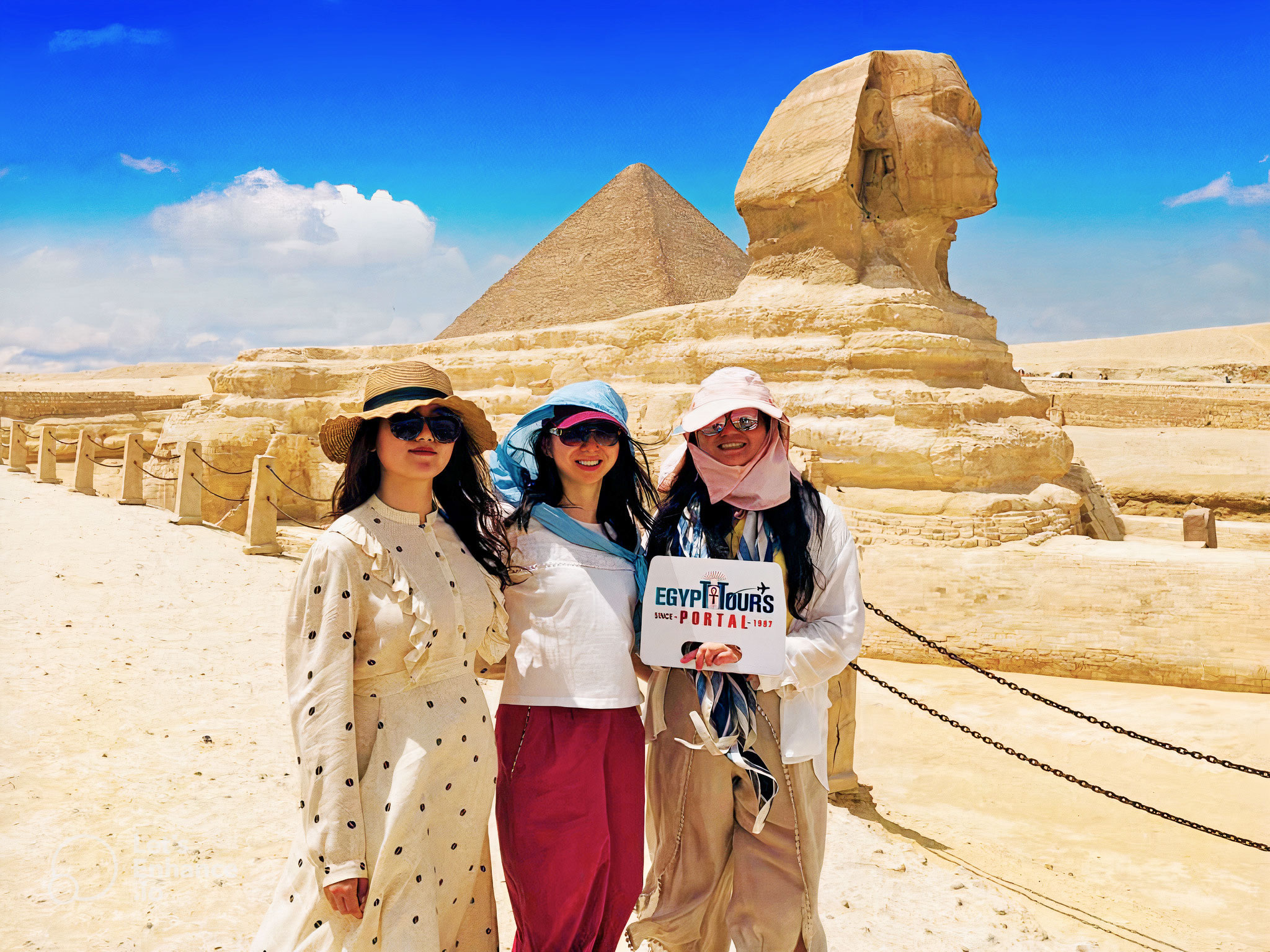
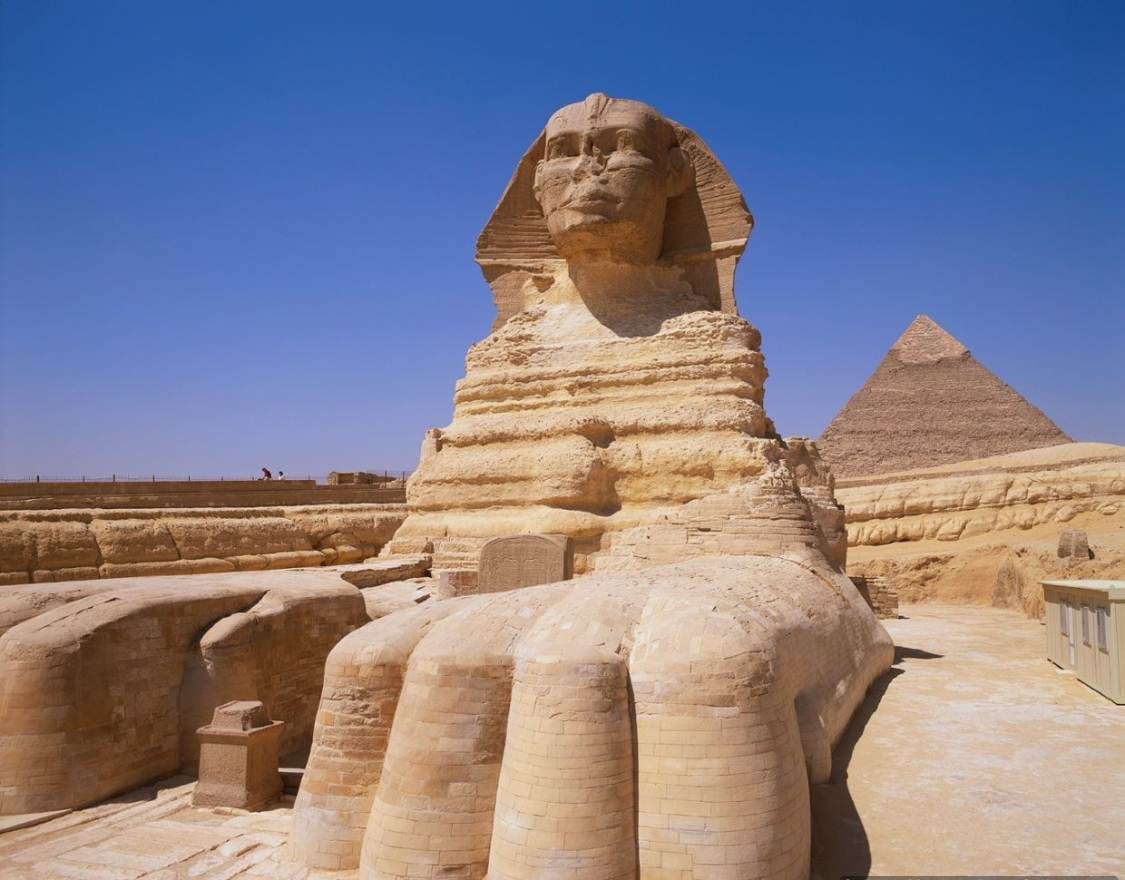
The Great Sphinx sits on the Giza Plateau on the Nile's west bank, roughly 10 kilometers from ancient Memphis and central Cairo, facing due east as part of the wider Memphite Necropolis alongside the pyramids of Khufu, Khafre, and Menkaure. Carved from a single monolith of Eocene-era limestone, part of the Mokattam Formation, it measures 73 meters from paw to tail, 20 meters tall, and 19 meters wide at the haunches, combining a reclining lion's body with a human head wearing the royal nemes headdress. The Roman writer Pliny the Elder recorded his own measurements in the first century AD, a head circumference of 102 feet and a height of 62 feet from belly to the crown, proof that visitors have been trying to pin the monument down in numbers for roughly two thousand years.
The limestone itself works against the Sphinx's preservation. Its legs and lower body sit on solid rock, but the torso was carved from a much softer layer that has crumbled steadily for millennia, while the harder stone of the head has worn far more slowly, which is largely why the head has kept its form while the body has needed repeated restoration.
The pairing of body and head was never accidental. A lion's body lent the monument raw physical power and the role of a guardian, while the human head, crowned with a pharaoh's headdress, added intellect and royal authority, together standing for the sun god in his form as Ra-Horakhty, watching over the necropolis behind him. A small temple, its stones cut from the same quarrying that shaped the Sphinx's body, once stood between its front paws, holding inscribed steles, including the Dream Stele discussed further below, though like the surrounding enclosure it appears to have been left unfinished in antiquity.
Figure Out Who Built the Great Sphinx
Most archaeologists still date the Sphinx to Egypt's Old Kingdom, somewhere between 2600 and 2500 BC, but which pharaoh's face it actually depicts remains one of Egyptology's longer-running arguments.
The Khafre Theory
The most widely accepted view credits Khafre, Khufu's son, who reigned around 2558 to 2532 BC. The case rests partly on a damaged cartouche on the Sphinx's own Dream Stele, where Egyptologist Thomas Young once inserted a missing glyph to complete the name "Khafre", a reconstruction that became harder to verify after the stele was re-excavated in 1925 and the relevant lines had flaked away entirely. Supporting the theory more solidly is the archaeology around it: Khafre's Valley Temple predates the Sphinx Temple in front of the Sphinx, and the causeway connecting them appears to have been built with the Sphinx's existence already in mind.
The Khufu and Djedefre Theories
Rainer Stadelmann, former director of the German Archaeological Institute in Cairo, has instead argued for Khufu himself, pointing to the style of the nemes headdress and detached beard as more consistent with his reign than his son's. In 2004, French Egyptologist Vassil Dobrev proposed a third candidate: Djedefre, Khafre's half-brother, who may have commissioned the Sphinx in his father Khufu's likeness to restore the dynasty's standing after a difficult succession. Other Egyptologists, including Nigel Strudwick, have called Dobrev's theory "not implausible" while noting it still lacks direct proof.
Older and Middle Kingdom Theories
A handful of more marginal theories push the date in both directions. German Egyptologist Ludwig Borchardt once attributed the monument to the 12th Dynasty Middle Kingdom, noting a resemblance to Pharaoh Amenemhat III, though this has been largely rejected by later scholarship.
On the older end, geologist Colin Reader has pointed to water erosion patterns around the Sphinx enclosure as evidence it may predate the surrounding quarries, and by extension the pyramids themselves, a serious, mainstream-adjacent argument distinct from the far more speculative fringe theories discussed further below.
Selim Hassan, who directed major excavations of the Sphinx enclosure in the 1940s, summarized the state of the evidence about as honestly as anyone has since: credit for the Sphinx likely belongs to Khafre, he wrote, "but always with this reservation: that there is not one single contemporary inscription which connects the Sphinx with Khafre." The debate is a useful reminder that even among Egypt's most famous pharaohs, attribution is not always as settled as a museum label suggests.
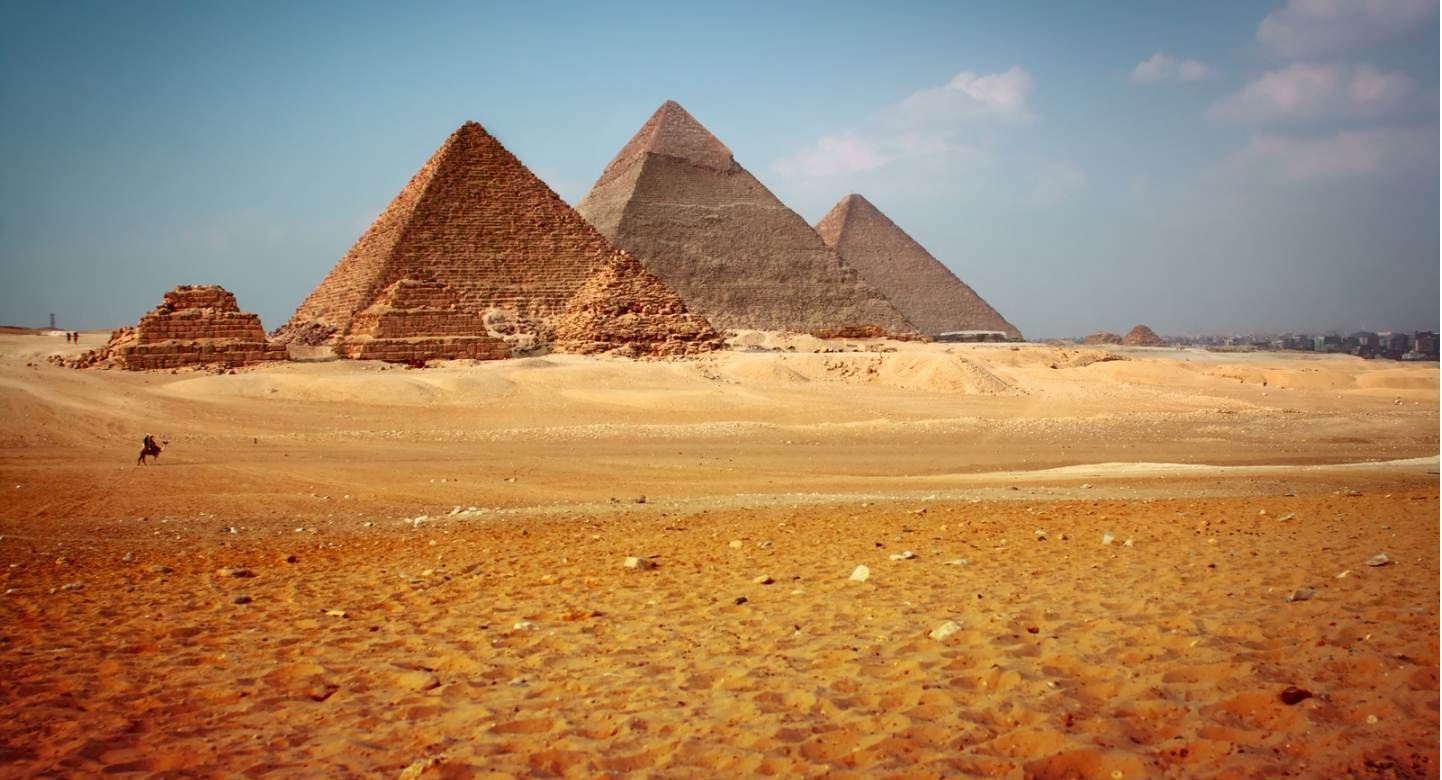
Giza Pyramids Complex: History, Construction, Layout, and Facts
Explore the Giza Pyramids Complex, its history, layout, construction, hidden secrets, and key facts about Egypt’s most iconic ancient wonder.
How Sphinx Imagery Evolved After Giza
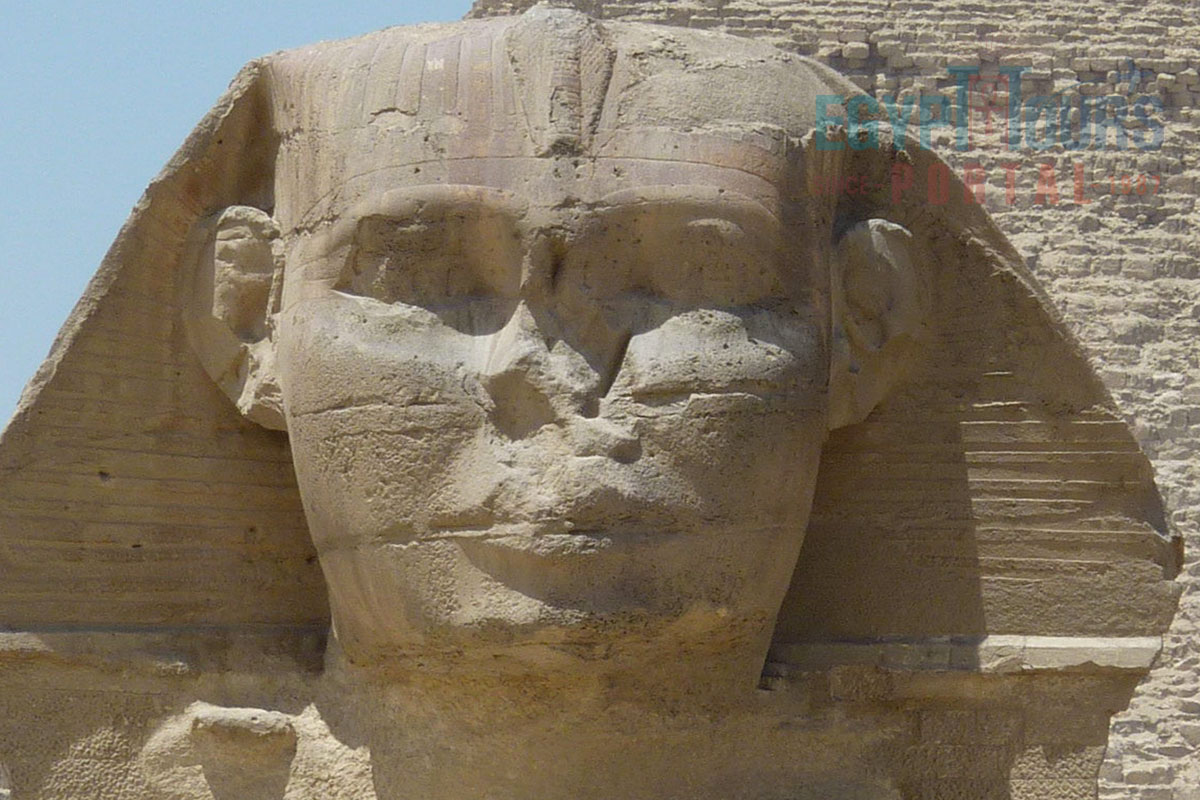
The Great Sphinx set a template that Egyptian art kept adapting for the next two thousand years, even as the original monument's own name faded from record. Its own Old Kingdom form paired a lion's body with a human head, a false ceremonial beard, and the royal nemes headdress, the version still standing at Giza today.
By the Middle Kingdom, the image had changed: King Amenemhat III, in the later 12th Dynasty, became the first pharaoh depicted as a sphinx with a full lion's mane rather than the smoother nemes cloth, folding himself more literally into the lion's own anatomy.
The New Kingdom brought a further change, as sphinxes began appearing with human arms in place of forelegs, often shown holding offering vessels or cult objects; Amenhotep III was the first pharaoh to adopt this form, generations before his son's Dream Stele legend became attached to the original Giza monument.
The Sphinx's Names Through History
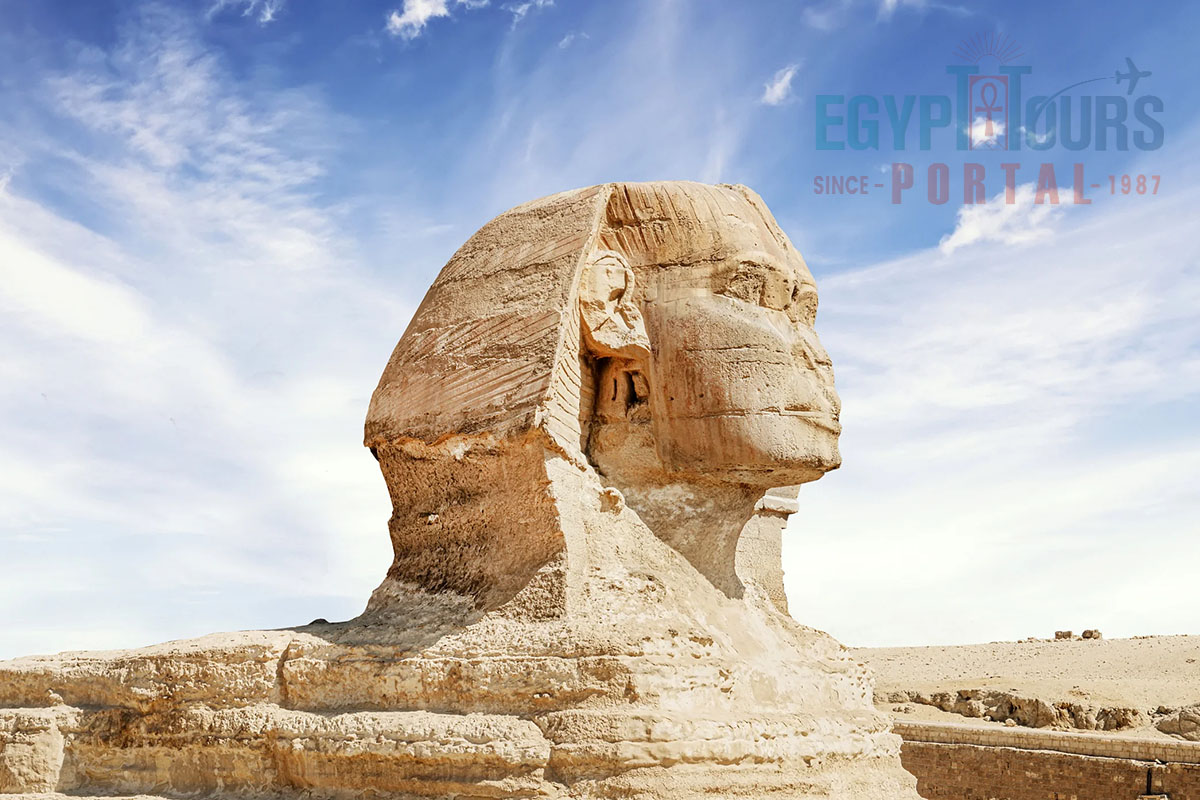
The Sphinx almost certainly had an Old Kingdom name, but it has never been recovered; the temple built in front of it, along with its surrounding enclosure, was seemingly never fully completed or put into cultic use during that period.
Egyptologists sometimes refer to it retroactively by the descriptive term shesep-ankh, or "living image," language borrowed from the wider vocabulary used for royal statuary of the period rather than a name confirmed on the monument itself. By the New Kingdom, roughly 1570 to 1050 BC, Egyptians knew it as Hor-em-Akhet, "Horus of the Horizon," a solar deity name the Greeks later rendered as Harmachis.
The name "Sphinx" itself did not arrive until the Greco-Roman period, some 2,000 years after construction, borrowed from the Greek verb sphingo, "to squeeze," after the riddling, strangling monster of Greek myth, even though the Greek sphinx traditionally had wings and a woman's head, features the ancient Egyptian woman never had.
Medieval Arab writers used their own names, including Bilhaub and Abu al-Hawl, "Father of Terror," a name still used in Egyptian Arabic today. Some medieval sources also linked the monument to the Canaanite god Hauron, one of several ways later cultures projected their own religious frameworks of Gods and Goddesses onto a monument whose original meaning had already been lost to time.
The Missing Nose and Beard: Myth Versus Reality
Close examination of the face shows clear evidence of deliberate damage: tool marks from rods or chisels are visible at the bridge of the nose and beneath the nostril, consistent with the nose having been pried off rather than simply eroding away.
The popular explanation, that Napoleon's troops shot the nose off with cannon fire during his 1798 Egyptian campaign, is demonstrably false. French artist Frederic Louis Norden sketched the Sphinx with its nose already missing in 1737, more than sixty years before Napoleon ever set foot in Egypt, and his drawings were published well before the myth took hold.
Historical writers instead point to Egypt's medieval period: some 10th-century Arab authors describe iconoclastic attacks on the monument, and 14th-century chronicler Ibn Qadi Shuhba records Mamluk-era desecration of sphinx statues nearby.
The most specific account comes from 15th-century historian al-Maqrizi, who attributed the damage to a Sufi cleric named Muhammad Sa'im al-Dahr in 1378, who reportedly defaced the Sphinx after seeing peasants leaving harvest offerings before it, a practice he considered idolatrous. Local legend later claimed the plague of sand that buried the Giza Plateau soon afterward was divine punishment for his act.
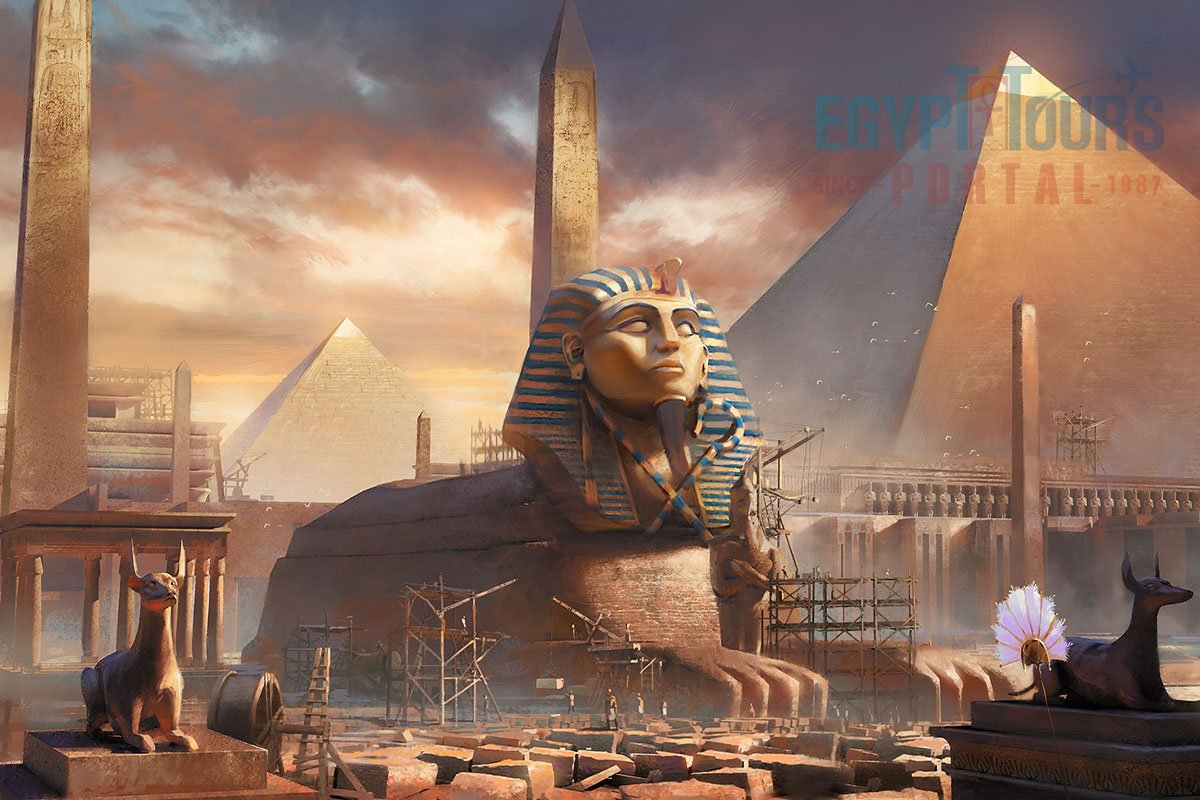
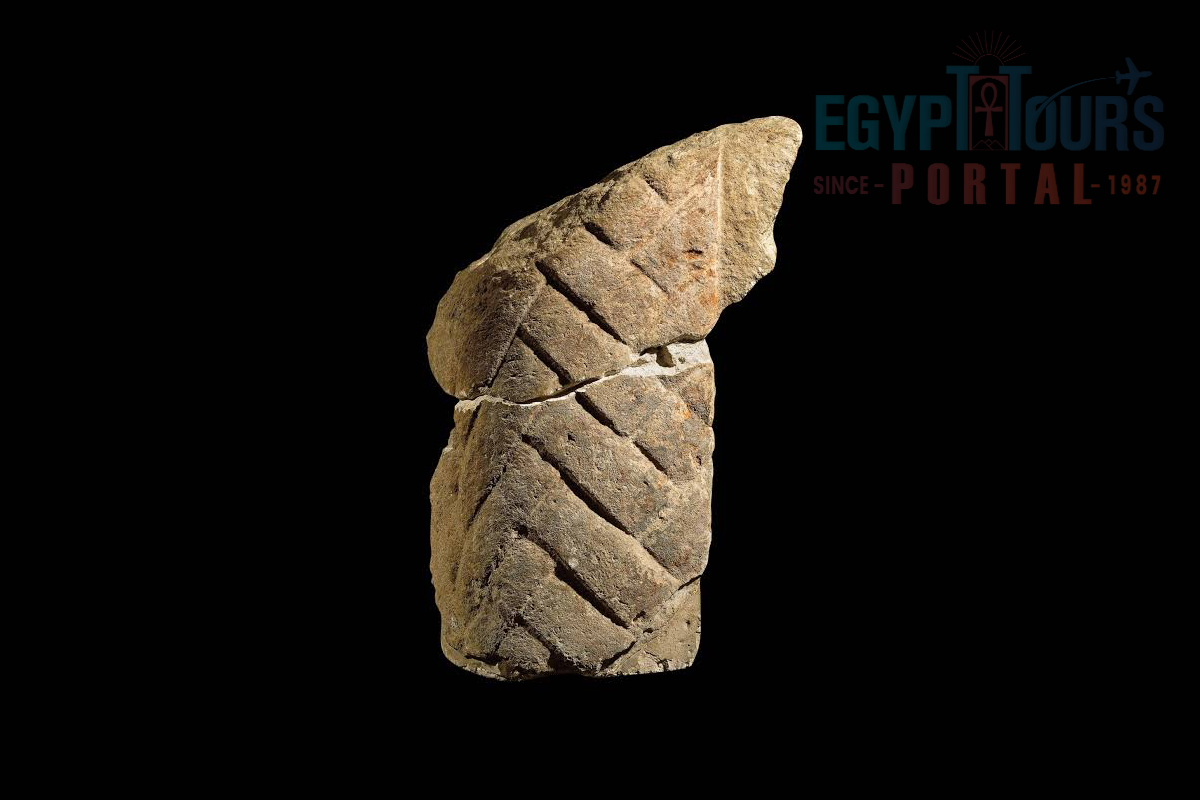
The Sphinx also once wore a ceremonial pharaonic beard, now broken away; a surviving fragment is held today in London's British Museum. Traces of red pigment remain visible on the face, with smaller traces of yellow and blue found elsewhere on the body, suggesting the monument was originally painted in vivid color rather than left as bare stone, a detail easy to forget standing before its current sun-bleached limestone.
The Dream Stele and Thutmose IV's Legend
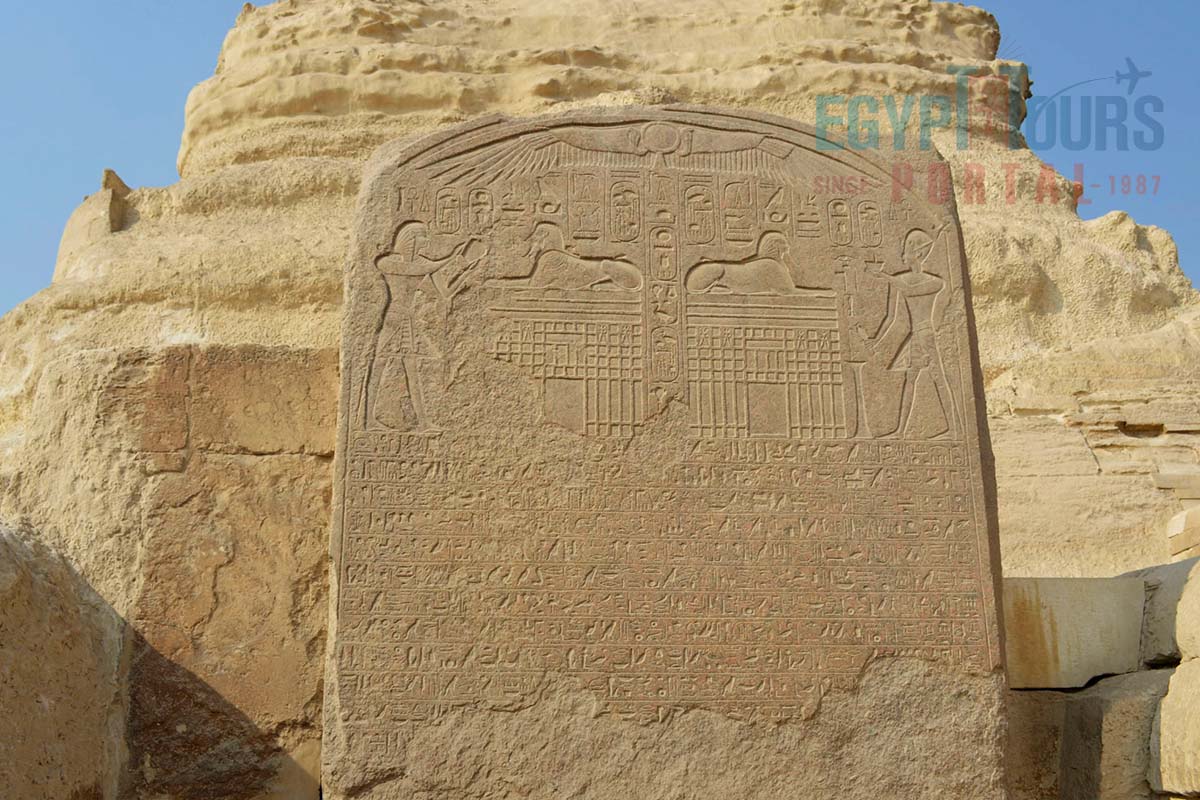
Around 1400 BC, a granite stele was placed between the Sphinx's paws by Pharaoh Thutmose IV, inscribed with a story that has outlasted almost every other legend attached to the monument.
According to the stele, the young prince fell asleep in the Sphinx's shadow while out hunting and dreamed that the monument spoke to him, identifying itself as the god Harmakhis and complaining that sand had buried its body: "The sand of the desert whereon I am laid has covered me. Save me, causing all that is in my heart to be executed."
In exchange for clearing the sand, the dream promised Thutmose the throne of Egypt, a throne he was not, at the time, first in line to inherit. Whether pure legend or a piece of dynastic propaganda written after the fact to justify his succession, the stele remains the earliest known excavation of the Sphinx on record, and it may not have been the last: some evidence suggests Ramses the Great ordered a second clearing generations later.
The Complex Mystery Around the Sphinx
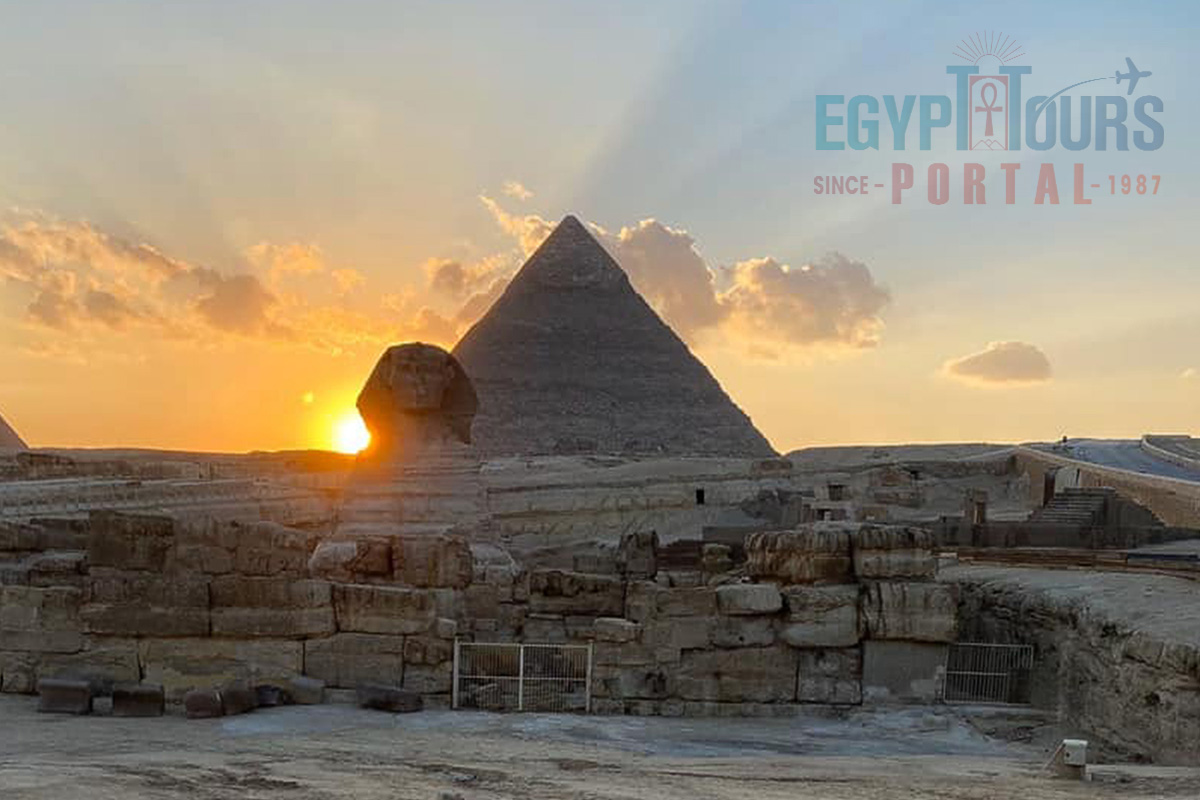
There has always been a debate concerning the age of the Sphinx, which is believed to have been constructed after the image of pharaoh Khafre about 2500 BC, which explains why the Sphinx is perfectly geographically aligned with the Khafre Pyramid.
The Sphinx has a lion's body and a human head, which some debate to be a tribute to the constellation of Leo according to the theory of alignment of the Orion constellation and relative position to the Milky Way by Robert Bauval and Graham Hancock.
They believed that the construction of the Great Sphinx began in 10,500 BC, and the Sphinx Lion design is a reference to the Leo constellation, plus the entire layout of the Giza pyramid complex and the Nile River is an accurate reflection and a map of the Orion belt, constellation of Leo, and the Milky Way that matched perfectly in 10,500 BC.
The observations state that these celestial bodies represent the astrological age of Leo that occurred between 10,970 BC and 8810 BC, which means it is much older than believed. Some believe that the head was re-carved various times after the Old Kingdom (2575 BC-2150 BC) as a means of repair, which altered the facial proportions of the original form that could have been the head of a ram or a hawk.
The Grand Evolution of the Sphinx
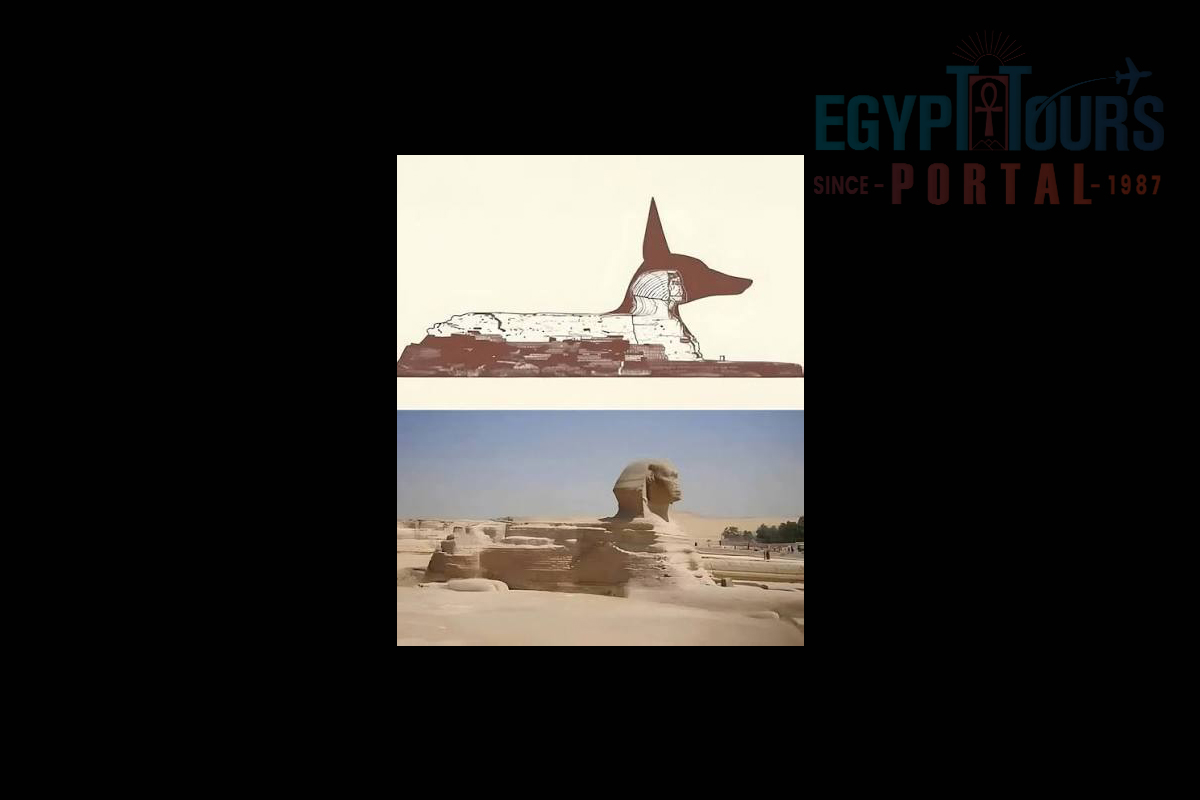
The Sphinx existed during the dynastic era in a simple two-dimensional form, but it changed later on. In the Old Kingdom, the sphinx statues were showcased with a human head and the body of a lion, with a false royal beard and the name's headdress. In the Middle Kingdom, the sphinx was just a representation of the king in the shape of the Sphinx, with the human head surrounded by the lion mane.
The first-ever King who represented himself in the form of a sphinx with a lion's mane was Amenemhat III, during the Middle Kingdom in the second half of the 12th dynasty. In the New Kingdom, the sphinx statues continue the Middle Kingdom traits, but they made some changes by transforming the forelegs of the declining lion into human arms holding cult objects; the first King to represent himself in this shape was King Amenhotep III.
The Ongoing Process of the Excavation and Restoration of the Sphinx
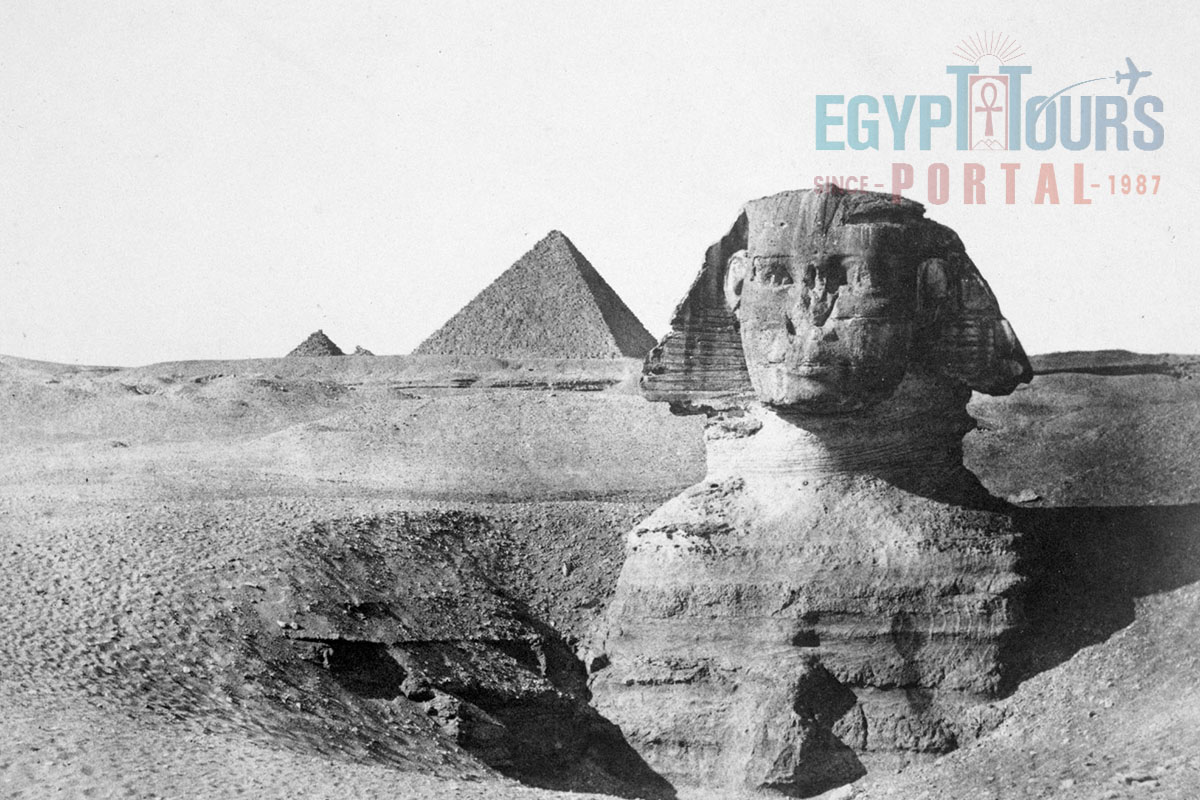
The Sphinx has spent more of its existence buried than exposed, and its excavation history reads almost like a second biography layered on top of the first.
After Thutmose IV's dig, the Sphinx was cleared again around the first century AD in honor of the Roman emperor Nero, under the supervision of Egypt's governor Tiberius Claudius Balbilus, who added a monumental stairway more than 12 meters wide leading down to the paws. A restoration stela dated to 166 AD records further repair work to the surrounding retaining walls, and the Roman emperor Septimius Severus, who visited around 200 AD, was the last emperor recorded at the site before it disappeared under sand once again.
Modern excavation began in 1817, when Italian engineer Giovanni Battista Caviglia became the first to fully expose the Sphinx's chest in the modern era. French archaeologist Auguste Mariette, founder of the Egyptian Museum in Cairo, cleared the site further in 1853 and uncovered the natural fissure running through the Sphinx's waist, while Gaston Maspero's 1886 survey concluded, based on the Dream Stele, that the monument had to predate Khafre's own reign. Flinders Petrie disagreed a few years earlier, arguing in 1883 that recent findings placed its construction firmly within Khafre's Fourth Dynasty.
The 20th century brought both progress and mistakes. In 1926, part of the headdress collapsed after erosion cut deep into the neck, and the 1931 repair effort added a concrete collar between the headdress and neck that permanently altered the Sphinx's profile. French archaeologist Émile Baraize spent 1931 and 1932 sealing the waist fissure with iron bars, limestone, and cement and dismantling the old Roman stairway.
Decades later, in 1978, Egyptologist Zahi Hawass cleared a small shaft near the enclosure's northern ledge, nicknamed the "Keyhole Shaft" for the shape of the cuttings above it, which Egyptologist Mark Lehner has interpreted as an unfinished tomb.
A forgotten passage on the Sphinx's rump, first noticed in 1926 and excavated in 1980, turned out to be a narrow, dead-end tunnel rather than any hidden chamber, its lower section clogged with modern debris, tin foil, and even a pair of shoes, an anticlimactic discovery after decades of speculation about what it might contain.
Further renovations to the base and body continued through the 1980s and were redone again in the 1990s, part of an ongoing, still-unfinished effort to slow the softer limestone's decay.
The Inventory Stela: Ancient Egypt's Own Historical Artifact
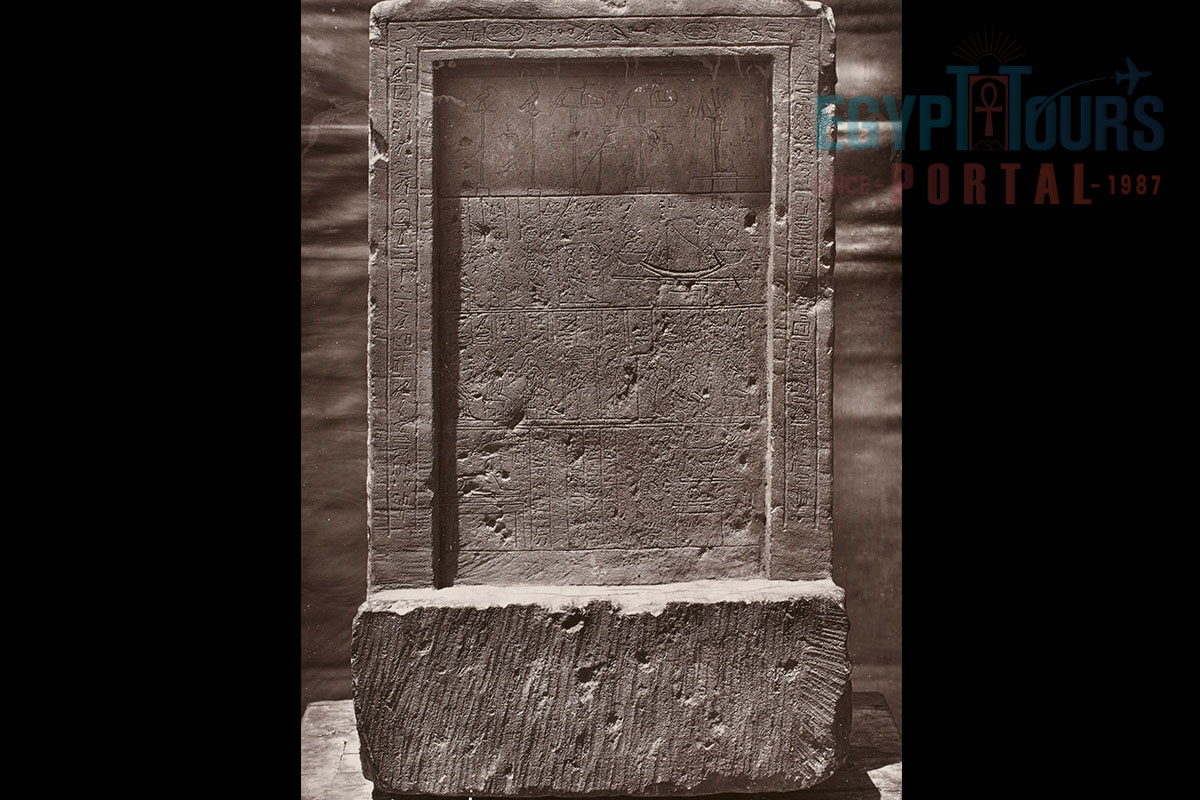
Not every ancient claim about the Sphinx survives scrutiny, including one written by the ancient Egyptians themselves. In 1857, Mariette also uncovered the so-called Inventory Stela, dated to the Twenty-sixth Dynasty around 664 to 525 BC, which claims Khufu found the Sphinx already buried in sand long before his own reign, pushing the monument's origin back many centuries earlier than the archaeological evidence supports.
Most Egyptologists now regard the stela as a piece of Late Period historical revisionism, likely commissioned by priests eager to lend their nearby Isis temple a false pedigree of ancient sanctity, a common practice when Egyptian religious institutions competed for royal favor and donations. It stands as a useful reminder that not every ancient text about an ancient monument is a reliable witness to its own history.
Hidden Chambers and Separating Fact from Fringe Theory
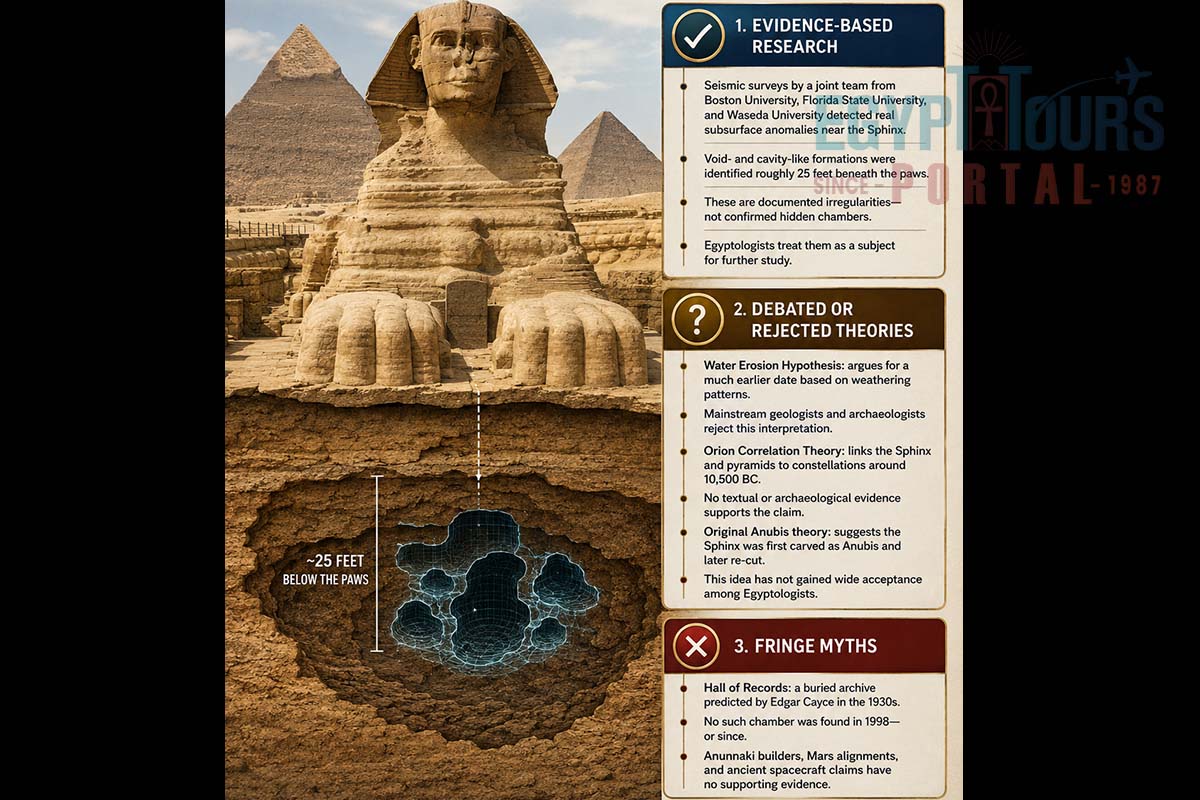
Few monuments attract speculation as reliably as the Sphinx, and it is worth being precise about which claims rest on evidence and which do not.
On the credible side, a joint research team from Boston University, Florida State University, and Waseda University has documented real seismic anomalies around the monument, including voids and cavity-like formations roughly 25 feet beneath the paws, detected using ground-penetrating survey equipment. These findings describe genuine subsurface irregularities, not confirmed chambers, and mainstream Egyptologists treat them as a subject for further study rather than proof of any specific hidden structure.
Considerably less credible is the so-called Sphinx Water Erosion Hypothesis, championed by writers including John Anthony West and geologist Robert Schoch, which argues that weathering patterns on the enclosure walls could only have been caused by heavy prehistoric rainfall, implying a construction date thousands of years earlier than 2500 BC. Mainstream geologists and archaeologists have rejected the theory on the strength of the surrounding climatological and archaeological evidence.
Related to it is the Orion Correlation Theory, popularized by Robert Bauval and Graham Hancock, which claims the Sphinx and the Giza pyramids were laid out to mirror the constellations Orion and Leo as they appeared around 10,500 BC; no textual or archaeological evidence supports the claim, and it is generally classified as pseudoarchaeology rather than serious research.
The most famous fringe claim may be the "Hall of Records," a supposed buried archive of lost knowledge that American psychic Edgar Cayce predicted in the 1930s would be discovered beneath the Sphinx by 1998. No such hall was found that year, or since, though the prediction still circulates in popular media decades later. A smaller, more academic theory, proposed by researcher Robert Temple, suggests the Sphinx was originally carved as the jackal god Anubis and later re-cut into its current human-headed form; it has not gained wide acceptance among Egyptologists.
At the far edge of the speculation sit claims that the Sphinx was built by the Anunnaki of Sumerian mythology, or that the Giza layout mirrors structures on Mars and once served as a landing marker for ancient spacecraft, ideas with no supporting evidence of any kind, mainstream or otherwise, but persistent enough online to be worth naming and dismissing directly. Taken together, the real archaeology of the Sphinx, its genuine attribution debate, its documented excavation history, its verified subsurface anomalies, is arguably more interesting than the myths built on top of it, precisely because so much of it remains honestly, rather than mysteriously, unresolved.

Ancient Egyptian Astronomy: Mapping the Heavens Along the Nile
Discover ancient Egypt's celestial wisdom—monument alignments, a 365-day calendar, and the deep ties between astronomy, religion, agriculture, and governance.
Fringe Theories About the Sphinx
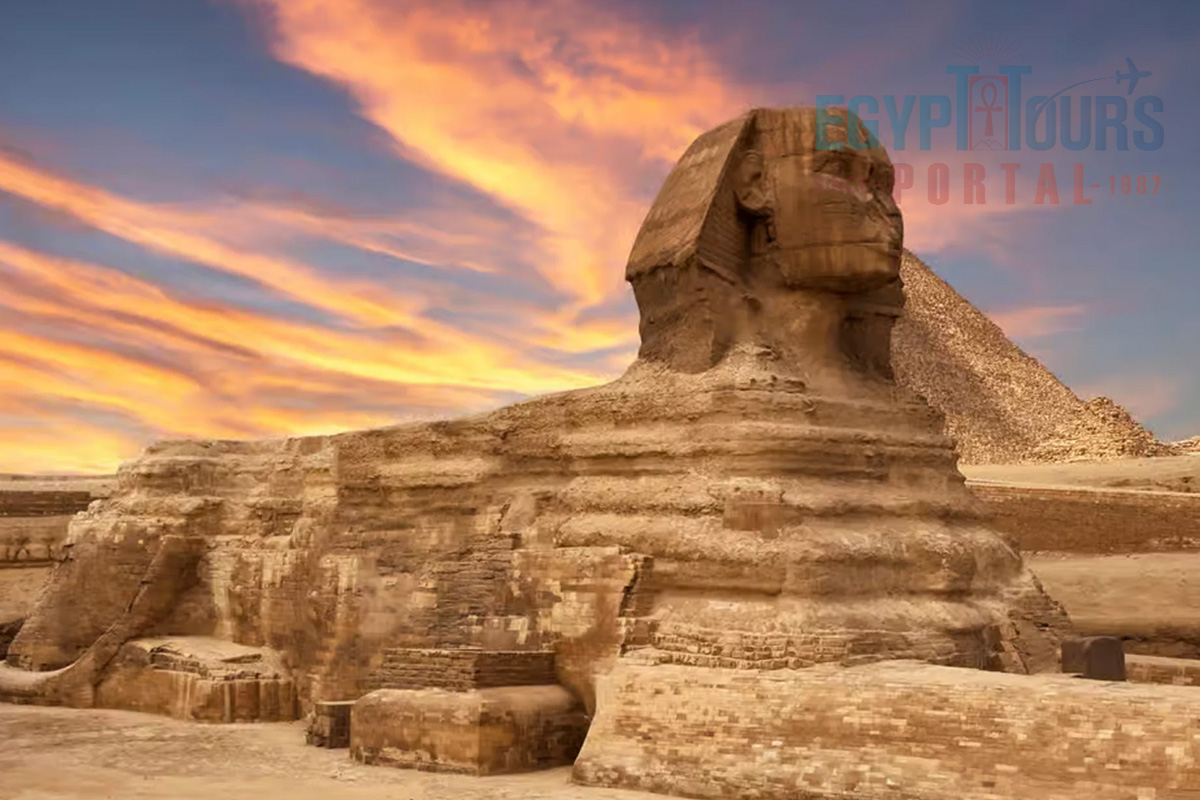
Over the years, there have been many theories that put the Great Sphinx under Question and sparked a massive debate when it comes to who, why, and when it was built. The statue had been damaged and restored many times over the millennia, and there were no documents of any kind in the Old Kingdom that would provide any information about its age or construction, which led many archeologists and Egyptologists to debate its origin and even led them into wild and even fringe theories.
Everything related to the Sphinx is under debate; even the identity of the people who constructed it is questionable, as some hypothesized that the Annunaki ( a group of deities that appeared in the ancient civilizations of Sumeria, Akkadian, Assyria, and Babylon) were the ones who constructed the Sphinx. Some people with a vivid imagination consider the alignment of the Sphinx and the Egyptian pyramids to be a replica or a mirror of pyramid-like structures found on Mars or even Giza as some sort of a landing strip for spacecraft.
Another theory that discusses the age of the Sphinx is the water erosion theory, which states signs of weathering were observed due to heavy rainfall over the Sphinx at the end of the ice age between 7,000 BC and 5,000 BC, which is older than believed, suggesting that the Sphinx was constructed when Egypt was dry and barren land. The sand that once covered the Sphinx acted as a protective barrier before being affected by natural causes.
Visiting the Great Sphinx Today
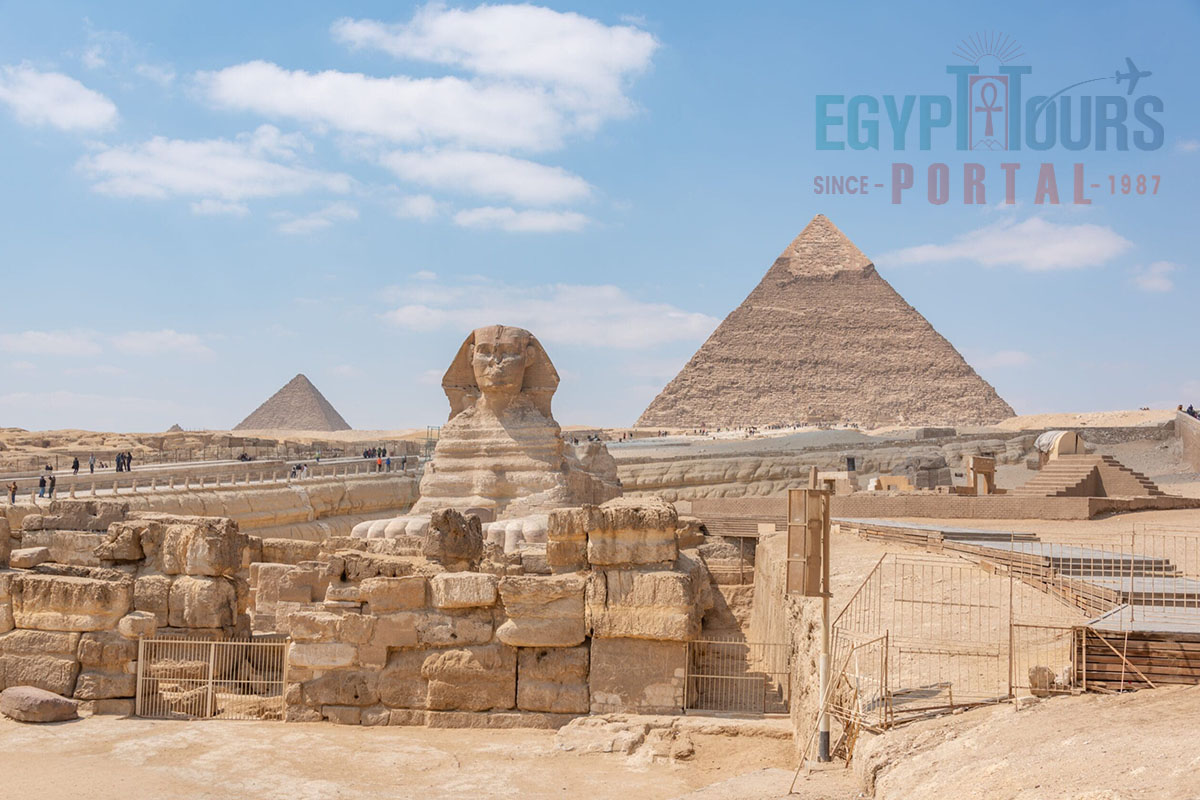
The Sphinx sits within walking distance of all three Giza pyramids and is included on virtually every Cairo day tour to the plateau, typically paired with the nearby Saqqara Step Pyramid, Egypt's earliest pyramid and a useful point of comparison for how quickly Old Kingdom building ambitions grew. The new Grand Egyptian Museum, built just north of the plateau, has made the area an even more natural single-day combination than it was a decade ago. Most visitors view the Sphinx from the public viewing platform in front of its paws, the same vantage point Thutmose IV's excavators would have stood on, more than three thousand years apart.
Explore the Miraculous Marvel of Egypt Starting From the Great Sphinx
The Great Sphinx is one of the top Cairo tourist attractions. Its real mysteries, patiently documented rather than invented, remain more than enough reason to stand there and look up, and reason enough on their own to read further into ancient Egyptian civilization as a whole, or to see the Sphinx as part of a wider adventure rather than a single afternoon stop. So if you prefer to visit Egypt, then we offer you the chance to explore our Egypt tour packages and choose your favorite vacation, which can also include a majestic Nile river cruise.