Summary
- Tutankhamun became pharaoh at approximately eight or nine years old and ruled Egypt during the Eighteenth Dynasty from around 1332 to 1323 BCE.
- Originally named Tutankhaten, he changed his name to Tutankhamun after restoring the worship of Amun and reversing many of Akhenaten’s religious reforms.
- His reign helped Egypt recover from the Amarna Period by reopening temples, reviving traditional festivals, restoring priesthoods, and strengthening the ancient principle of maat.
- Tutankhamun died unexpectedly at approximately eighteen or nineteen years old. Although malaria and a serious leg fracture may have contributed to his death, its exact cause remains uncertain.
- Howard Carter discovered his nearly intact tomb, KV62, in 1922. Its thousands of objects, including the golden mask, solid-gold inner coffin, royal throne, and meteorite-iron dagger, transformed Tutankhamun into the world’s most famous pharaoh.
King Tutankhamun is one of the most legendary names in ancient kingship across history. His name gained incredible fame due to his intact tomb and his mysterious life & death during the most complex times in ancient Egypt. His golden funerary mask has become an international symbol of the pharaonic civilization, while the discovery of his nearly intact tomb remains one of the most celebrated archaeological events of all time.
Despite his worldwide fame, Tutankhamun was not one of Egypt’s longest-reigning or most powerful pharaohs. He became king as a child, ruled for approximately nine years, and died before reaching the age of twenty. Nevertheless, his reign took place during a critical period in Egyptian history, when the country was recovering from the religious and political disruption caused by Pharaoh Akhenaten.
Tutankhamun’s importance does not depend solely on the treasures discovered in his tomb. During his reign, Egypt restored the worship of its traditional gods, reopened neglected temples, revived religious ceremonies, and abandoned the revolutionary religious policies of the Amarna Period. His government helped reconnect the Egyptian monarchy with centuries of tradition and reestablish the religious order upon which ancient Egyptian kingship depended.
More than three thousand years after his death, the young king continues to fascinate historians, Egyptologists, archaeologists, scientists, and travelers. His family background, short reign, mysterious death, magnificent burial, and extraordinary treasures have made him one of the most studied figures from the ancient world.
Who Was King Tutankhamun?
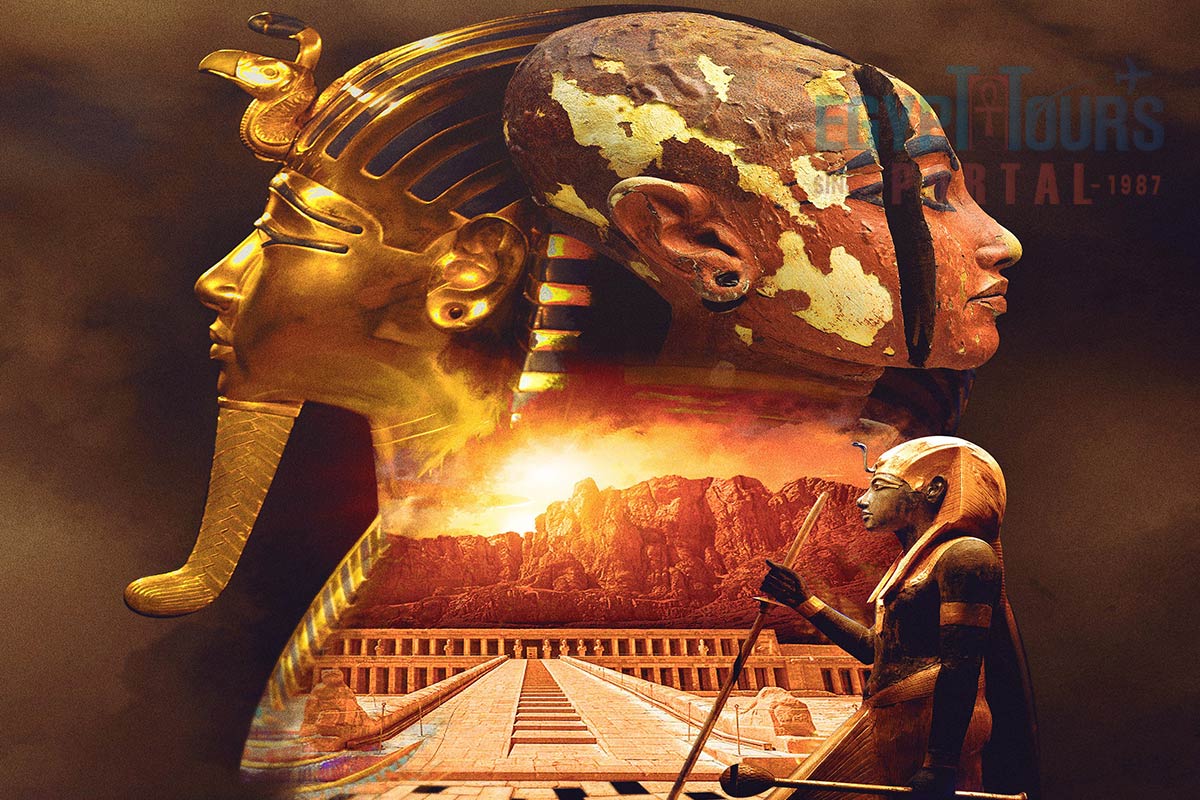
Tutankhamun was a pharaoh of the Eighteenth Dynasty, which ruled during the New Kingdom of ancient Egypt (1550 BC - 1070 BC). He was born around 1342 BCE and became king at approximately eight or nine years of age. His reign is generally dated from around 1332 to 1323 BCE, although exact dates can differ slightly according to the chronological system used by historians.
His original name was Tutankhaten, meaning “Living Image of Aten.” This name reflected the religious environment in which he was born. Aten was represented as the visible disk of the sun and had been elevated to a position of exceptional importance by Akhenaten, the ruler who preceded Tutankhamun by only a few years. After restoring the traditional worship of Amun, the young king changed his name from Tutankhaten to Tutankhamun, meaning “Living Image of Amun.” His throne name was Nebkheperure, a royal name often translated as “Lord of the Manifestations of Re.”
Tutankhamun became king during a difficult transitional period. Because he was still a child, he could not have governed Egypt independently. Senior officials, priests, military commanders, and royal advisers must have played major roles in directing the kingdom. Among the most important figures at his court were Ay, an elderly royal official who later became pharaoh, and Horemheb, the commander of Egypt’s army who would eventually rule after Ay. Although Tutankhamun was young, his reign represented an important attempt to restore stability after one of the most controversial historical periods in the Ancient Egyptian Civilization.
The Religious Revolution Before Tutankhamun
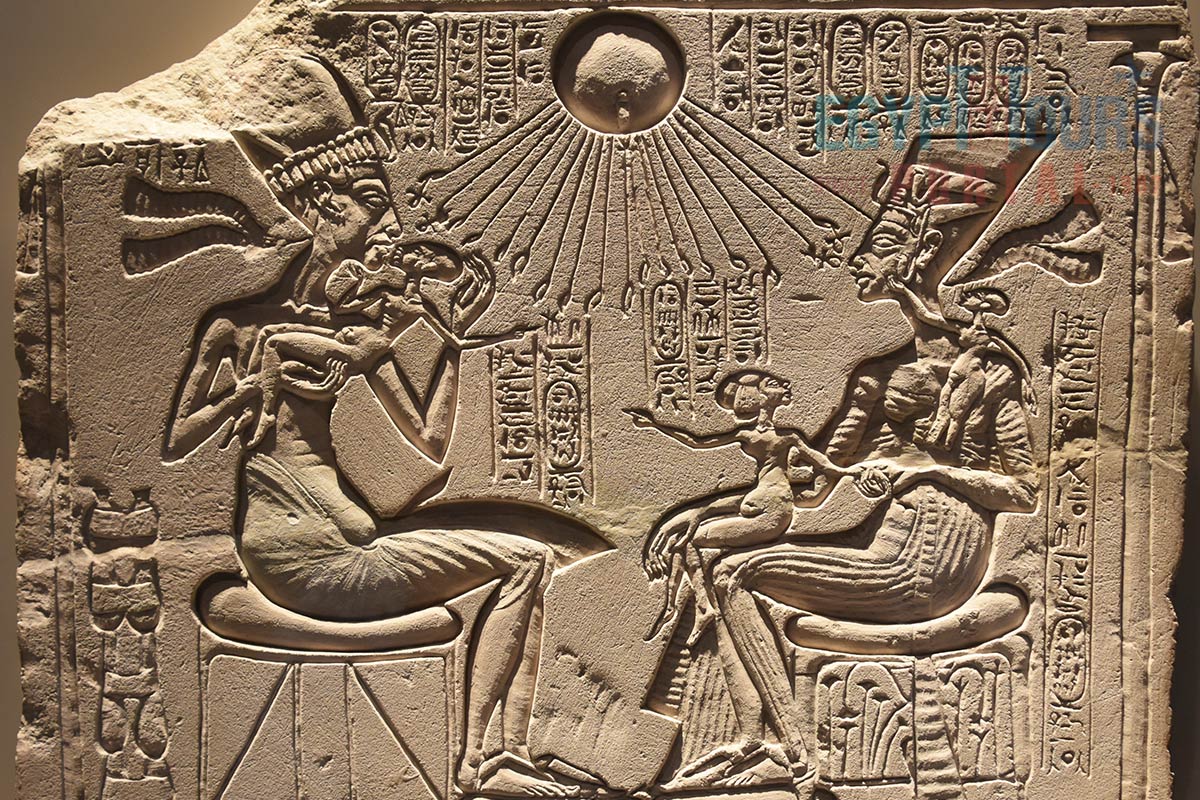
Tutankhamun’s reign cannot be understood without examining the religious revolution associated with Akhenaten. Before Akhenaten, the ancient Egyptians worshiped a large number of gods and goddesses. Different deities were associated with particular cities, natural forces, occupations, and aspects of life and death. Amun, whose principal cult center was at Thebes, had become one of the most powerful and influential gods of the New Kingdom.
Akhenaten dramatically changed the system of ancient Egyptian religion by promoting the worship of Aten, the sun disk. He reduced royal support for the traditional temples, weakened the authority of the priesthood of Amun, and ordered the removal or destruction of the names and images of certain traditional gods. The nature of Akhenaten’s religion is still debated. It is frequently described as an early form of monotheism because Aten was elevated above the other gods. However, some historians prefer to describe it as monolatry, meaning the worship of one supreme deity without necessarily denying that other gods existed.
Akhenaten also founded a new royal capital called Akhetaten, meaning “Horizon of Aten.” The city, now known as Amarna, was constructed on previously undeveloped land in Middle Egypt. The royal family, government officials, artists, priests, and administrators moved there, separating the court from Egypt’s older religious and political centers.
The establishment of Akhetaten and the suppression of traditional cults created major changes within Egyptian society. Temples were not only religious institutions; they also controlled agricultural land, employed large numbers of people, managed workshops, and influenced the economy. Weakening these institutions affected far more than religious worship.
By the time Tutankhamun came to the throne, the Amarna religious experiment was losing support, and Egypt was beginning to return to its traditional beliefs.

Tell El-Amarna
Discover Tell El-Amarna's history, tombs, letters, and more! Explore its excavations, art, architecture, and ancient secrets in this detailed guide.
Explore Tutankhamun’s Family and Parentage
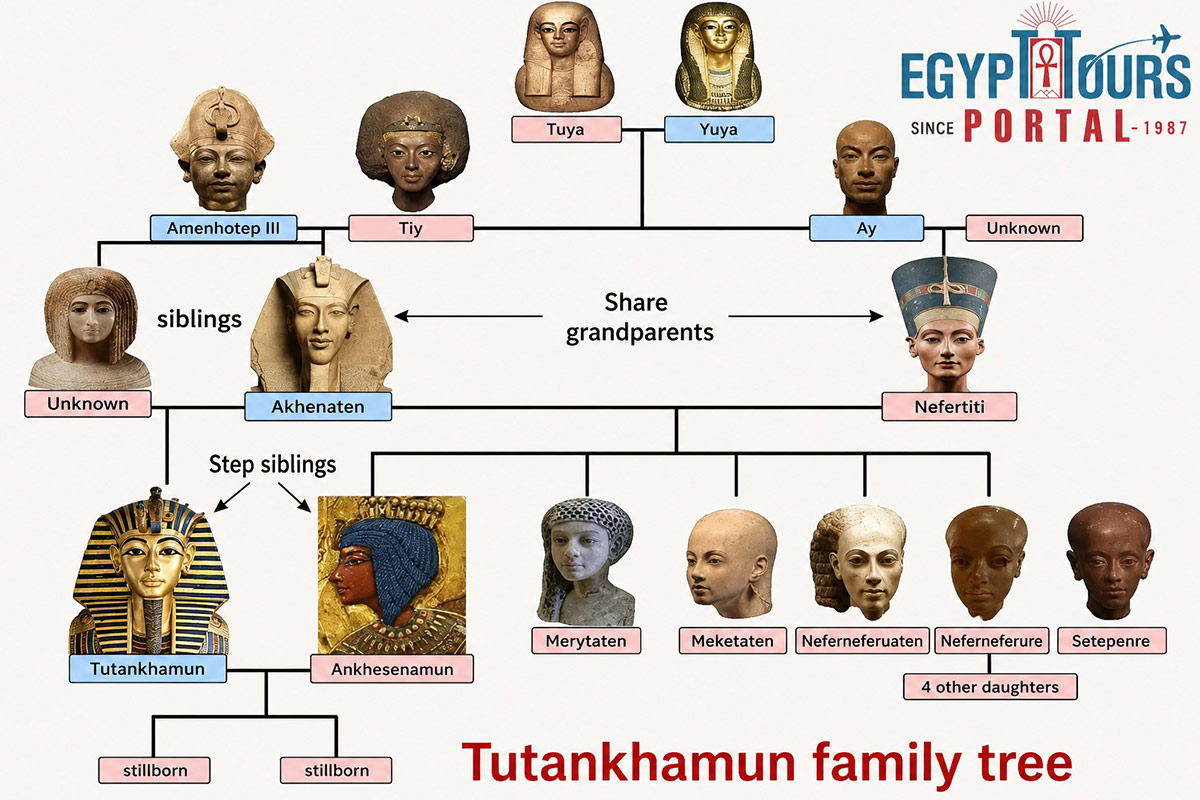
The identity of Tutankhamun’s parents has been debated for decades because no surviving inscription clearly identifies both his father and mother.
DNA testing carried out on royal mummies identified Tutankhamun’s father as the man whose mummy was discovered in tomb KV55 in the Valley of the Kings. Many Egyptologists believe the KV55 mummy belongs to Akhenaten, although some researchers have proposed that it may instead be Smenkhkare, another poorly understood ruler of the late Amarna Period.
Tutankhamun’s mother was identified genetically as the royal mummy known as the Younger Lady. Her mummy was discovered in tomb KV35, which originally belonged to Pharaoh Amenhotep II and was later used as a hiding place for several royal mummies.
The personal identity of the Younger Lady remains unknown. DNA research suggested that Tutankhamun’s parents were closely related, probably full siblings and children of Amenhotep III and Queen Tiye. However, the interpretation of ancient DNA is complicated by the deterioration of genetic material and the repeated marriages between members of the same royal family.
Older theories proposed that Tutankhamun’s mother was Queen Nefertiti or a royal woman named Kiya. Neither identification has been conclusively proven. For this reason, it is not historically accurate to identify Kiya or Nefertiti as his mother with certainty.
Tutankhamun was cared for during childhood by a royal nurse named Maia. Her tomb at Saqqara identifies her as the nurse of the king and contains scenes showing her with the young Tutankhamun. The existence of Maia’s tomb provides a rare connection to the pharaoh’s early life before he became ruler of Egypt.
Tutankhamun and Queen Ankhesenamun
Tutankhamun married Ankhesenpaaten, one of the daughters of Akhenaten and Queen Nefertiti. She was probably Tutankhamun’s half-sister, although the exact relationships within the late Eighteenth Dynasty royal family remain difficult to reconstruct.
After the restoration of Amun, Ankhesenpaaten changed her name to Ankhesenamun, meaning “Her Life Is of Amun.” Her name change reflected the same political and religious transformation represented by Tutankhamun’s new name.
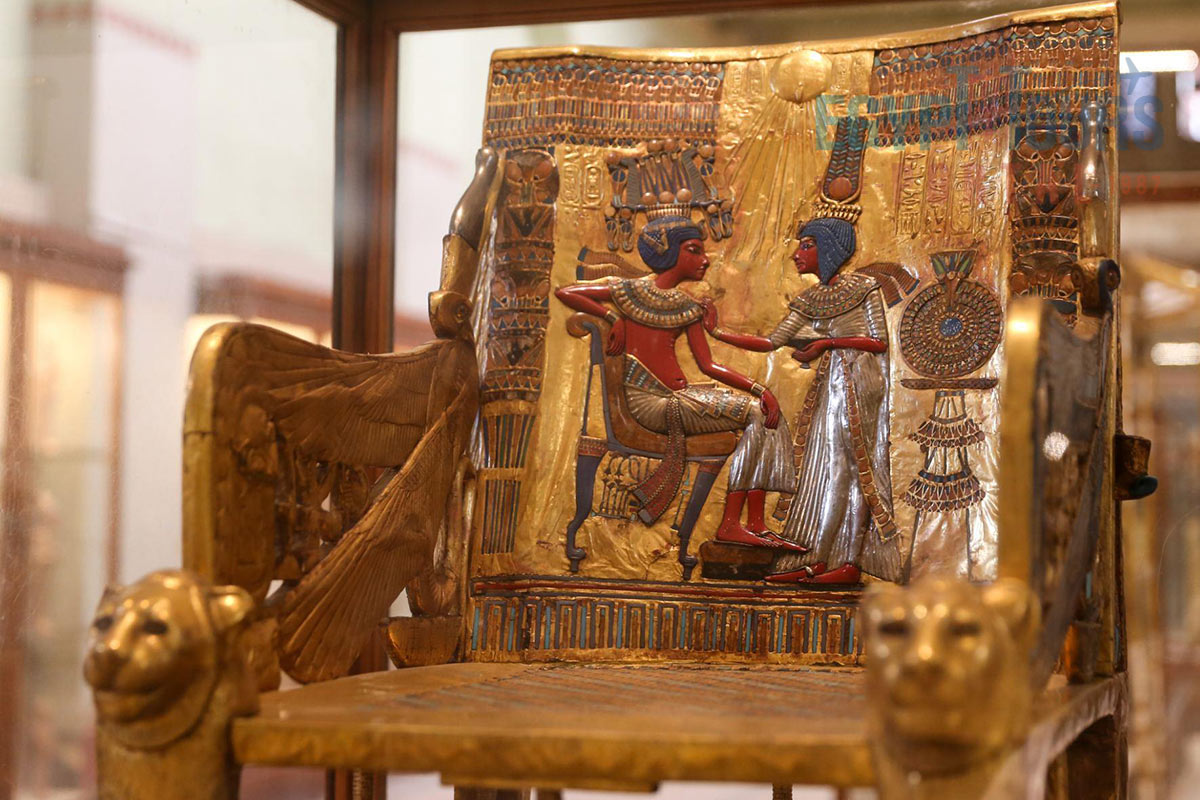
The royal couple appears together on several beautiful objects discovered inside the tomb. The most famous example is Tutankhamun’s golden throne. Its backrest depicts Ankhesenamun standing before the seated king and gently applying perfume or ointment to his shoulder.
The scene is remarkable for its sense of intimacy and affection. Unlike the rigid and formal images found in much Egyptian royal art, the king and queen are shown in a tender domestic moment. The rays of Aten appear above them, demonstrating that some elements of Amarna artistic and religious symbolism continued during the early part of Tutankhamun’s reign.
Two mummified girls were discovered inside small coffins in the tomb. Medical examinations indicate that both were Tutankhamun’s daughters. One appears to have died after approximately five or six months of pregnancy, while the other was carried much closer to full term. Both were either stillborn or died shortly after birth.
Their deaths meant that Tutankhamun left no surviving child to inherit the throne. This absence of a direct heir contributed to the political uncertainty that followed his unexpected death.
Tutankhamun’s Accession to the Throne
Tutankhamun became king when he was approximately eight or nine years old. The political events immediately before his accession are uncertain because the final years of the Amarna Period are poorly documented.
Akhenaten may have ruled with a co-regent, and he appears to have been followed by one or more short-lived rulers. These included Smenkhkare and a female pharaoh known as Neferneferuaten. The order of their reigns, their identities, and their relationships to the royal family continue to be debated.
When Tutankhamun became pharaoh, he inherited a kingdom that had experienced religious conflict, weakened temple institutions, and possible diplomatic problems abroad. Because of his age, senior officials must have directed much of the government’s work. The reign of a child king could have created political instability, but Tutankhamun’s court instead launched a major program to restore Egypt’s traditional religious and administrative structure.
The Restoration of Egypt’s Traditional Religion
The most important development of Tutankhamun’s reign was the official restoration of the traditional Egyptian gods. During the first years of his rule, the royal court still maintained some connections with Atenism. However, the government soon began reversing Akhenaten’s reforms. The worship of Amun was restored, the temples of traditional deities were reopened, and the privileges of their priesthoods were reinstated.
This restoration was recorded on a monument known as the Restoration Stela. The text describes the temples as having fallen into neglect, their sanctuaries abandoned, and their gods no longer receiving the proper offerings. Tutankhamun is presented as the ruler who repaired the damage and restored the correct relationship between Egypt, its gods, and its king.
The government returned land, workers, wealth, and resources to the temples. New divine statues were commissioned, damaged images were restored, and religious processions and festivals were revived.
These actions were not only expressions of personal belief. Egyptian temples were major economic and political institutions. Restoring them helped revive agricultural production, workshops, employment, local administration, and the authority of religious officials throughout the country. The restoration also reinforced the traditional ancient Egyptian concept of maat.
Maat represented truth, justice, order, balance, and harmony. The pharaoh’s most important responsibility was to maintain maat and prevent chaos. By restoring the gods and their temples, Tutankhamun’s government presented the young king as the ruler who had returned Egypt to its correct cosmic and political order.
The Abandonment of Amarna
Akhenaten had established Akhetaten as the center of his religion and royal government. During Tutankhamun’s reign, the city was gradually abandoned. The royal administration appears to have returned primarily to Memphis, which was strategically located near the northern and southern parts of Egypt and had long served as an important administrative center.
Thebes, modern Luxor, regained its position as the greatest religious center because it was the home of the vast Karnak Temple complex and the cult of Amun. It is therefore more accurate to explain that Tutankhamun abandoned Akhenaten’s capital and restored Egypt’s traditional centers of power rather than simply saying that the capital was moved back to Thebes. Akhetaten did not completely disappear immediately, but its importance declined rapidly. Many of its temples and buildings were later dismantled, while their stones were reused in construction projects elsewhere.
Tutankhamun’s Building and Restoration Projects
Tutankhamun’s short reign included important architectural and artistic activity, although many of his monuments were later altered or appropriated by his successors. At Karnak Temple, work was carried out in honor of Amun and other traditional deities. New statues were commissioned to replace divine images damaged during Akhenaten’s reign. Tutankhamun also contributed to ceremonial structures and an avenue associated with the temple of the goddess Mut.
At Luxor Temple, the young king completed the decoration in the great colonnade originally constructed by Amenhotep III. The walls include scenes of the Opet Festival, one of the most important ancient Egyptian religious celebrations in ancient Thebes.
During this festival, statues of Amun, Mut, and Khonsu traveled ceremonially from Karnak Temple to Luxor Temple. The festival renewed the divine power of the king and reinforced the relationship between the royal family and the Theban gods. Tutankhamun also appears to have begun work on a mortuary temple on the West Bank of Thebes. However, his sudden death prevented the completion of several projects.
Ay and Horemheb later appropriated many monuments belonging to Tutankhamun. They erased his name and replaced it with their own, making it difficult for modern researchers to determine the full extent of the young king’s building activity.
Foreign Relations and Military Activity
Egypt’s international position had become more difficult during the later Amarna Period. Correspondence from the time suggests that Egyptian influence in parts of Syria and the Near East was under pressure.
Tutankhamun’s government attempted to restore diplomatic relations with neighboring kingdoms, particularly the Mitanni. Foreign objects and materials discovered in his tomb provide evidence of trade and international connections with both the friends and enemies of ancient Egypt.
Military scenes from monuments associated with his reign show Egyptian victories over enemies in Nubia and Asia. The tomb also contained a large collection of military weapons and equipment, including bows, arrows, shields, chariots, daggers, clubs, and curved swords.
Some images depict Tutankhamun riding ancient Egyptian chariots & horses and attacking enemies. However, Egyptian royal art regularly presented the pharaoh as a victorious warrior regardless of whether he personally participated in battle.
Tutankhamun’s youth does not make military training impossible. Royal princes could begin learning archery, chariot driving, and other military skills at an early age. Nevertheless, there is no conclusive evidence that Tutankhamun personally commanded an army or fought in a military campaign. The military imagery should therefore be understood as a combination of royal ideology, political symbolism, and possible historical events.
Witness the Unique Tutankhamun’s Face and Appearance
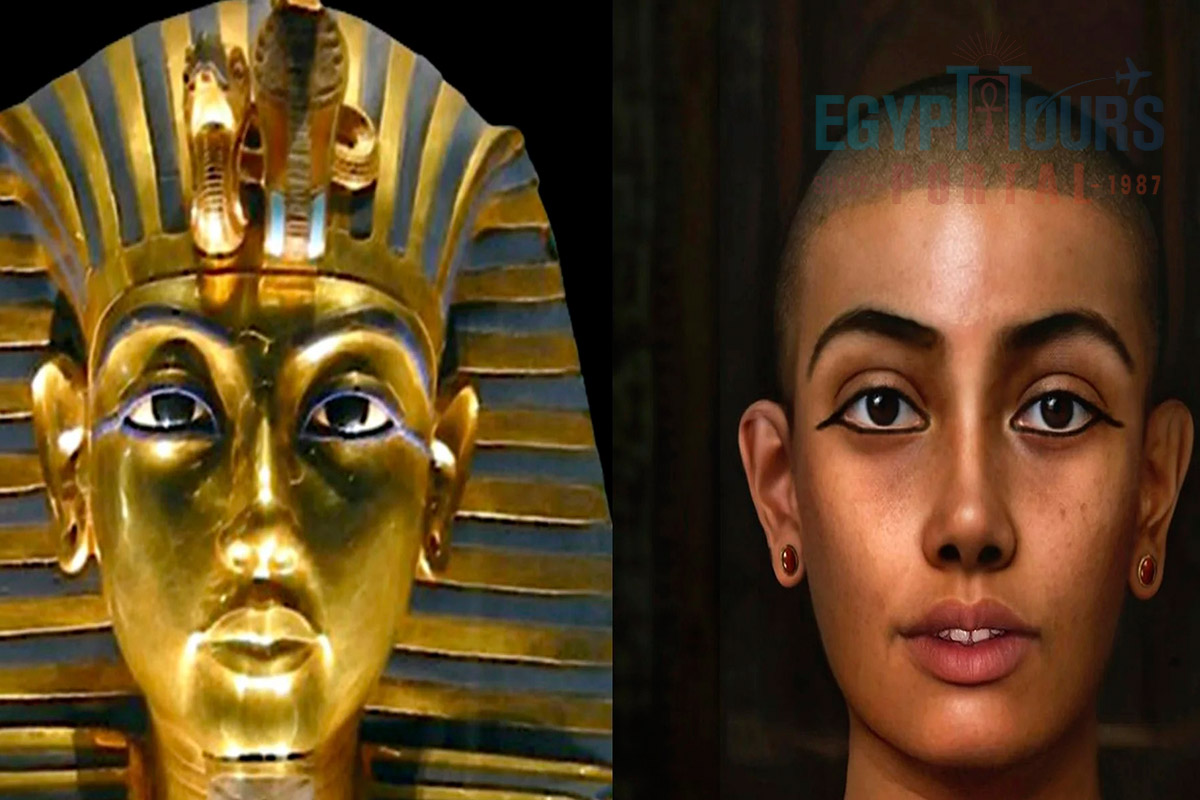
Tutankhamun’s mummy measured approximately 167 centimeters, or around five feet six inches, in height. He had a slender build and physical characteristics associated with other members of the late Eighteenth Dynasty royal family. His skull showed an elongated shape and a noticeable overbite. Similar features appear in the remains and artistic representations of other members of the royal family.
Several modern teams have attempted to reconstruct Tutankhamun’s face using CT scans of his skull. These reconstructions differ because the skull cannot reveal every feature of a living face. Skin tone, facial fullness, ears, hairstyle, wrinkles, and soft tissues must be estimated.
Images of Tutankhamun from ancient Egypt are also not exact portraits. Egyptian royal art was governed by religious and artistic conventions. The king was generally shown as youthful, physically perfect, and divine, regardless of his actual appearance. The golden funerary mask combines possible personal features with an idealized representation of eternal kingship. Its purpose was not simply to preserve the king’s likeness but to transform him into a divine and immortal being.
Tutankhamun’s Health
The health of Tutankhamun has been examined through X-rays, CT scans, genetic testing, and studies of his mummy and burial objects. The results have produced many theories, but not all of them are accepted.
Researchers have suggested that Tutankhamun may have suffered from problems affecting his feet, bones, spine, or immune system. Some studies proposed that he had a clubfoot or a condition involving damage to the bones of the foot. More than 130 walking sticks, staffs, canes, scepters, and ceremonial rods were discovered in his tomb. This large collection led some scholars to argue that the king required walking aids.
However, many of these objects were symbols of royal authority rather than medical equipment. Walking staffs were associated with status, ceremony, travel, and official position. Similar collections have been found in the tombs of people who were not physically disabled.
Studies of the wear on the sticks found that many of them had not been used heavily enough to support the idea that Tutankhamun depended upon them for daily movement. The even wear on some of his sandals has also been used to challenge the theory that he consistently favored one leg.
Researchers have additionally proposed that Tutankhamun suffered from Marfan syndrome, gynecomastia, cranial disorders, epilepsy, hormonal conditions, and various inherited diseases. Several of these theories were later rejected or found to lack sufficient evidence.
It is, therefore, misleading to describe Tutankhamun as certainly suffering from numerous severe disabilities. He may have had health problems, but the nature and extent of those problems remain disputed.
The Mysterious Death of Tutankhamun
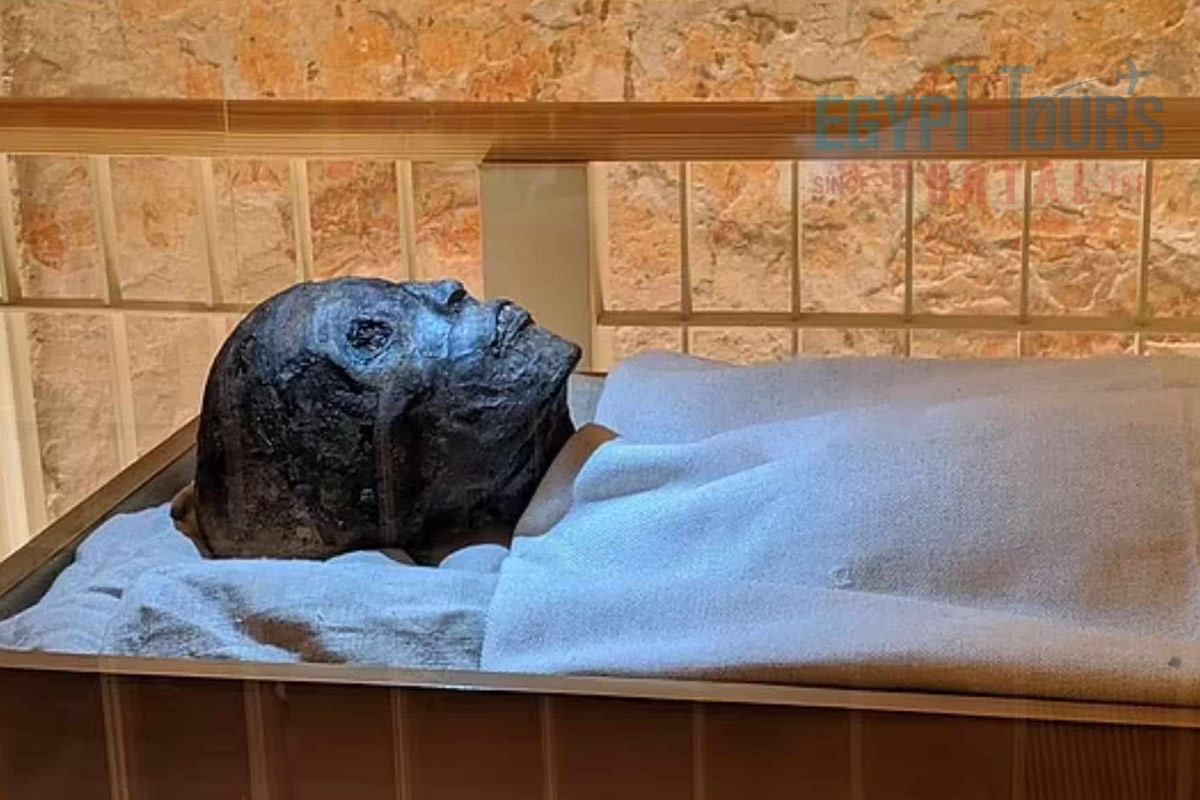
Tutankhamun died unexpectedly when he was approximately eighteen or nineteen years old. No surviving ancient document records how or where he died. His early death has inspired numerous theories, including murder, malaria, infection, a chariot accident, inherited illness, and complications from an injury. An X-ray examination conducted in 1968 revealed loose bone fragments inside the king’s skull. This led to the popular theory that Tutankhamun had been murdered by a blow to the head.
Later CT scans found no convincing evidence of a fatal injury to the skull. The fragments were loose and were not attached to the embalming resin, indicating that they were probably created during the ancient mummification process or through damage caused when the mummy was examined in modern times. The hole in the skull was also connected to embalming procedures rather than murder. For these reasons, the theory that Tutankhamun was killed by a blow to the head is no longer considered the most probable explanation.
Another theory suggested that the king died in a chariot accident because several ribs and part of the chest were missing. However, photographs taken during the original examination of the mummy show that the chest was more complete when the tomb was first opened. The missing areas were probably damaged after the discovery, possibly when jewelry, amulets, or other objects were removed from the body. Therefore, the missing ribs cannot be treated as reliable proof of a chariot accident.
Modern medical examinations found evidence of a serious fracture in Tutankhamun’s left leg. The injury showed little or no healing, suggesting that it occurred shortly before his death. Embalming material was present around the fracture, confirming that the injury existed before mummification. Genetic testing also detected evidence associated with Plasmodium falciparum, the parasite responsible for a severe form of malaria. This led researchers to propose that malaria, combined with complications from the leg injury, may have contributed to the king’s death.
However, the presence of malaria does not prove that malaria alone killed him. People living in regions where malaria was common could survive repeated infections. The exact relationship between the parasite, the injury, and Tutankhamun’s death remains uncertain. The most responsible conclusion is that the cause of Tutankhamun’s death has not been definitively established. A serious leg fracture, infection, malaria, and his general health may all have played a role.
The Funeral of Tutankhamun
Ancient Egyptian mummification and burial usually took approximately seventy days. During this period, the body was preserved, wrapped, protected with amulets, and prepared for the afterlife. Tutankhamun’s sudden death appears to have created an urgent problem because a large royal tomb may not have been ready for him. A smaller tomb, perhaps originally intended for another person, was adapted for the young king’s burial.
His body was mummified and placed inside three human-shaped coffins. The coffins were placed inside a stone sarcophagus, which was surrounded by four enormous gilded wooden shrines. The funeral included rituals intended to transform the dead king into an eternal and divine being. One of the most important was the Opening of the Mouth ceremony, which symbolically restored the deceased person’s ability to breathe, speak, see, hear, eat, and receive offerings.
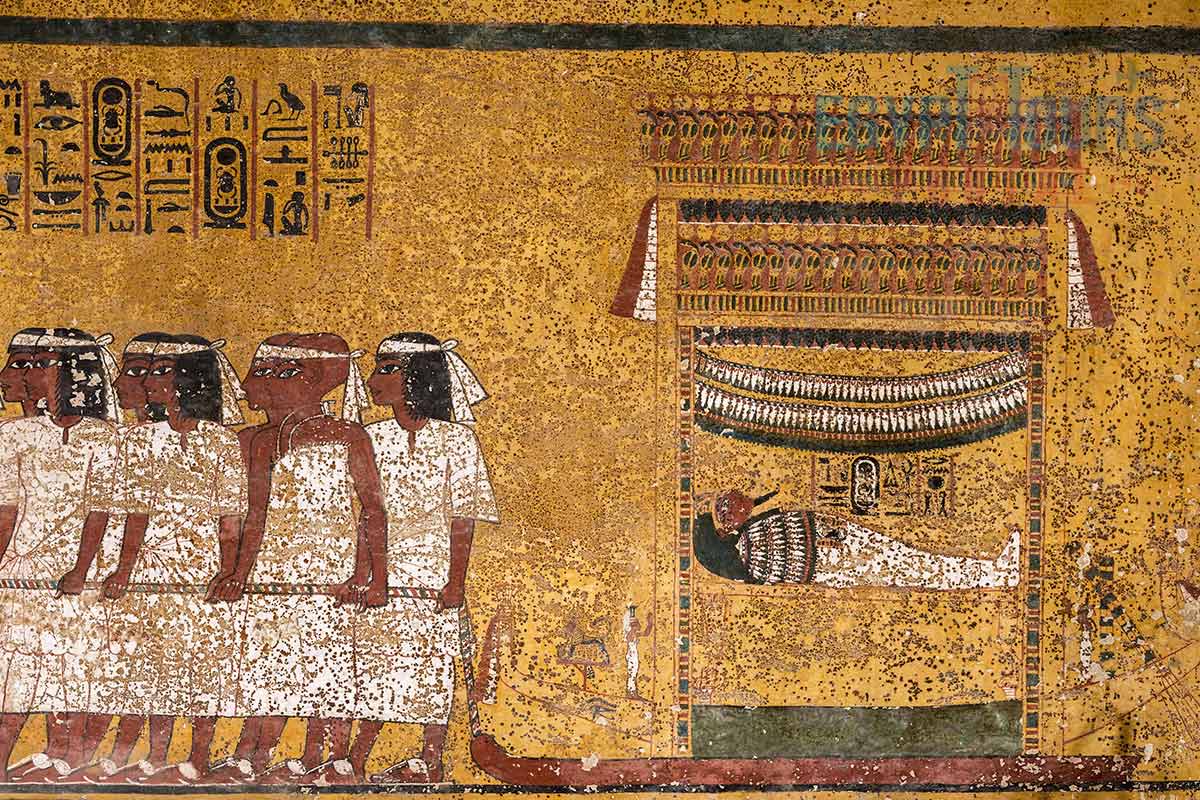
A scene on the north wall of the burial chamber shows Ay performing this ceremony for Tutankhamun. In royal funerals, the ritual was generally performed by the new king for his predecessor. Ay’s appearance in this role demonstrates that he had succeeded Tutankhamun by the time of the burial.
The Succession After Tutankhamun
Tutankhamun died without a surviving child, creating uncertainty over who would inherit the throne. His widow, Ankhesenamun, may have been involved in an unusual diplomatic event recorded by the Hittites. According to Hittite documents, an Egyptian queen wrote to King Suppiluliuma I and explained that her husband had died and that she had no son. She asked the Hittite king to send one of his sons to marry her and become king of Egypt.
Suppiluliuma was initially suspicious because such a request was unprecedented, but he eventually sent Prince Zannanza to Egypt.The prince died or was killed before reaching the Egyptian court. This event increased tension between Egypt and the Hittite kingdom. The identity of the Egyptian queen is not certain, but Ankhesenamun is the most commonly suggested candidate because her husband died young and left no heir.
Tutankhamun was succeeded by Ay, an elderly royal official who may have been connected to the royal family. Ay ruled for only a few years. After Ay’s death, Horemheb became pharaoh. Horemheb had served as commander of the army under Tutankhamun and had probably been one of the most powerful figures in the kingdom.
Horemheb attempted to erase the Amarna rulers from official history. He appropriated monuments belonging to Tutankhamun and Ay and presented himself as the legitimate successor of Amenhotep III. Because Horemheb had no surviving son, he selected a military official named Paramessu as his heir. Paramessu became Ramesses I and established the royal line that later produced Seti I and Ramesses II.
Why Was Tutankhamun Buried in a Small Tomb?
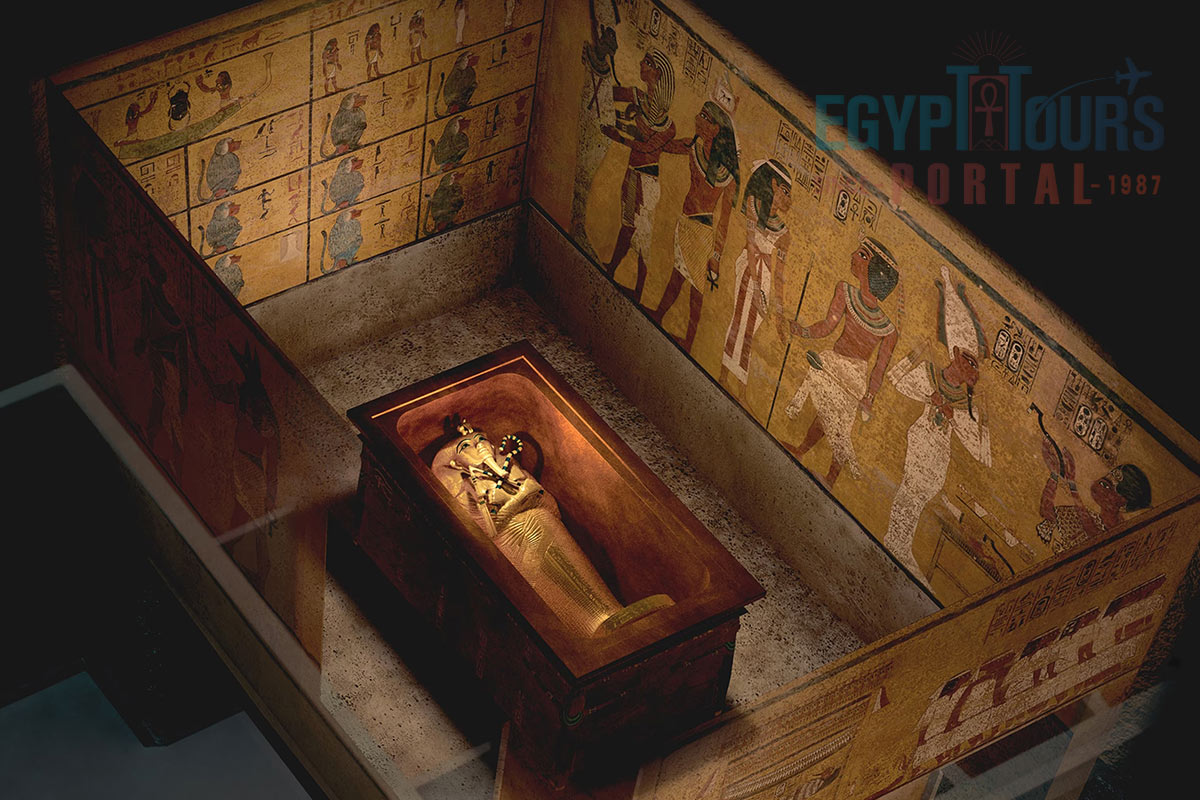
Tutankhamun’s tomb, known as KV62, is unusually small for a pharaoh. The tomb contains a short entrance staircase, a descending corridor, an antechamber, a small annex, a burial chamber, and a treasury. Its limited size and simple layout suggest that it may not originally have been designed as the permanent burial place of a king.
Tutankhamun’s unexpected death probably occurred before a larger royal tomb could be completed. Officials may therefore have adapted a smaller tomb for his funeral. The burial objects were packed tightly into the available space. Chariots were dismantled, furniture was stacked, boxes were placed on top of one another, and ritual objects filled almost every part of the chambers.
Only the burial chamber was decorated with painted scenes. This differs from the tombs of other New Kingdom pharaohs, which normally had long decorated corridors and multiple painted chambers. The modest size of the tomb makes the quantity and richness of its contents even more remarkable.
The Layout of Tutankhamun’s Tomb
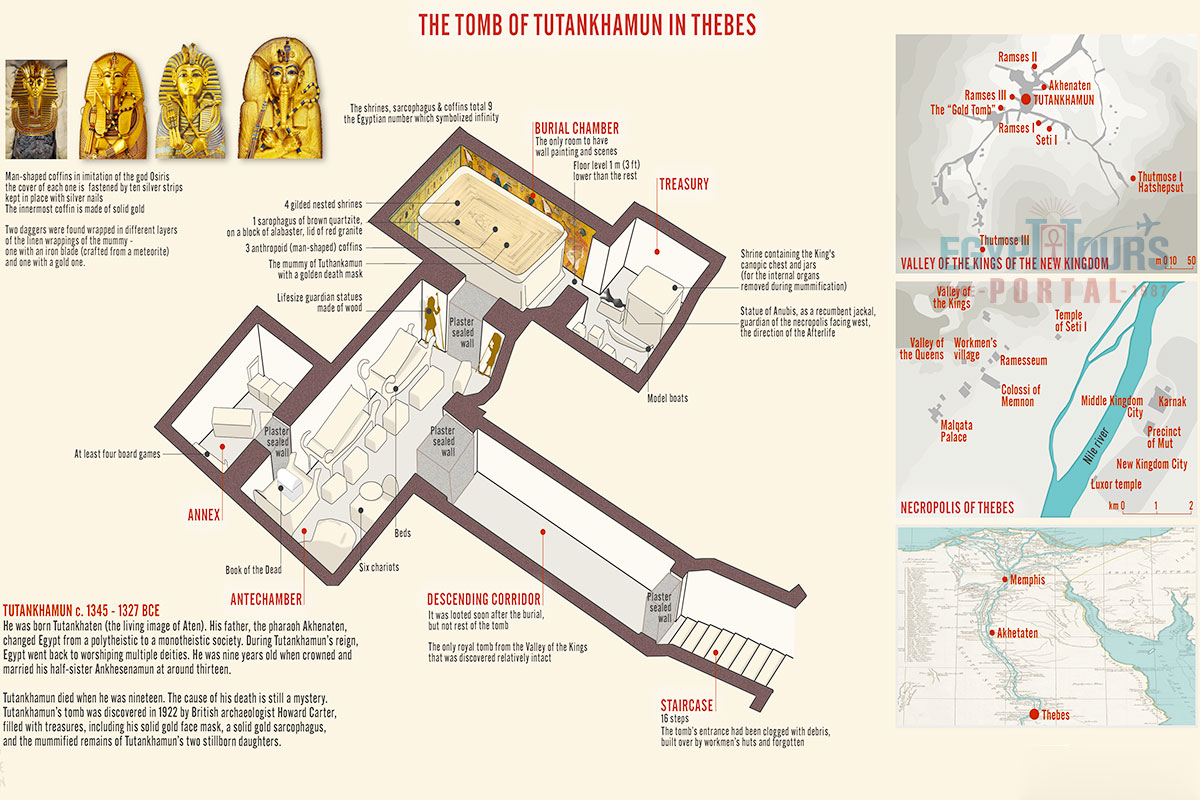
Visitors entered the tomb by descending a staircase cut into the bedrock. At the bottom stood a sealed doorway bearing official necropolis seals. Behind the first doorway was a descending corridor filled with limestone debris. At its end, another sealed entrance led into the antechamber. The antechamber contained ceremonial beds, chariots, furniture, boxes, statues, weapons, and other objects. Two life-sized black guardian statues stood near the entrance to the burial chamber, symbolically protecting the king.
A small side room known as the annex contained food, wine, oils, perfumes, baskets, vessels, furniture, and everyday items. The objects were found in a particularly disordered arrangement, possibly because ancient robbers entered the room and officials later resealed it. The burial chamber contained the king’s stone sarcophagus. Four nested gilded wooden shrines surrounded it, occupying most of the room.
Inside the sarcophagus were three anthropoid coffins. Tutankhamun’s mummy rested inside the innermost coffin, which was made from solid gold. The walls of the burial chamber depict scenes connected with the king’s funeral and journey into the afterlife. Tutankhamun is shown with several deities, while Ay appears performing the Opening of the Mouth ceremony. The treasury contained the canopic equipment used to preserve the king’s internal organs. It also included statues, model boats, ritual objects, and a figure of the jackal god Anubis guarding the chamber.
The Epic Discovery of Tutankhamun’s Tomb
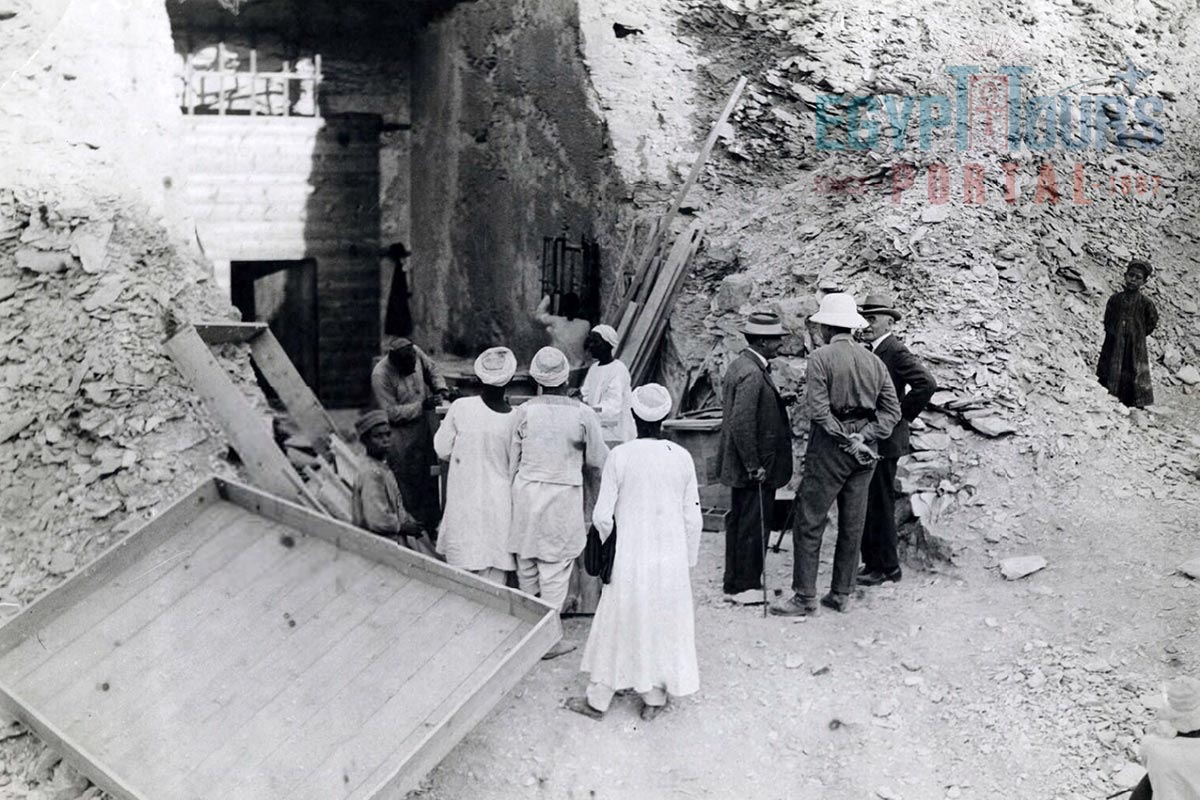
The discovery of King Tutankhamun’s tomb began on November 4, 1922, in the Valley of the Kings on the West Bank of Luxor, when Howard Carter’s excavation team uncovered the first stone step of a staircase hidden beneath ancient workmen’s huts near the tomb of Ramesses VI. The excavation was directed by the British archaeologist Howard Carter and financed by George Herbert, the Fifth Earl of Carnarvon, after several years of searching in an area that many believed had already been exhausted.
Before Carter, the American archaeologist Theodore Davis had discovered objects connected to Tutankhamun, including an embalming cache and items bearing the king’s name, but he mistakenly believed that the pharaoh’s burial had already been found. Carter disagreed and, after carefully studying excavation records and the layout of the valley, became convinced that Tutankhamun’s tomb was still hidden in an unexplored section.
After the first step was discovered, further clearing revealed a sealed doorway marked with ancient necropolis seals, and Carter immediately informed Lord Carnarvon, who traveled to Egypt to witness the opening. A popular account credits a young Egyptian water boy named Hussein Abdel-Rassoul with finding the first step while placing a water jar in the sand, though the exact details remain debated; however, the essential role of Egyptian workers in the discovery and excavation is undeniable. On November 26, 1922, after Carnarvon’s arrival, Carter made a small opening in the inner sealed doorway and looked inside by candlelight, where he saw golden couches, statues, chariots, boxes, furniture, and countless objects filling the antechamber.
The burial chamber was officially opened on February 17, 1923, in the presence of Egyptian officials, archaeologists, museum representatives, and members of the press. The tomb was not empty, as many had expected, but instead contained one of the richest and most extraordinary royal burial collections ever discovered, making the finding of Tutankhamun’s tomb one of the defining archaeological events of the twentieth century.
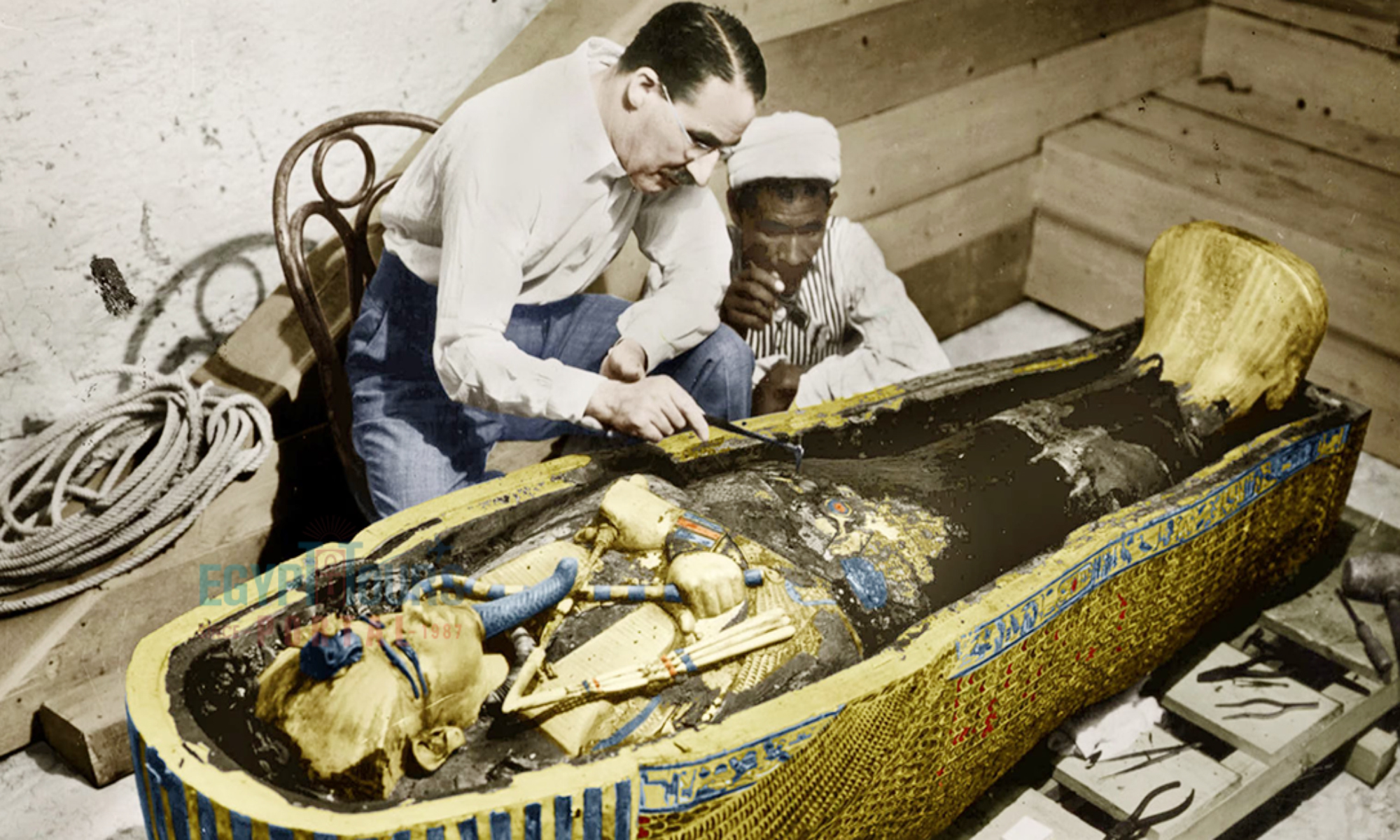
Discover the Life-Changing Discovery of Tutankhamun Tomb
Discovery of Tut’s tomb by Howard Carter in 1922 stunned the world, reshaping Egyptology and igniting global fixation with ancient Egypt & the Pharaoh's curse.
Explore Why Tutankhamun’s Tomb Survived and Remained Intact
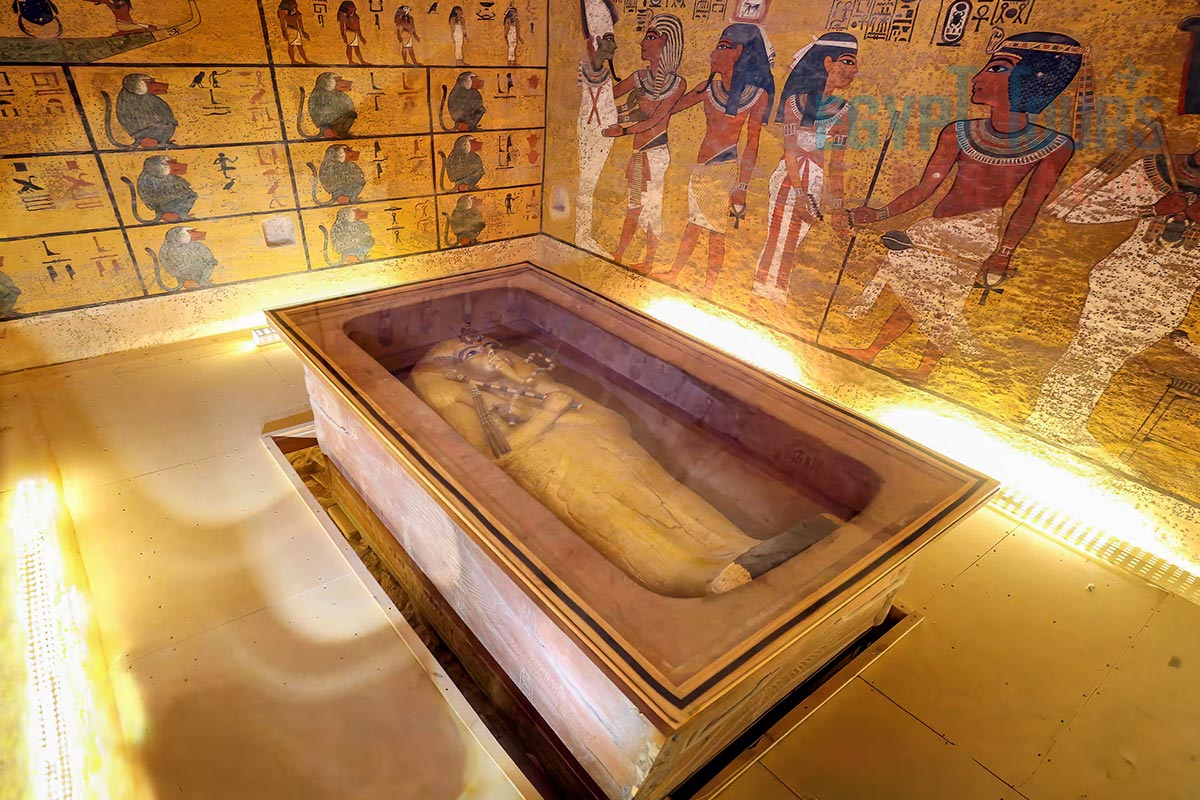
Tutankhamun’s tomb was not completely untouched when Howard Carter found it. Evidence showed that ancient robbers had entered the tomb at least twice, probably within a relatively short time after the burial. They may have stolen portable jewelry, oils, perfumes, and precious materials.
Ancient officials later reorganized some of the contents, repaired the entrances, and resealed the tomb. The burial survived because the entrance was eventually hidden beneath debris created during the construction of the nearby tomb of Ramesses VI. Workmen’s huts were later built above the area, further concealing the staircase.
Tutankhamun’s name was also excluded from later official royal records because Horemheb attempted to erase the Amarna rulers from history. As the young king’s memory faded, the location of his tomb was forgotten. These circumstances protected KV62 from the extensive looting that emptied most of the royal tombs in the Valley of the Kings.
The Majestic Treasures of Tutankhamun’s Tomb
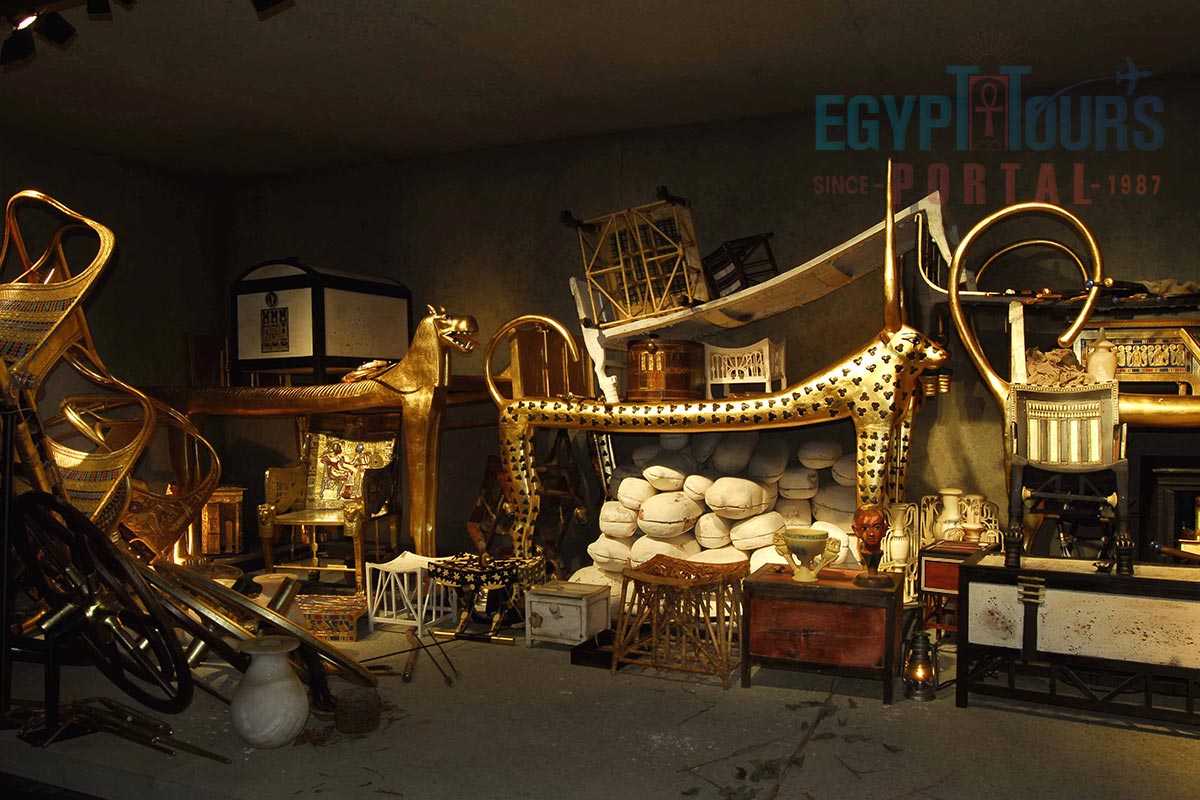
Approximately five thousand objects were discovered inside Tutankhamun’s tomb. The frequently cited catalog total is 5,398 items, although some catalog entries represented groups of objects. The collection included coffins, shrines, statues, furniture, jewelry, clothing, weapons, chariots, food, wine, oils, perfumes, games, sandals, ritual equipment, and personal possessions. Howard Carter and his team spent around ten years documenting, photographing, conserving, and removing the objects. The clearance of the tomb was completed in 1932.
Photographer Harry Burton produced a detailed visual record of the excavation. His photographs captured the objects as they appeared before removal and remain essential resources for understanding the original arrangement of the burial. The importance of the collection lies not only in its gold and artistic beauty. It provides an almost complete view of the material objects considered necessary for the eternal life of a New Kingdom pharaoh.
Tutankhamun’s Golden Funerary Mask
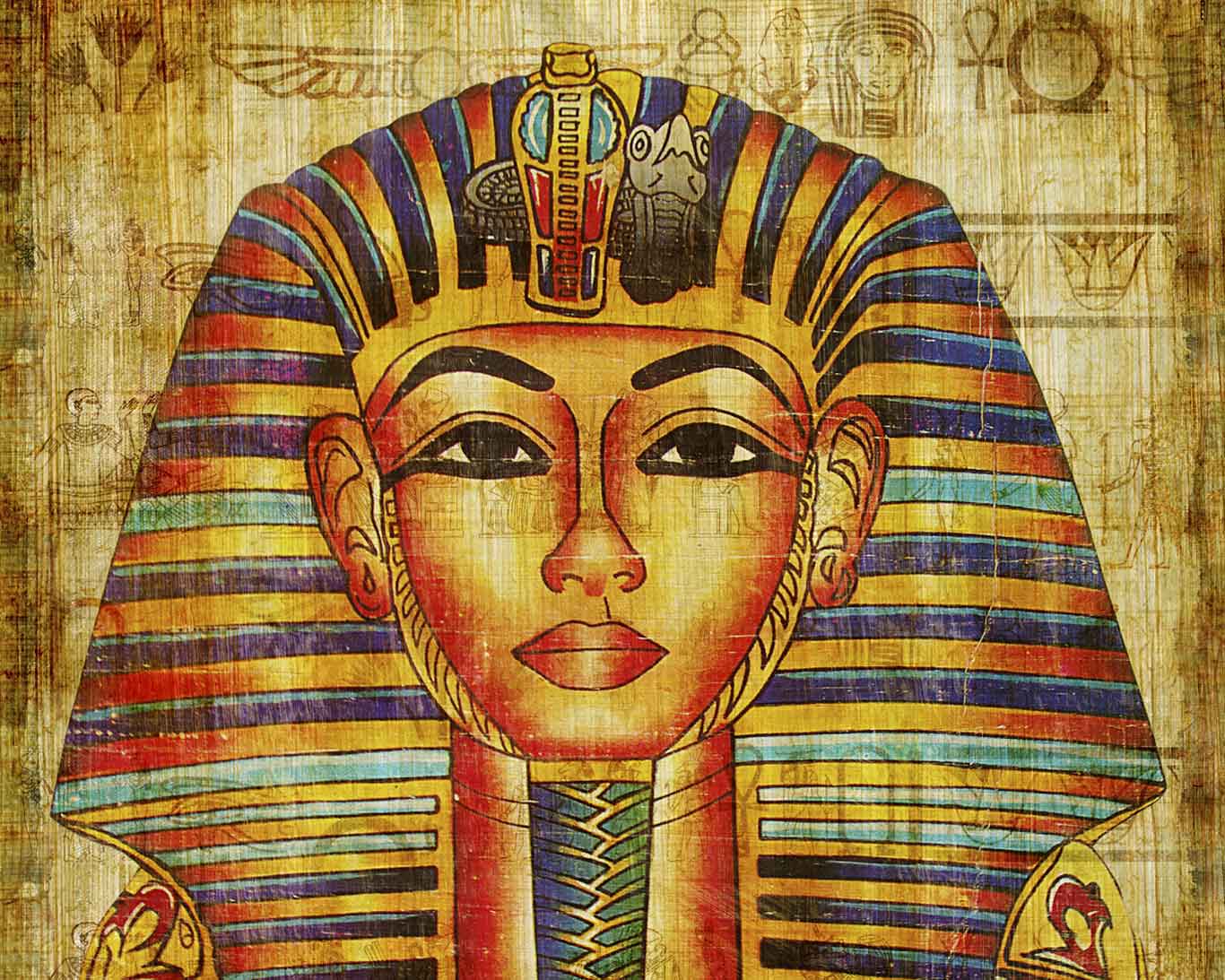
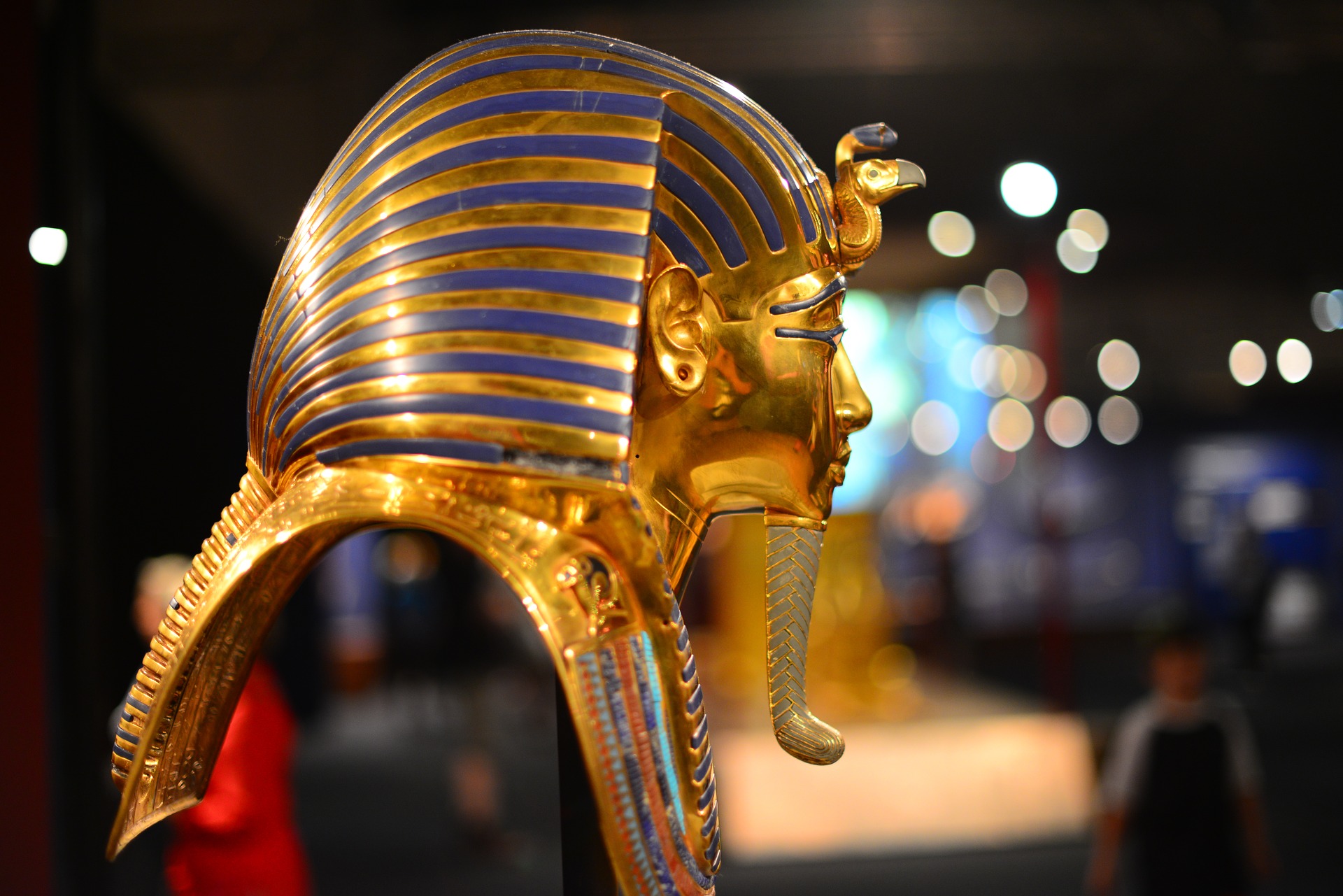
The golden funerary mask is the most famous object discovered inside the tomb. It covered the head and shoulders of Tutankhamun’s mummy and represented the king wearing the striped nemes headdress. A cobra and vulture appear on the forehead, symbolizing the royal protection of Lower and Upper Egypt. The mask was made principally from gold and decorated with colored glass and semiprecious stones. Its back and shoulders carry a protective funerary spell intended to defend the king’s body.
The mask portrays Tutankhamun as both a human king and an immortal divine being. In ancient Egyptian belief, gold was associated with the flesh of the gods because it did not corrode or decay. The mask was therefore not simply a portrait. It played an essential role in transforming the dead king into an eternal being identified with Osiris and the solar gods.
The Coffins and Sarcophagus of Tutankhamun's Tomb
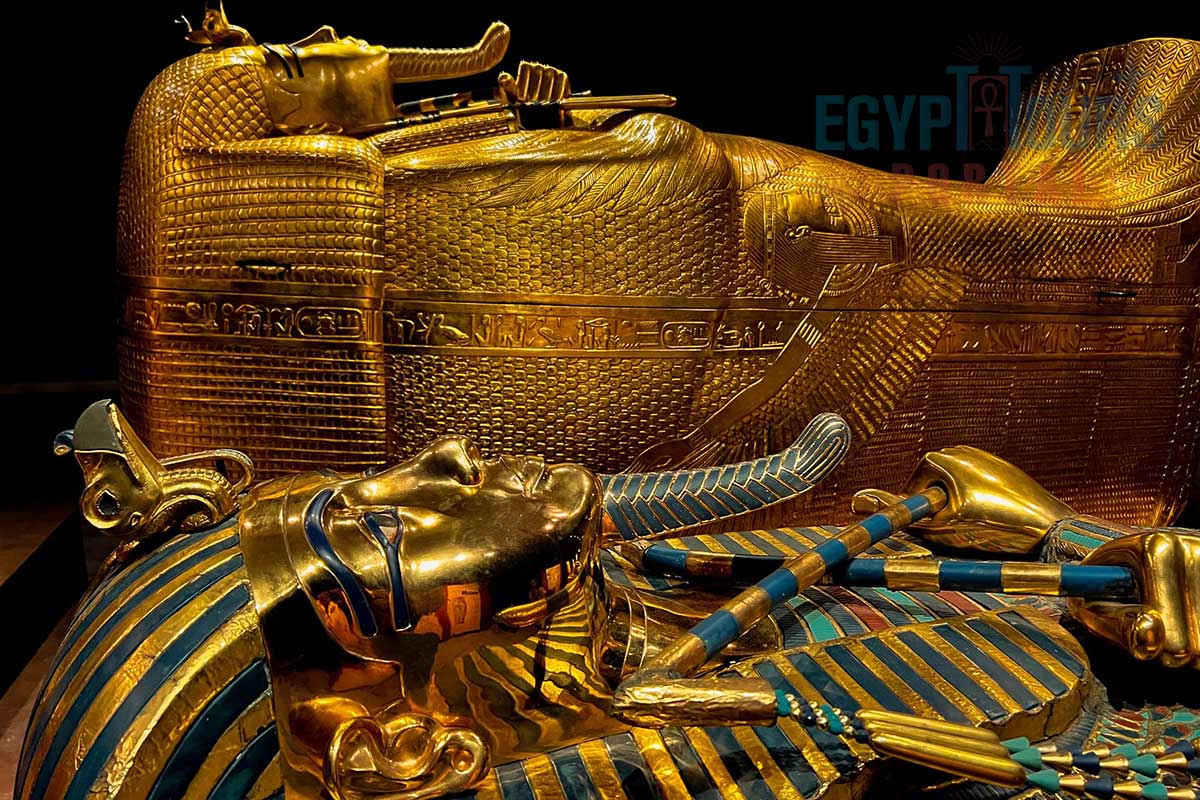
Tutankhamun’s mummy was placed inside three human-shaped coffins nested within one another. The outer coffin was constructed from gilded wood. The middle coffin was also made from wood and covered with gold, colored materials, and elaborate decoration. Only the innermost coffin was made from solid gold. It weighs approximately 110 kilograms, or around 243 pounds.
This corrects the common misconception that all three coffins were made from solid gold. The coffins were placed inside a quartzite sarcophagus with a granite lid. Protective goddesses were carved at the corners, extending their wings around the king. The sarcophagus was surrounded by four enormous gilded wooden shrines. Each shrine was placed inside the next, creating several layers of spiritual and physical protection around the royal body.
The Golden Throne of Tutankhamun
Tutankhamun’s golden throne is one of the finest surviving examples of ancient Egyptian royal furniture. The backrest depicts the king seated before Queen Ankhesenamun. She appears to place perfume or ointment on his shoulder while the rays of Aten shine above the royal couple. The scene combines traditional royal symbolism with the intimate artistic style developed during the Amarna Period. Although Tutankhamun restored the worship of Amun, artists did not immediately abandon all features of Amarna art. The throne demonstrates how artistic, religious, and political traditions changed gradually rather than disappearing at once.
The Meteorite-Iron Dagger of Tutankhamun
One of the most scientifically remarkable objects found with Tutankhamun was a dagger with an iron blade. Modern analysis found unusually high levels of nickel and cobalt, demonstrating that the metal came from a meteorite. During Tutankhamun’s lifetime, iron was much rarer than gold in Egypt because large-scale iron production had not yet developed. Meteorite iron was therefore a precious and mysterious material that literally came from the sky. The dagger also demonstrates the exceptional skill of ancient Egyptian craftsmen. They shaped and polished a difficult material with great precision, creating an object suitable for a king.
Chariots, Weapons, and Hunting Equipment of Tutankhamun
Several dismantled chariots were discovered inside the tomb. They may have been used for ceremony, transportation, hunting, military training, or warfare. The tomb also contained bows, hundreds of arrows, shields, clubs, daggers, curved swords, arm guards, and other military equipment. Some of the weapons showed signs of use, suggesting that they were not all created exclusively for the funeral. Tutankhamun may have practiced archery and chariot driving as part of his royal education. The abundance of military equipment demonstrates the importance of the king’s role as defender of Egypt, even if it does not prove that Tutankhamun personally fought in battle.
Clothing, Sandals, and Personal Possessions of Tutankhamun
Tutankhamun was buried with an extensive collection of clothing and personal items. The tomb contained linen garments, gloves, belts, loincloths, headdresses, socks, sandals, and other textiles. These objects provide rare evidence of royal clothing during the Eighteenth Dynasty because ancient fabrics rarely survive. Some sandals carried images of foreign enemies on their soles. Every time the king walked, he symbolically trampled upon the enemies of Egypt.
The tomb also contained beds, chairs, stools, boxes, cosmetic containers, mirrors, fans, jewelry, games, and musical instruments. These objects reveal that the burial was intended to provide the king with everything he might need in the next world, from royal symbols and religious equipment to clothing, entertainment, food, and personal comfort.
Food, Wine, Oils, and Perfumes of Tutankhamun
Ancient Egyptians believed that the dead required nourishment in the afterlife. Tutankhamun’s tomb contained food, wine, oils, perfumes, and other provisions. Meat, bread, fruit, and wine were prepared for the king’s eternal use. Wine jars carried inscriptions identifying vineyards, production dates, and officials responsible for the contents. These labels provide valuable information about ancient Egyptian agriculture and royal estates. Perfumes and oils were both practical and religiously significant. They were associated with cleanliness, beauty, divine fragrance, ritual purification, and the preservation of the body.
Tutankhamun’s Two Daughters
Among the most emotional discoveries inside the tomb were two small coffins containing the remains of infant girls. Medical examinations indicated that they were Tutankhamun’s daughters. One died during a premature stage of development, while the other was much closer to full term. Their burial with their father suggests that they were intended to accompany him into the afterlife. It also reveals the personal tragedy behind the political problem of Tutankhamun’s succession. Because neither daughter survived, the king died without a direct heir, bringing the royal bloodline of the late Eighteenth Dynasty close to its end.
The Conservation of Tutankhamun’s Tomb
The discovery of KV62 created a new challenge. Millions of visitors wanted to enter a tomb that had survived for more than three thousand years in a relatively stable environment. Human breath, heat, humidity, dust, lighting, and physical contact can damage ancient wall paintings. Changes in temperature and moisture may affect plaster, pigments, stone, and biological growth. A major conservation project studied the tomb’s environment, wall paintings, visitor patterns, and physical condition. Improvements included new lighting, ventilation systems, walkways, protective barriers, environmental monitoring, and visitor-management measures.
Dark brown spots visible on the burial chamber walls had already been recorded in photographs taken soon after the tomb’s discovery. Researchers examined these marks to determine whether they were active microorganisms or ancient growth that had stopped spreading. The conservation work aimed to preserve the authenticity of the original tomb while continuing to allow visitors to experience one of the greatest archaeological discoveries in the world.
The Curse of Tutankhamun
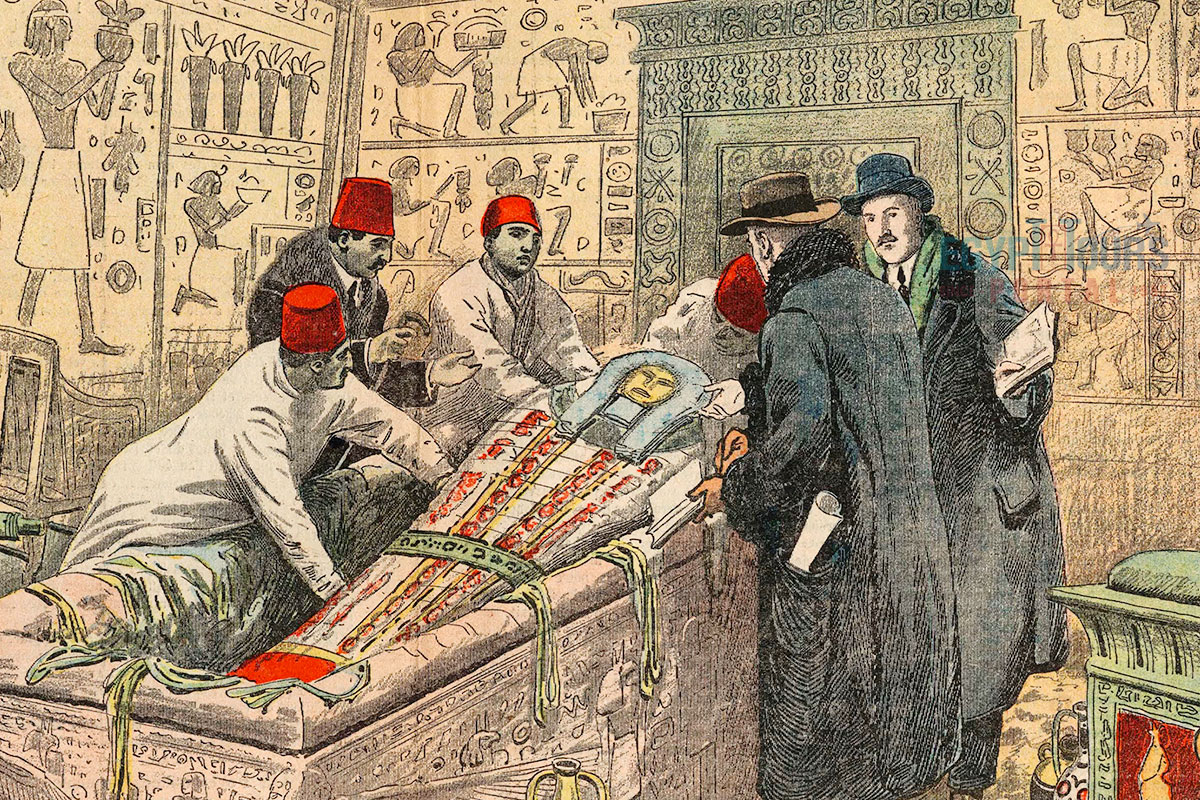
The so-called Curse of the Pharaohs is a modern legend claiming that anyone who disturbs an Egyptian royal tomb will suffer illness, misfortune, or death. The legend became famous after Lord Carnarvon died in April 1923, approximately five months after the discovery of the tomb. Carnarvon had suffered from poor health for years. A mosquito bite or shaving cut on his face became infected, and the infection was followed by pneumonia.
Newspapers connected his death with Tutankhamun and created dramatic stories about supernatural revenge. Some articles claimed that ancient warnings had been written inside the tomb, although no such curse inscription was found. The historical evidence does not support the idea of a supernatural curse. Many people who entered the tomb lived for decades afterward. Howard Carter died in 1939 at the age of sixty-four, around seventeen years after the discovery. Lady Evelyn Herbert, Lord Carnarvon’s daughter and one of the first people to enter the tomb, lived until 1980.
Some modern theories have proposed that bacteria, fungi, poisonous gases, chemicals, or radiation caused illnesses connected with the tomb. While sealed environments can contain harmful microorganisms, there is no evidence that the ancient Egyptians deliberately created a biological or chemical trap inside KV62. The curse remains one of the most famous legends associated with archaeology, but it is not an established historical or scientific fact.
Where Are Tutankhamun’s Treasures Today?
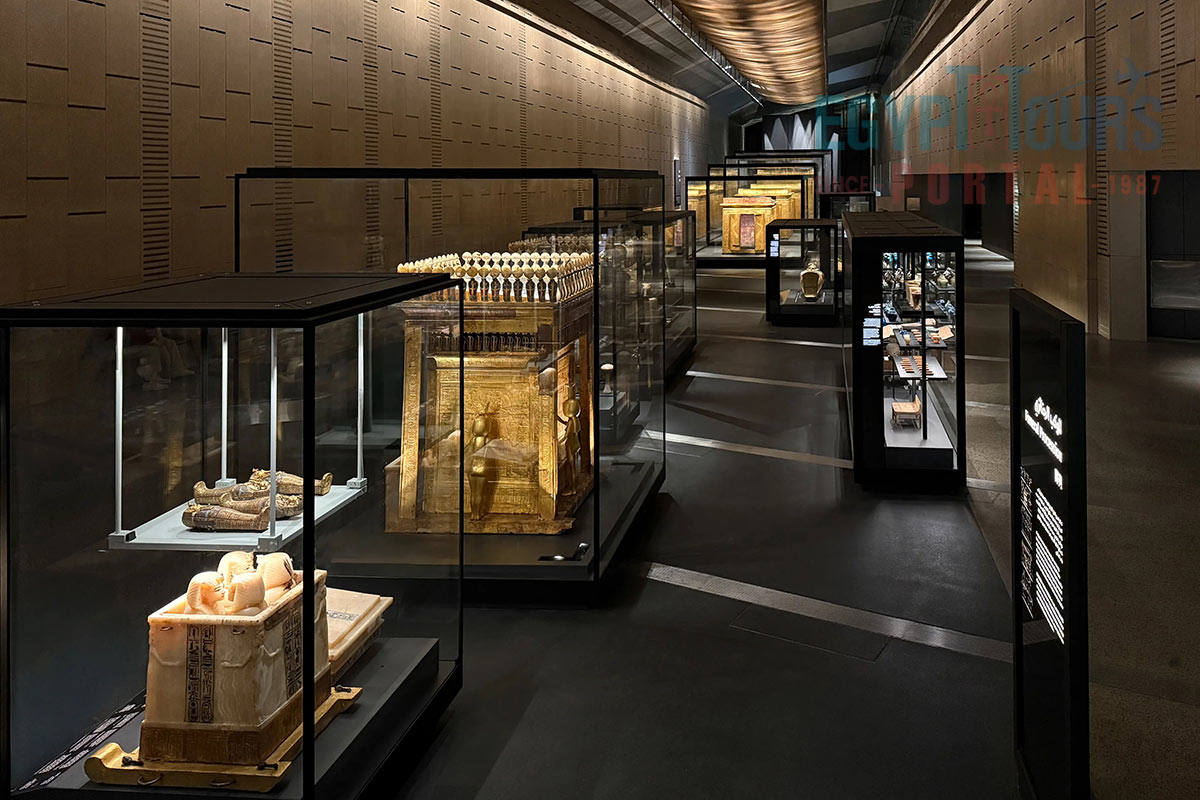
Many of Tutankhamun’s most important objects are displayed in the Tutankhamun Galleries at the Grand Egyptian Museum near the Giza Pyramids. The galleries present the treasures within a broader explanation of the king’s life, court, religious beliefs, funeral, burial, and expected transformation in the afterlife. The collection includes the golden mask, royal furniture, jewelry, statues, ritual objects, coffins, weapons, clothing, chariots, and personal possessions.
The museum presentation enables visitors to understand the objects as parts of a complete royal burial rather than as isolated works of art. Tutankhamun’s mummy remains inside his tomb in the Valley of the Kings. Keeping the mummy at KV62 preserves the physical connection between the king and his original burial place. Travelers can therefore visit the tomb in Luxor and later see the treasures near Giza, creating a journey through both the archaeological setting and the material splendor of Tutankhamun’s afterlife.
Why Is Tutankhamun So Famous?
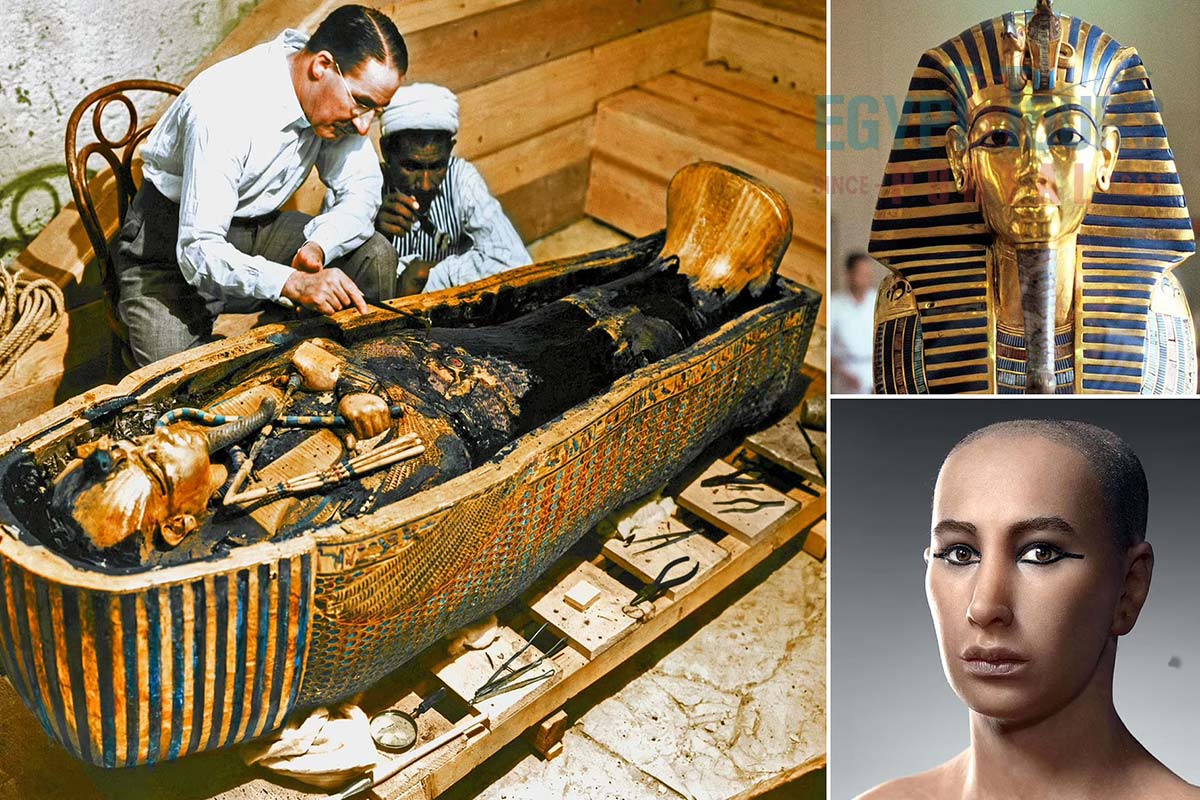
Tutankhamun was not the most powerful pharaoh of ancient Egypt. He did not rule for decades, conquer a vast empire, or construct enormous temples and monuments on the scale of Thutmose III, Amenhotep III, Seti I, or Ramesses II. His fame comes primarily from the exceptional survival of his burial. Most royal tombs in the Valley of the Kings were robbed in antiquity. Their gold, jewelry, furniture, coffins, and ritual equipment disappeared long before modern archaeologists arrived.
Tutankhamun’s tomb preserved thousands of objects in their original archaeological context. Researchers could study how a royal burial was arranged and understand the relationships between the mummy, coffins, shrines, statues, food, furniture, weapons, clothing, and ritual equipment. The discovery also occurred during the early twentieth century, when newspapers, photography, cinema, and international travel allowed the story to reach a worldwide audience.
Images of the golden mask and tomb treasures inspired a wave of fascination often called Tutmania. Ancient Egyptian designs influenced jewelry, fashion, furniture, architecture, advertising, cinema, music, theater, and the decorative arts. Tutankhamun became more famous in the modern world than he had ever been during his lifetime.
The Historical Importance of Tutankhamun
Tutankhamun’s significance extends far beyond the wealth of his tomb. His reign marked the official rejection of Akhenaten’s religious revolution and the restoration of Egypt’s traditional religious institutions. The reopening of temples strengthened local economies, returned workers to temple estates, revived festivals, restored priestly authority, and renewed the traditional relationship between the gods and the monarchy.
His monuments reveal how Egypt transitioned away from the Amarna Period without completely abandoning its artistic influence. The contents of his tomb provide extraordinary evidence about royal life during the Eighteenth Dynasty. They illuminate ancient Egyptian craftsmanship, religion, furniture, clothing, warfare, food, medicine, trade, technology, art, and burial customs.
The tomb also provides insight into the political uncertainty surrounding the end of the Eighteenth Dynasty and the emergence of the Ramesside royal line. Few archaeological discoveries have contributed so greatly to both scholarly knowledge and public fascination with the ancient world.
The Eternal Legacy of King Tutankhamun
Tutankhamun lived a short and politically difficult life. He became pharaoh as a child, inherited a kingdom divided by religious change, and died before reaching adulthood. During his reign, Egypt restored the traditional gods, repaired their temples, revived religious festivals, abandoned Akhenaten’s capital, and attempted to rebuild its political and spiritual stability. His death without a surviving heir ended the immediate royal line and opened the way for Ay, Horemheb, and eventually the Ramesside kings. The small tomb prepared for him was robbed but resealed. It was later hidden beneath debris and forgotten for more than three thousand years.
When Howard Carter’s team uncovered KV62 in 1922, Tutankhamun was transformed from a relatively obscure ancient ruler into the most famous pharaoh in the world. His golden mask has become a symbol of Egyptian civilization, but his story is greater than any single treasure. It is a story of religious revolution, royal restoration, family tragedy, political uncertainty, extraordinary craftsmanship, archaeological discovery, and humanity’s enduring desire to understand the past.
Today, visitors can stand inside Tutankhamun’s original tomb in Luxor and view the objects created for his eternal life at the Grand Egyptian Museum. Through his mummy, monuments, treasures, and the records of his discovery, Tutankhamun continues to connect the modern world with the beliefs, achievements, and mysteries of ancient Egypt.
Go On an Adventure Journey To Egypt
Check our Egypt tour packages or Nile river cruises to explore the treasures of King Tutankhamun and many other Egyptian Pharaohs, and the famous temples and tombs along the Nile Valley.