Summary
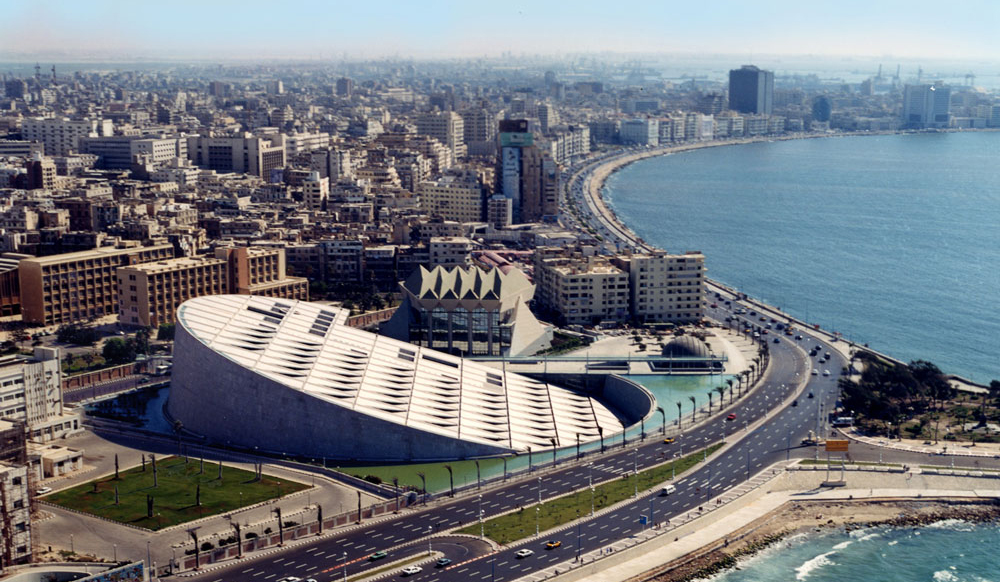
- The Bibliotheca Alexandrina is a modern cultural and academic landmark created as a contemporary revival of the ancient Library of Alexandria.
- It was officially inaugurated on 16 October 2002 and includes a major reading room, specialized libraries, museums, galleries, exhibitions, a planetarium, conference center, manuscript restoration facilities, digital archives, and cultural programs.
- The library stands on the Mediterranean coast of Alexandria, near the ancient harbor and close to the historical area where the original Library of Alexandria is believed to have stood.
- Its design by Snøhetta features a circular tilted form, an 11-story structure, a 20,000 m² reading room, capacity for up to 8 million books, and a granite wall carved with about 4,000 characters from global writing systems.
- The complex includes major museums and exhibitions such as the Antiquities Museum, Manuscript Museum, Sadat Museum, Our Digital World, Culturama, and the Planetarium, making it a center for knowledge, science, culture, memory, and public education.
The Bibliotheca Alexandrina is a very significant cultural milestone and one of the most symbolic libraries in the world. It was created mainly as a contemporary revival of the legendary ancient Library of Alexandria. It stands as a major center for learning, research, culture, dialogue, technology, art, and public education. The original Library of Alexandria from ancient times is the primal inspiration for the Bibliotheca Alexandrina, which was once one of the greatest knowledge institutions of the ancient world before it was lost in a tragic fire, and the modern Bibliotheca Alexandrina was created to revive that spirit in a new architectural and intellectual form.
The Bibliotheca Alexandrina, officially inaugurated on 16 October 2002, is far more than a national library; it is a major cultural and academic complex with a large reading room, specialized libraries, museums, art galleries, permanent exhibitions, a planetarium, conference center, manuscript restoration facilities, digital archives, and cultural programs. At the time of construction, its main reading room was the largest in the world, and the institution was designed to serve students, researchers, children, visually impaired readers, artists, historians, and the public.
It also symbolizes Alexandria’s identity as a Mediterranean city of knowledge, linking Egypt’s ancient intellectual heritage with modern scholarship, digital preservation, public culture, and international cooperation. It hosts many exhibitions, conferences, concerts, lectures, classes, and cultural events, attracting around one million visitors annually and supporting Egypt’s cultural and academic life.
Location of the Magnificant Bibliotheca Alexandrina
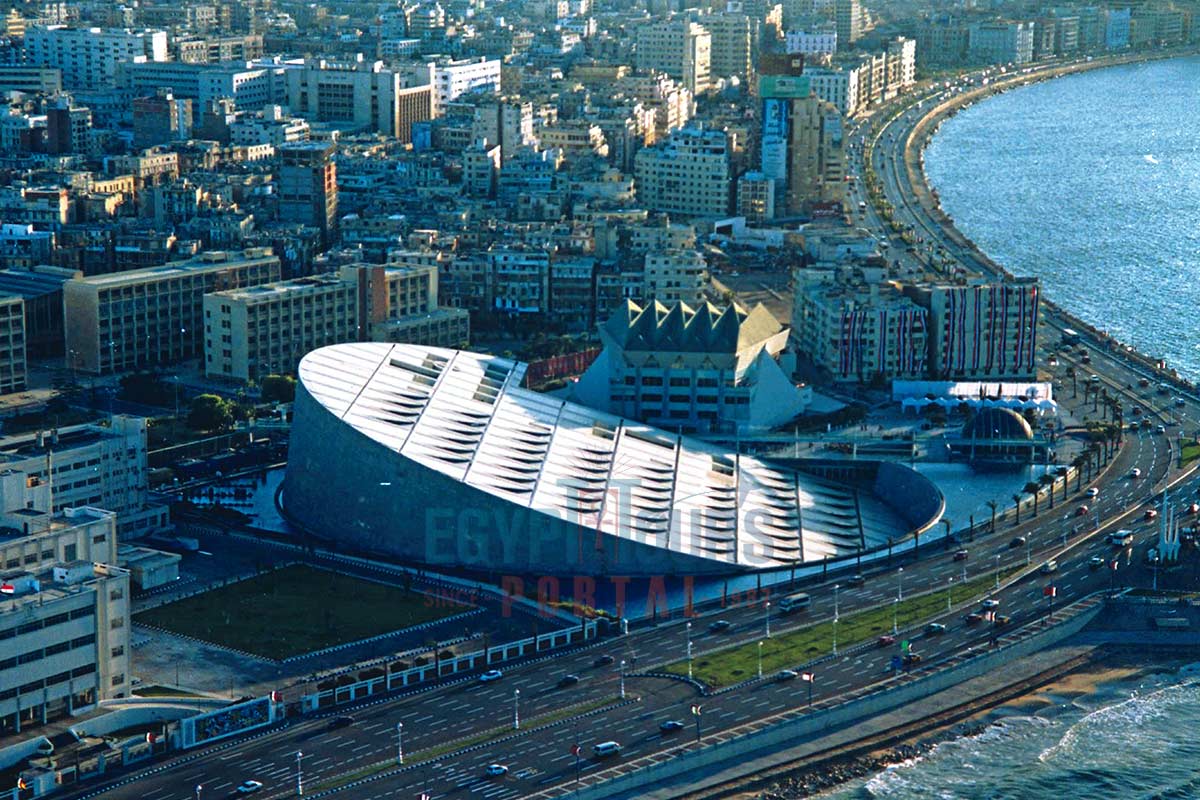
The Bibliotheca Alexandrina is located on the Mediterranean Sea coast in Alexandria, near the city’s ancient harbor and close to the historical area where the ancient Library of Alexandria is believed to have once stood. Its position is highly symbolic: the modern library rises beside the sea in the historic center of Alexandria, linking the city’s ancient role as a global center of learning with its modern cultural future.
The site is also connected to the University of Alexandria, which originally helped select and donate land for the project. The building is surrounded by an open plaza and a reflecting pool, while a footbridge links the library area with the nearby university zone. This setting makes the library feel like both a public cultural monument and an academic gateway between the city, the sea, and the university community.
The History of How the Bibliotheca Alexandrina Came to Be
The idea of reviving the ancient Library of Alexandria began in 1974, when a committee established by Alexandria University selected a plot of land between the university campus and the seafront. The vision was to create a modern institution that would honor the memory of the ancient library while serving contemporary research, culture, and public education. The project gained support from the Egyptian state, especially former President Hosni Mubarak, and from UNESCO, which played a central role in giving the project international visibility and structure.
In 1988, UNESCO organized an international architectural design competition to select the library’s design. The competition received 524 entries, and the winning design was created by the Norwegian architectural firm Snøhetta. More than 1,300 architects from 77 countries registered for the competition, reflecting the global importance of the project. The first stone was laid on 26 June 1988, and in October 1990, Egypt and UNESCO signed a project agreement that established the international framework for the library.
Funding pledges began at a conference in Aswan in 1990, where around US$65 million was pledged, mostly from Middle East and North African states. Construction work began in the 1990s, though archaeological excavations uncovered remains of Roman villas and mosaics, delaying the building process. After around US$220 million had been spent, the Bibliotheca Alexandrina was officially inaugurated on 16 October 2002.
The library also grew through major international donations. The Internet Archive donated about US$5 million in digital resources and infrastructure, including billions of web pages, television broadcasts, archival films, large-scale data storage, and a book-scanning facility. The Bibliothèque nationale de France later donated 500,000 books, making the Bibliotheca Alexandrina one of the largest Francophone libraries in the world.
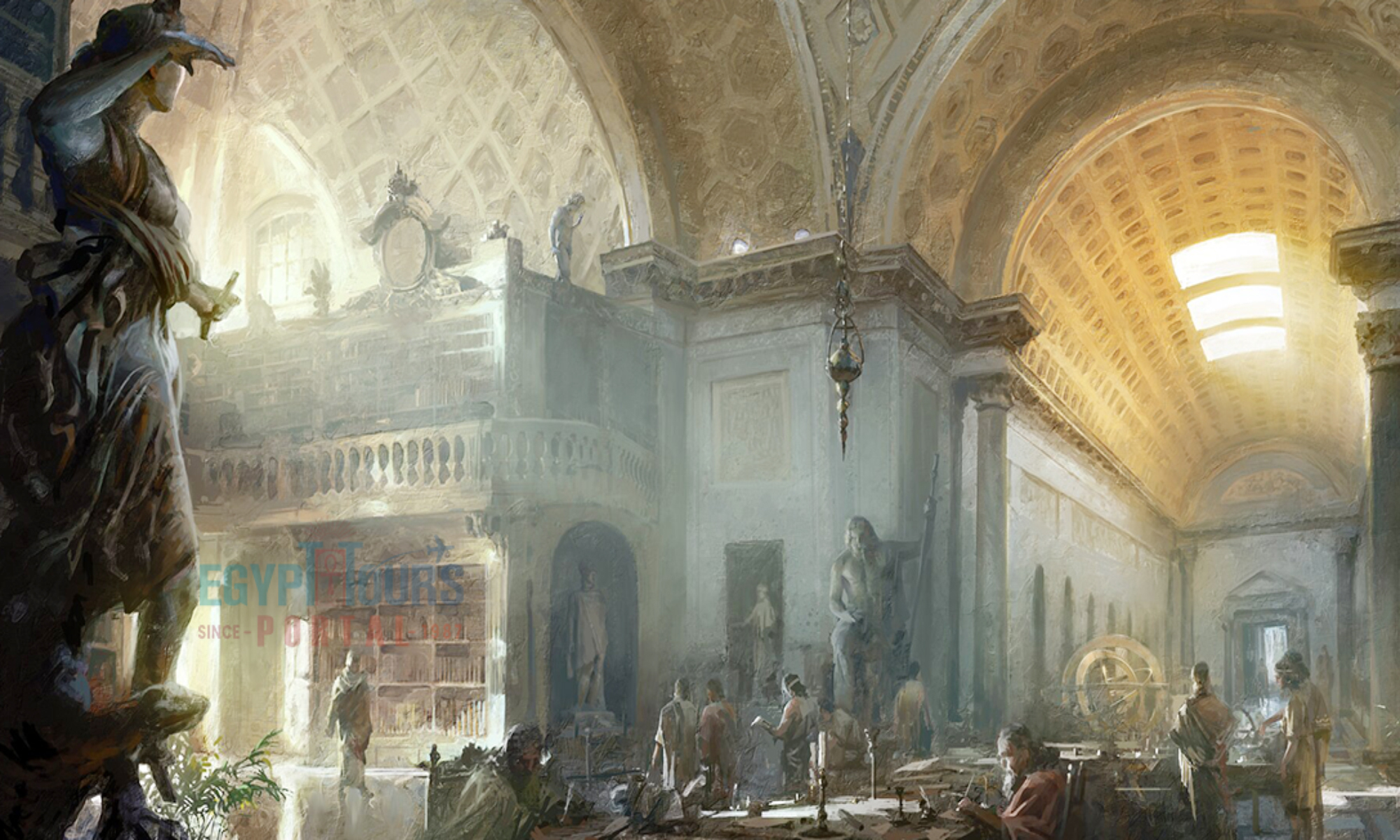
The Ancient Library of Alexandria: Where the World’s Knowledge Once Lived
Learn About Legendary History of the Rise and Fall of the Library of Alexandria
The Enchanting Design and Features of the Bibliotheca Alexandrina
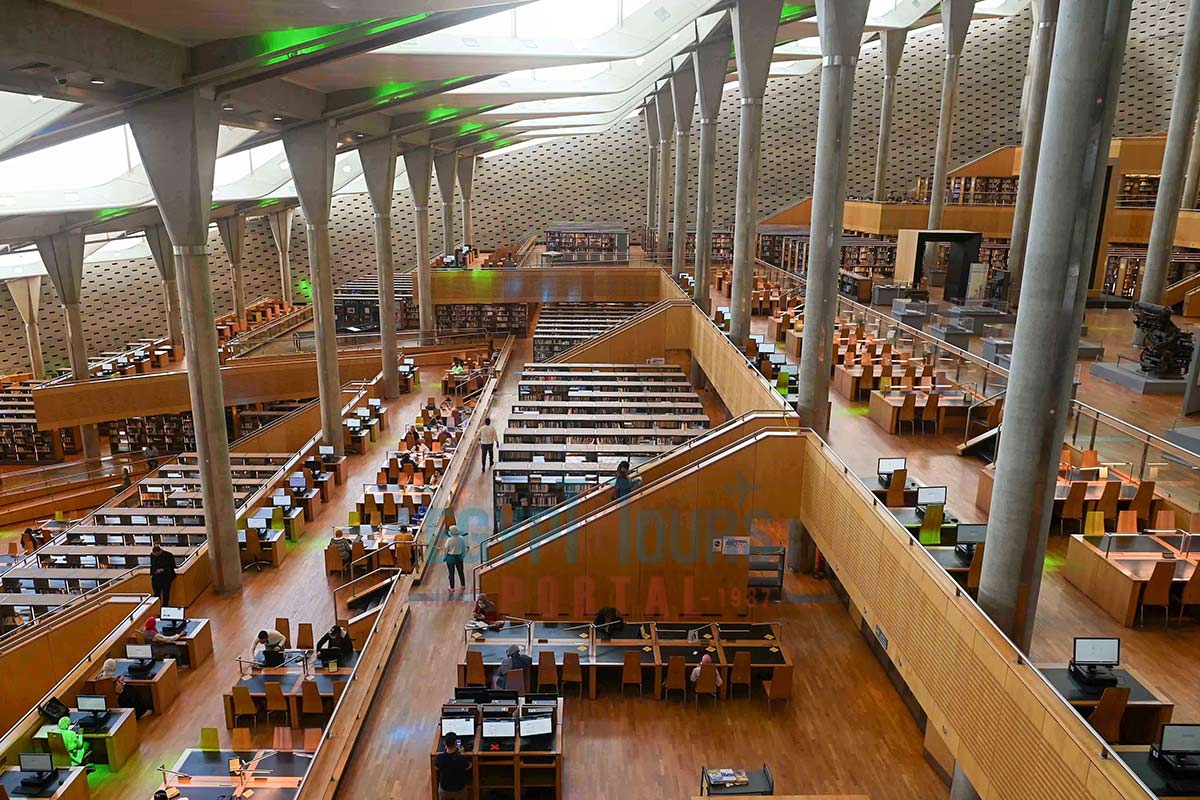
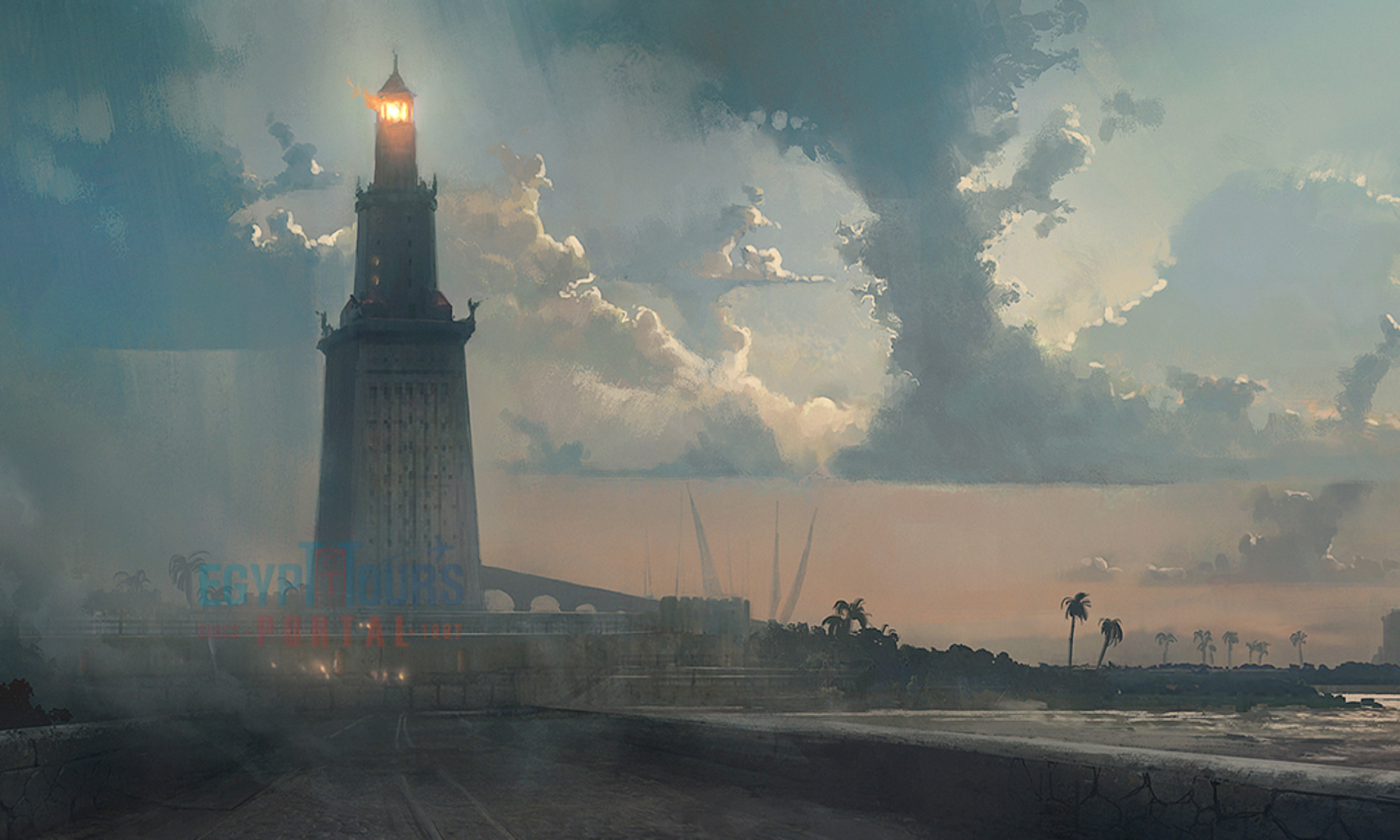
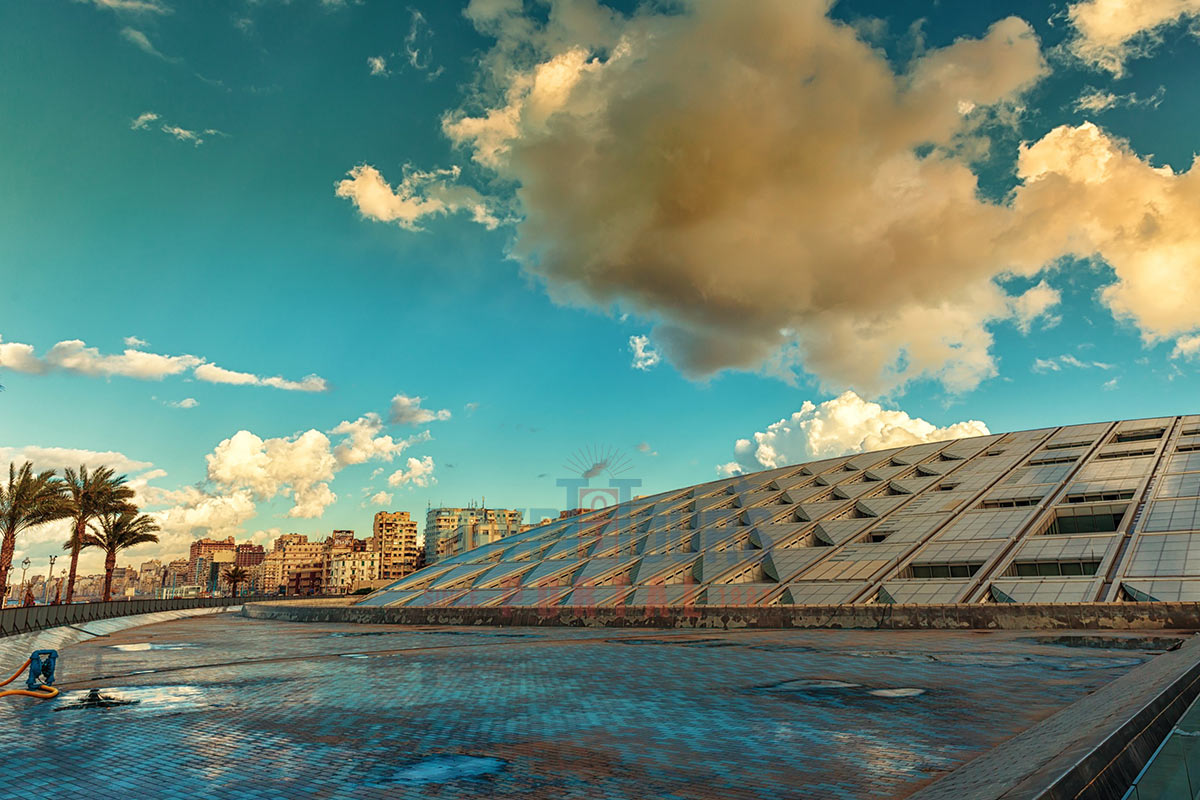
The design of the Bibliotheca Alexandrina is one of its most powerful and striking features. The building was created as a bold modern symbol of knowledge, continuity, and cultural rebirth. Its circular, tilted form was designed to reflect the cyclical nature of knowledge, connecting the past, present, and future. The glistening roof tilts toward the Mediterranean like a sundial or a rising sun, while its form also evokes Alexandria’s ancient harbor and the memory of the ancient Lighthouse of Alexandria.
The building is 160 meters in diameter, rises to about 32 meters in height, and descends roughly 12 meters underground. It has 11 stories and can hold up to 4 million volumes, expandable to 8 million volumes through compact storage. Its main reading room covers around 20,000 square meters and is arranged across cascading terraces, allowing readers to be close to book stacks while enjoying natural light and views across the vast interior space.
The reading room was once the largest open reading room in the world and was designed like a large intellectual amphitheater. It is lit by vertical, north-facing skylights that bring in natural light without exposing books and manuscripts to damaging direct sunlight. This design improves comfort for readers while protecting the collections.
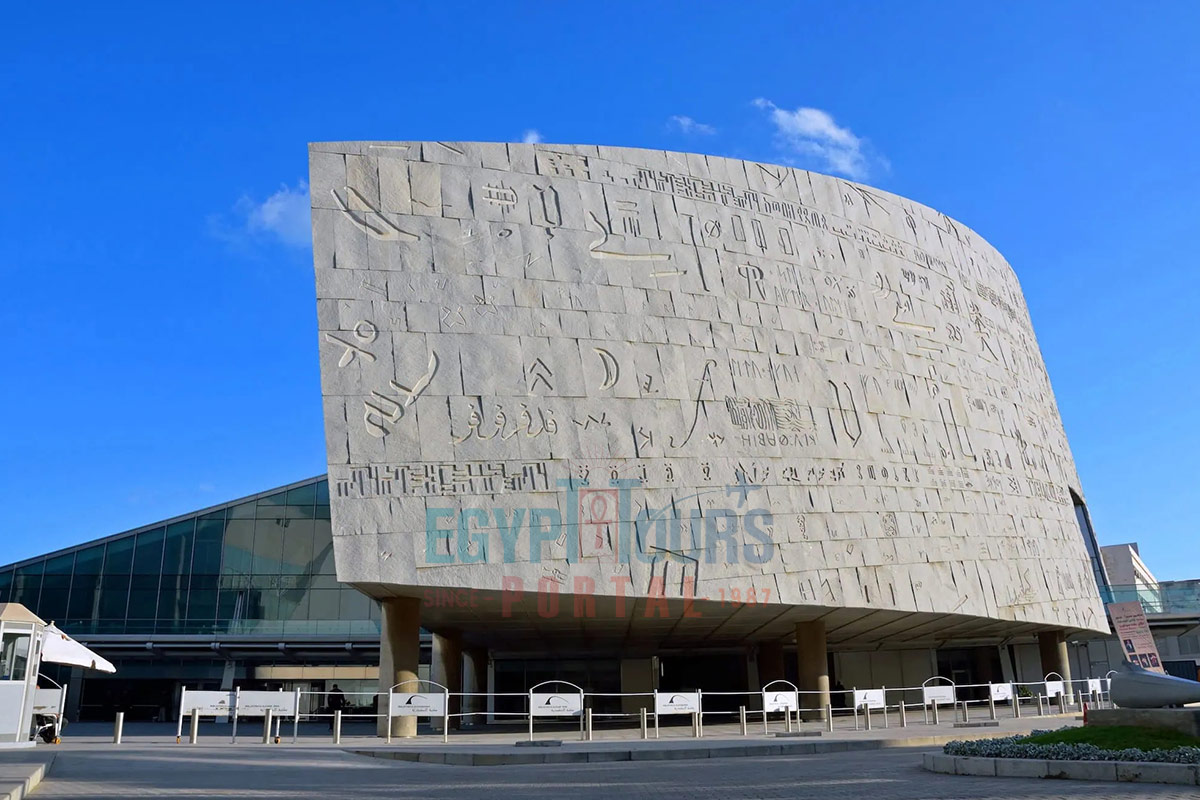
The exterior of the Library of Alexandria is incredibly remarkable. The granite wall is made of nearly 6,000 square meters of hand-carved stone and is one of the largest contemporary art projects in the world. It includes about 4,000 unique characters from writing systems across human history, including alphabets, symbols, musical notation, mathematical signs, Braille, barcodes, and other forms of inscription spanning around 10,000 years of human communication. The gray granite came from Aswan, and the project helped revive traditional stoneworking skills by training young Egyptian stonemasons.
The library was also designed with environmental considerations. More than 80% of the materials were locally produced, the interior relies heavily on natural light and fresh air, the building uses thermal massing to maintain a comfortable temperature, and the surrounding reflecting pool helps reduce air pollution around the site.
Services, Opening Times, and Tickets of the Bibliotheca Alexandrina
The Bibliotheca Alexandrina offers a wide range of public, academic, cultural, and research services. Its main library can hold up to 8 million books and includes collections in Egyptian, classical Arabic, English, and French. It also offers specialized libraries for maps, multimedia, children, young people, and blind or visually impaired readers. The Taha Hussein Library serves blind and visually impaired visitors through special software that allows access to books and journals, and it is named after the Egyptian writer and scholar Taha Hussein, who lost his sight at the age of three.
The library also provides access to digital collections through the Digital Assets Repository, which preserves and makes available digitized materials through online search and browsing. It contains digital projects, archived materials, and cultural heritage resources. Other services include exhibitions, conferences, lectures, concerts, classes, public events, manuscript restoration, conservation facilities, book-scanning services, and access to special collections such as the Nobel Section, which contains works of Nobel Prize winners in literature from 1901 onward.
Bibliotheca Alexandrina's current public opening hours are generally Monday to Thursday from 9:30 AM to 4:00 PM, Saturday and Sunday from 10:00 AM to 2:00 PM, and Friday is closed; the Children’s, Young People’s, and Taha Hussein Libraries follow similar hours, though the Taha Hussein Library is closed on Saturday and Sunday. The Main Library is open Monday to Thursday from 10:00 AM to 6:00 PM and Saturday and Sunday from 10:00 AM to 2:00 PM, so visitors should verify the exact schedule for the day on the official website before going.
It is worth knowing that the main Library tickets include guided tours, Culturama shows, Sadat Museum, and access to permanent and temporary exhibitions. Ticket prices listed by the official site are EGP 10 for Egyptian adults, EGP 5 for Egyptian students and senior citizens, EGP 150 for non-Egyptian adults and senior citizens, and EGP 20 for non-Egyptian students; admission is free for visitors with special needs and for the Taha Hussein Library. Guided tours are available in Arabic, English, and French, with multiple scheduled times during opening days.
The Grand Museums of the Bibliotheca Alexandrina
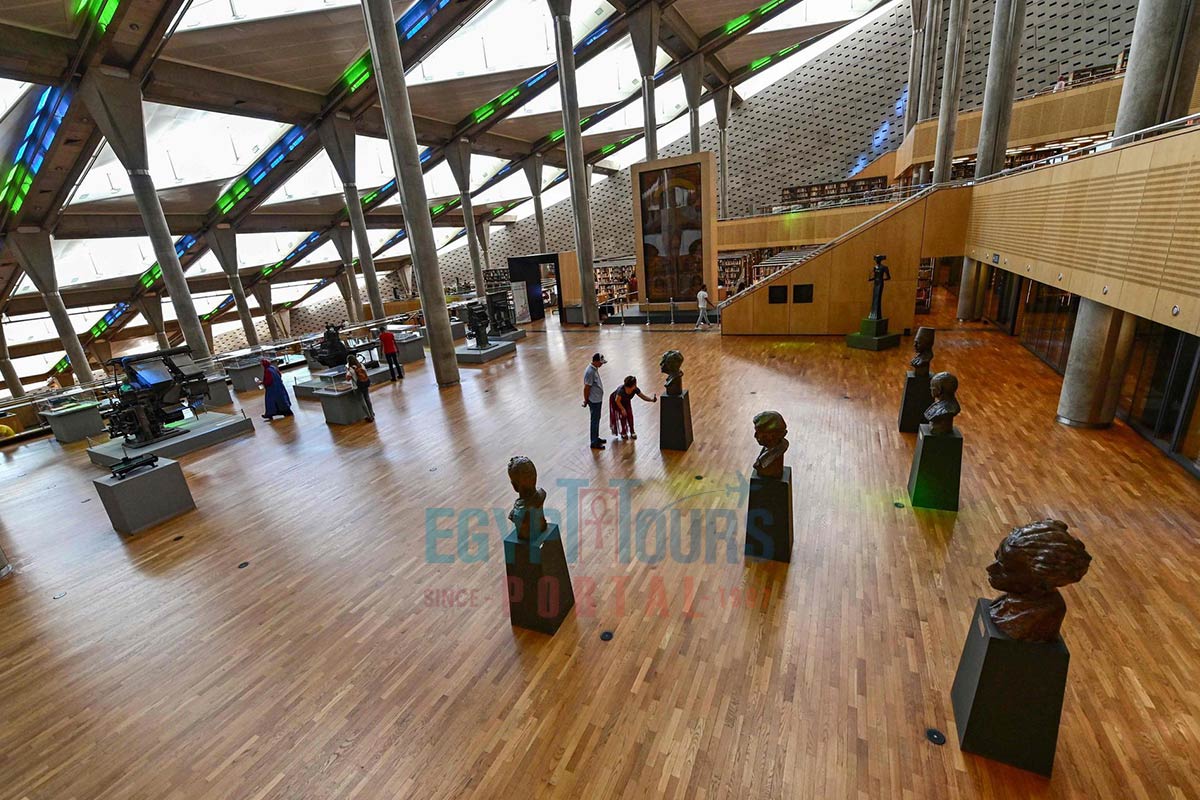
The Bibliotheca Alexandrina contains several important museums that transform it from a library into a complete cultural complex. These museums help visitors understand Egypt’s ancient, modern, artistic, political, and manuscript heritage.
The Antiquities Museum in the Alexandria library was established in 2001, and it is an archaeological museum located inside the library. It contains around 1,316 artifacts, including underwater antiquities recovered from the Mediterranean seabed near the Eastern Harbour and the Bay of Abukir. The museum presents artifact descriptions in Arabic, English, and French, making it accessible to both Egyptian and international visitors.
The Manuscript Museum, also established in 2001, gives visitors and researchers access to rare manuscripts and books. It contains one of the world’s largest collections of digital manuscripts and works alongside the Manuscript Center, supporting preservation, research, and public access to handwritten heritage.
The Sadat Museum is dedicated to former Egyptian President Anwar Sadat. Its collection includes personal belongings such as military robes, his Nobel Prize medal, his copy of the Qur’an, handwritten letters, family photographs, newspaper articles, a recording of him reciting part of the Qur’an, and the blood-stained military robe he wore on the day of his assassination. In 2023, the museum also retrieved Sadat’s passport from an online auction in the United States.
In addition to the museums, the complex includes several major exhibitions. Our Digital World presents the library’s digital projects, including archives of former presidents, the Science Supercourse, and the Encyclopedia of Life. The World of Shadi Abdel Salam displays works by the Egyptian filmmaker and screenwriter, donated by his family.
Impressions of Alexandria explores Alexandria through the eyes of artists, travelers, and photographers, including the city’s cosmopolitan memory. The library also includes Culturama, a 180-degree panoramic interactive screen system developed by the Egyptian Center for Documentation of Cultural and National Heritage, and a Planetarium, making the Bibliotheca Alexandrina a center for science, culture, memory, and public education.
Explore The Best Tours to the Gems of the Mediterranean
Bibliotheca Alexandrina is the closest thing we have to the original ancient library of Alexandria, which will deliver a true magical glimpse of the times that was. This explains why the library is by far one of the amazing Alexandria tourist attractions. Our wide variety of Egypt tour packages mixed with a Nile river cruise between Luxor and Aswan, will deliver the ultimate travel adventure of your lifetime, so make your dream a reality right now.