



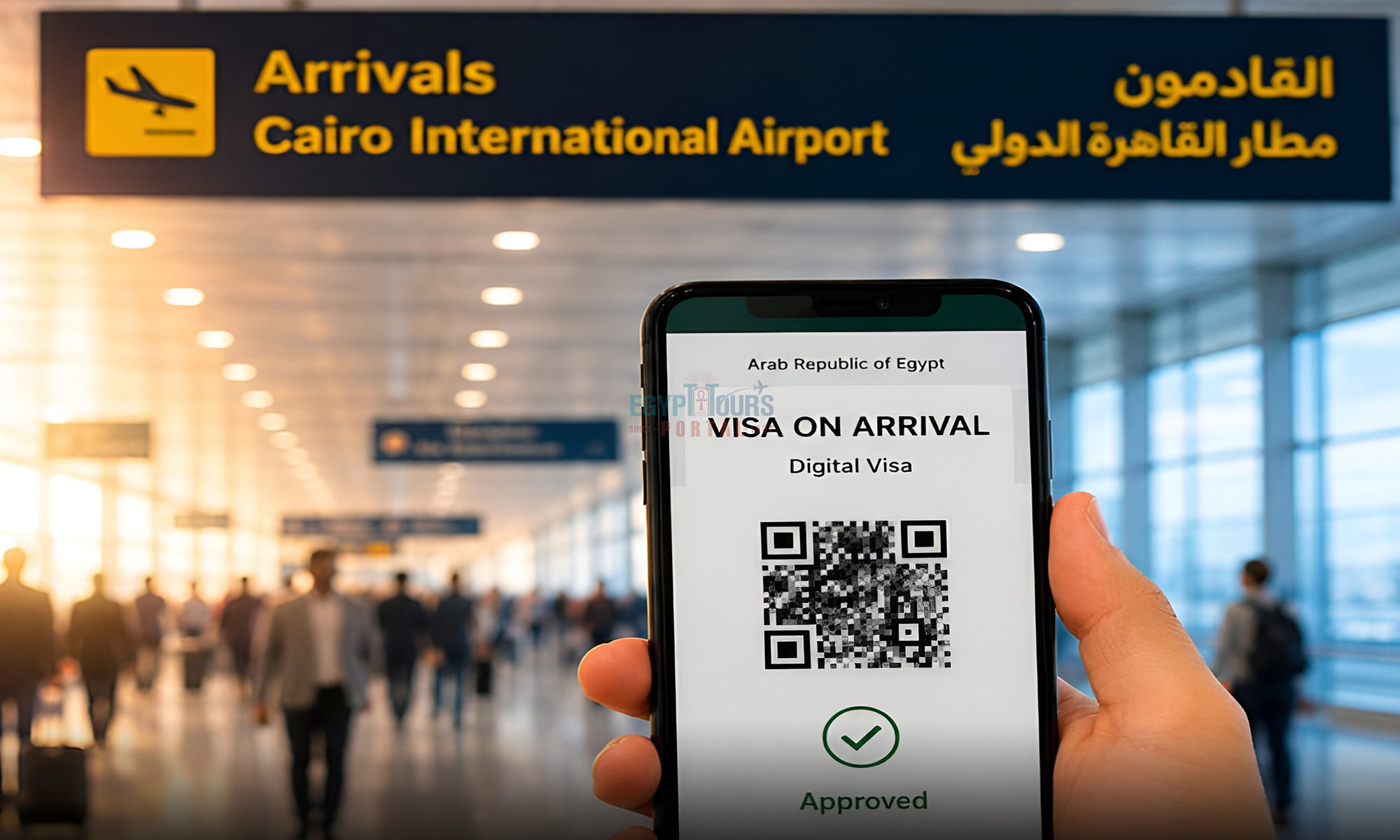
Beginning August 1, 2026, the arrival process at Cairo International Airport is changing. For travelers who already qualify for Egypt's visa on arrival, the familiar paper sticker will no longer be the only option; a new Visa QR Code system launches as a pilot across all of Cairo Airport's arrival terminals, letting eligible travelers generate their visa digitally before they ever reach the immigration desk.
For millennia, entry into Egypt has been a ritual of stamps, stickers, and small kiosks tucked between baggage claim and passport control. This pilot marks the first real break from that tradition, trading a moment of paperwork for a scan of a phone or a printed page. What follows is a practical breakdown of how the system works, what it costs, and, most importantly, the timing rule that can catch travelers off guard if they are not paying attention.
This guide covers exactly how to request the QR code, the $36 total cost, the strict 48-hour validity window, who the pilot applies to, and what stays the same for travelers flying into Hurghada, Sharm El Sheikh, Luxor, or Marsa Alam in the meantime, alongside those planning Cairo tours around the new arrival process.
What Is Changing at Cairo Airport on August 1
The Egyptian Ministry of Tourism and Antiquities, through the Egyptian Tourism Authority (established in 1981), announced the pilot as the first phase of a nationwide digital rollout. During this phase, eligible travelers arriving at Cairo International Airport will receive a Visa QR Code instead of relying solely on the traditional visa sticker.
At the border, an immigration officer scans the QR code together with the traveler's passport. The code itself can be shown two ways: pulled up on a phone from an email, or presented as a printed copy. That flexibility matters for travelers who prefer not to depend on airport Wi-Fi, international roaming, or a phone battery holding out through a long-haul flight.
It is worth being clear about what the pilot does not do. It does not create a new visa category, and it does not change who is allowed to use visa on arrival in the first place. It changes only how that existing visa is issued and checked. The rest of the arrival sequence; passport control, baggage claim, and customs continues exactly as before, so travelers should still budget time for immigration lines, particularly when several international flights land close together.
How to Get Your Egypt Visa on Arrival QR Code
Egypt has set up three channels for generating the code:
- The official online portal, expected to go live approximately 48 hours before the pilot begins, pointing to around July 30, 2026.
- A dedicated official mobile application.
- Self-service machines installed in the arrival halls at Cairo International Airport.
Travelers can generate the code before departure, mid-flight, or immediately after landing. Travel agencies and tour operators are also permitted to apply on behalf of their clients, which is useful for group tours and organized itineraries where a single point of contact handles the paperwork.
One caution worth repeating: at the time of this writing, the official portal address has not yet been published. Once live, it should be linked directly from the Egyptian Tourism Authority's official channels. Travelers searching for it online before the launch should be wary of sponsored results or third-party sites charging extra "processing fees" for something the government intends to issue directly.
What the Digital Visa on Arrival Costs
The total price for the digital visa on arrival is $36, made up of the existing $30 visa-on-arrival fee plus a new $6 service fee for digital issuance. In euros, that works out to roughly €31.55 (€26.29 plus €5.26). This is the same underlying visa cost travelers have paid for years; the $6 addition covers the QR code's issuance, not a new type of entry permit.
This is a different cost structure from Egypt's separate e-Visa system, run by the Ministry of Interior, which allows travelers to apply for an Egyptian visa entirely online before departure. A single-entry e-Visa currently costs $30, and a multiple-entry e-Visa costs $65. The two systems are not connected, and applying for one does not affect eligibility for the other. Egypt Tours Portal's Visa guide breaks down both routes by nationality if you are still deciding which one applies to you.
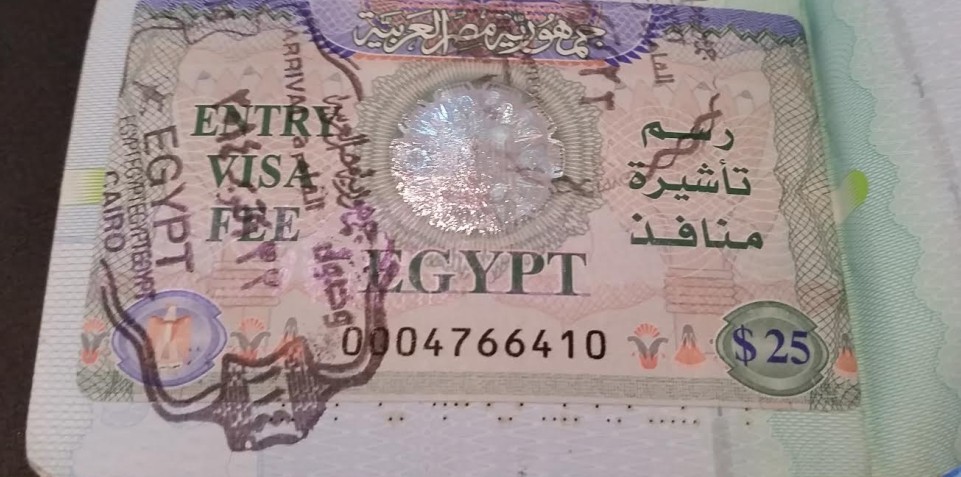
Visto de Viagem para o Egito: Guia de Tipos, Custos e Regras de Entrada
Plan your trip to Egypt with ease. Learn all about visa types, costs, entry requirements, and who qualifies for e-visas, on-arrival, or visa-free access.
The 48-Hour Rule: Why Timing Matters More Than It Sounds
Every QR code issued through this system remains valid for 48 hours from the moment it is generated, not from the moment a traveler lands in Cairo. This distinction is the single most important planning detail in the entire system.
Consider a traveler landing in Cairo on August 2. Generating the code on July 30, simply because the portal has just opened, would let the code expire before the flight even departs. The safer approach is to count backward from the scheduled Cairo arrival time and build in a buffer for delays, rather than generating the code as early as the portal allows.
Flight delays deserve particular attention here. A traveler whose flight is pushed back should check the QR code's issue time before assuming it is still valid; a code older than 48 hours at the point of arrival will likely need to be generated again. Anyone flying long routes, such as a nonstop from a North American gateway, should base the 48-hour countdown on the scheduled Cairo landing time, not the departure time at the origin airport.
Who the Pilot Applies To
This digital system is available only to travelers whose nationality already qualifies for Egypt's visa on arrival under current rules. The pilot does not expand or change that eligibility list, it changes the delivery method for travelers who already qualify. Reported nationality counts for visa-on-arrival eligibility have varied across sources at the time of this announcement, so the safest step is to confirm current eligibility directly with the nearest Egyptian embassy or consulate, with your airline, or through Egypt Tours Portal's Egypt travel visa page, before booking or paying for anything.
Travelers whose nationality is not on the visa-on-arrival list still need to arrange an e-Visa or an embassy visa before departure, the QR system does not serve as a substitute for that, and airlines can and do check entry documents at the departure gate, before a traveler ever reaches a kiosk in Cairo.
Regardless of which visa route applies, Egypt requires a passport with at least six months of validity remaining from the date of arrival. That requirement is unchanged by the new system.
Paper Visa or Digital QR Code: Both Work During the Pilot
The paper visa sticker is not disappearing on day one. During the pilot, the traditional process and the new digital system will run side by side, giving travelers who arrive without a QR code, or who run into a technical problem, a working fallback.
The Egyptian Tourism Authority has said the paper sticker will eventually be phased out entirely, with the QR code becoming the sole method of entry. No end date for the pilot, and no firm date for retiring the paper visa, has been announced. Egypt had signaled this shift months earlier: Ahram Online reported in May 2026 that the government had signed technology and banking agreements, reportedly involving the National Bank of Egypt and Banque Misr, to support electronic issuance and payments ahead of the wider rollout.
For now, that overlap is a practical advantage rather than a compromise. A new border-technology system can expose gaps in payment processing, language support, or machine reliability in its first weeks, and having the paper option available reduces the risk of stranding early adopters at the border.
Flying Into Hurghada, Sharm El Sheikh, Luxor, or Marsa Alam
The pilot is limited to Cairo International Airport. Travelers arriving at Hurghada, Sharm El Sheikh, Luxor, or Marsa Alam will continue to use the existing paper visa-on-arrival process for now, with no announced date for when, or in what order, those airports will join the digital system. Egypt has said the Cairo pilot is the first phase of a staged national rollout, with additional airports to follow and dates to be announced separately.
Travelers with connecting flights that touch down first in Cairo before continuing to a Red Sea or Nile Valley destination should apply the digital process at their first point of entry into Egypt, since that is where the visa is actually issued and checked.
Before You Fly to Cairo: A Quick Checklist
- Confirm eligibility. Check with the nearest Egyptian embassy or consulate that your nationality still qualifies for visa on arrival — the list can change without notice.
- Watch for the official portal. It is expected to go live around July 30, 2026, linked from the Egyptian Tourism Authority's official channels — not from a sponsored search result.
- Time the QR code carefully. Generate it close to your scheduled Cairo arrival, with a buffer for delays, rather than as soon as the portal opens.
- Keep a backup. Save the confirmation email somewhere accessible offline, and print a copy in case of unreliable data or a low phone battery.
- Carry standard paperwork regardless. A return or onward ticket, hotel bookings, and — for business or family visits — a supporting letter are still worth having on hand.
- Build in extra time. New border-technology systems tend to run slower in their first weeks, so leave a buffer if you have a tight onward connection out of Cairo.
- Line up the rest of the trip. Once the visa is sorted, Egypt Tours Portal's guides on the best time to visit Egypt and what to pack for Egypt are worth reading before you finalize your itinerary.
Frequently Asked Questions
Is the QR code a new type of Egyptian visa?
No. It is a new delivery and verification method for the existing visa-on-arrival category. The underlying visa, its cost basis, and who qualifies for it remain the same.
Can I generate the QR code weeks before my trip?
No. The code expires 48 hours after issuance, so generating it far in advance means it will likely expire before you land. Generate it close to your scheduled arrival in Cairo instead.
Does the digital visa on arrival replace Egypt's e-Visa?
No. The e-Visa, run separately by the Ministry of Interior, is a different application process with its own pricing ($30 single-entry, $65 multiple-entry) and remains untouched by this pilot.
What happens if my flight is delayed past the 48-hour window?
The QR code becomes invalid once 48 hours have passed since issuance, regardless of the reason for the delay. Travelers in this situation should be prepared to generate a new code, either through the app, the portal, or a self-service machine at the airport.
Will I still be able to get a paper visa sticker after August 1?
Yes, for now. The paper process runs alongside the QR system throughout the pilot. Egypt intends to phase out the paper sticker eventually, but no date has been set.
Does this affect visa on arrival at other Egyptian airports?
Not yet. Hurghada, Sharm El Sheikh, Luxor, and Marsa Alam continue with the existing paper-based process until Egypt announces further rollout dates.
Final Takeaway
Egypt's shift toward a digital visa on arrival is a modest change with an outsized planning detail buried inside it: the 48-hour clock starts the moment the code is generated, not the moment a traveler steps off the plane. Get that timing right, and the rest of the new system is designed to make the walk from the jet bridge to passport control just a little smoother — one small, golden step in Egypt's longer effort to modernize how it welcomes the world at its door.
Travelers still finalizing their Egypt travel packages itinerary, or unsure which visa route applies to their nationality, are welcome to reach out to the Egypt Tours Portal team directly. Planning the paperwork correctly now means one less thing to think about once you are standing in front of the Pyramids of Giza.

Egypt Tours Portal is dedicated to preserving and sharing the rich history, culture, and mysteries of ancient Egypt, helping travelers and history enthusiasts explore Egypt’s most iconic destinations and monuments. The team consists of experienced Egyptologists, archaeologists, historians, travelers, content creators, marketers, consultants, and explorers with 5–20 years of expertise in their respective fields.
The website provides accurate, regularly updated information developed by qualified experts and supported by trusted sources to ensure reliability and educational value. Drawing on more than 39 years of industry knowledge and resources, Egypt Tours Portal offers a wide range of travel services, including Egypt tours, Nile cruises, day tours, shore excursions and multi-country tours. Their services have earned positive reviews from travelers, recognition through awards, and mentions by respected news outlets and travel blogs, delivering both educational and memorable travel experiences across Egypt.





















































Leave a Comment