Summary
- The Labyrinth was Amenemhat III's mortuary temple beside the Hawara Pyramid, about 100 km southwest of Cairo in the Fayoum.
- Herodotus described twelve courts and 3,000 rooms, half underground, and was refused entry to the lower level.
- Flinders Petrie found its foundations in 1888 and concluded the building had been quarried away.
- Scans from Mataha (2008), peer-reviewed studies (2010, 2024), and Merlin Burrows claim buried features, but only excavation can confirm them.
- Hawara is open to visitors from EGP 150, and new fieldwork at the site is under way.
The Labyrinth of Egypt is one of the most talked-about subjects across social media, the podcast-verse, world archaeology, and the Egyptology academic field. It was a vast temple complex built about 3,800 years ago beside the Hawara Pyramid of Amenemhat III, at the entrance to the Fayoum Oasis. Greek writers called it a wonder greater than the pyramids, and Herodotus claimed it held 3,000 rooms, half of them underground. Today little shows above ground, yet geophysical scans, a long debate over what lies below, and new fieldwork have made Hawara one of the most talked-about archaeological sites in Egypt.
Few places on earth have kept a secret for so long; the Labyrinth has been hiding in plain sight beneath the fields of the Fayoum for almost four thousand years. Everyone will learn where the Labyrinth of Egypt and the Hawara Pyramid are located, what Herodotus and other ancient writers saw, what Flinders Petrie found when he excavated it, and the key Hawara Pyramid facts. You will also read what the different Hawara Labyrinth scans claim, how far the latest excavation has gone, and how to visit the site yourself.
Labyrinth of Egypt Hawara Pyramid Location
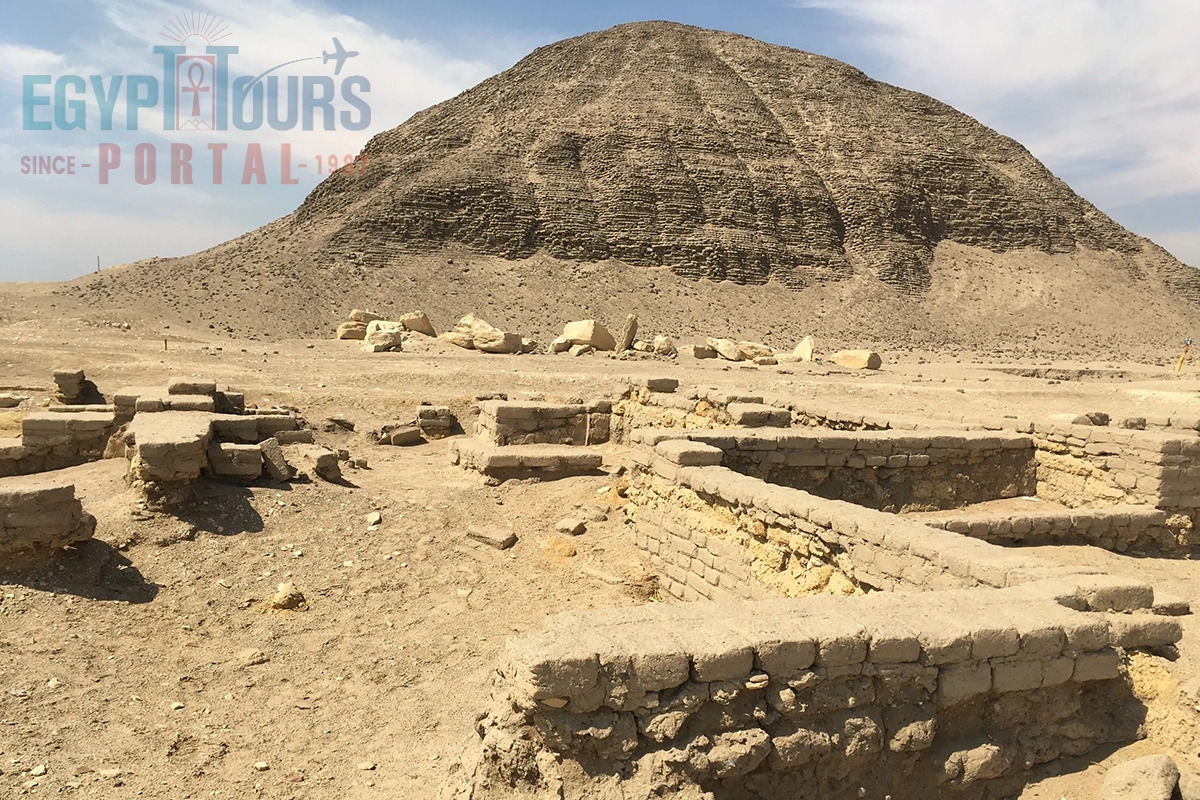
The Labyrinth of Egypt lies just south of the Hawara Pyramid, near the village of Hawara in Fayoum Governorate. The site is about 9 km southeast of Medinet el-Fayoum and roughly 100 km southwest of Cairo, a drive of about two hours. Its coordinates are 29°16′23″N, 30°53′56″E.
The location was no accident. Hawara sits where the Bahr Youssef canal enters the Fayoum depression, the fertile basin that Middle Kingdom kings turned into one of Egypt's richest farming regions. Ancient writers placed the Labyrinth near Lake Moeris, the great lake that once filled much of the Fayoum and survives today as the smaller Lake Qarun.
Who Built the Labyrinth?
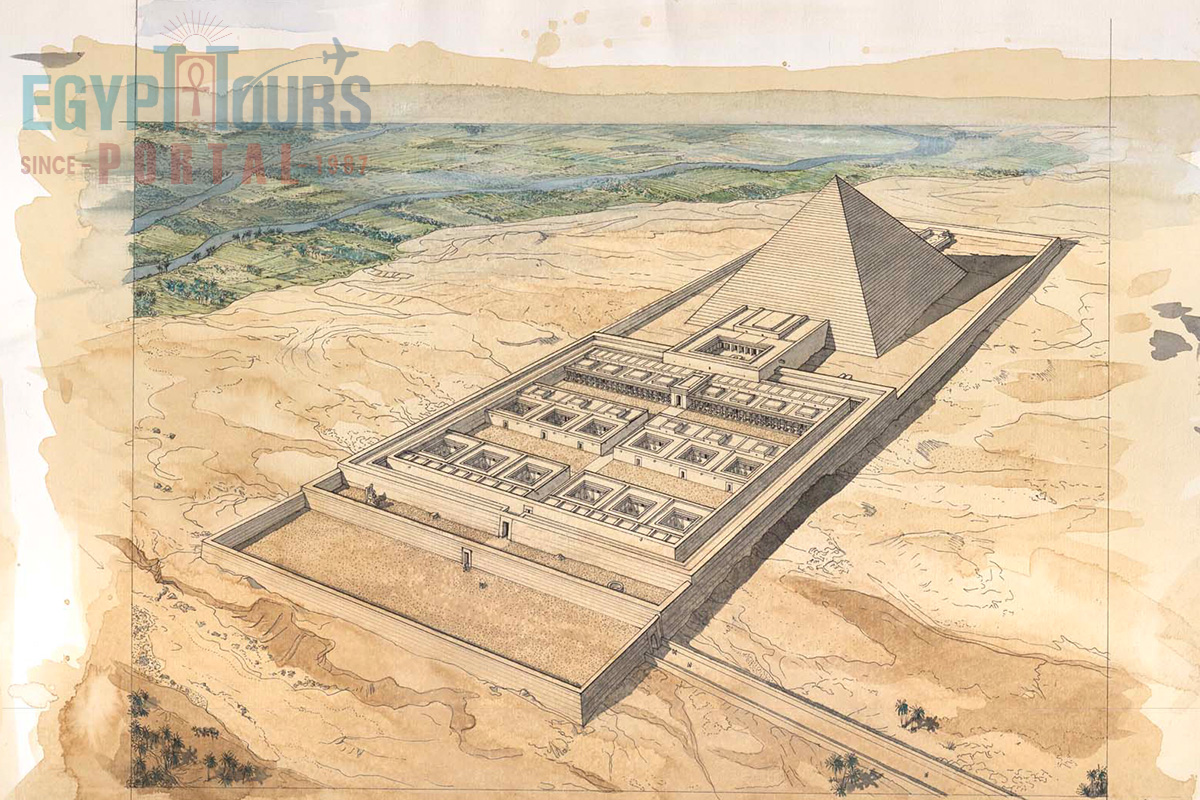
Most scholars credit Amenemhat III, the sixth king of the 12th Dynasty, who ruled around 1860 to 1814 BC during the Middle Kingdom. He first built a pyramid at Dahshur, but it began to crack and sink, so he built a second pyramid at Hawara, where he was most likely buried. The Labyrinth was his mortuary temple, raised on the south side of that pyramid.
Cartouches of his daughter Sobekneferu, one of the earliest women to rule Egypt as king, show that she added to the decoration after his death. Amenemhat III ranks among the most active builders of the ancient Egyptian pharaohs, and his statues still fill museum halls in Cairo.
What Was It For?
The Labyrinth was most likely a group of funerary temples serving the king's cult. Many researchers think it also worked as an administrative and religious center. Strabo wrote that it held one court for each of Egypt's provinces, or nomes, where their officials met for rites and justice.
How Were the Pyramids Built?
Solved, how the Pyramids were built, explore the top information about this question, read more about the workforce, architecture, and more..
Hawara Labyrinth Herodotus: What the Ancient Writers Saw
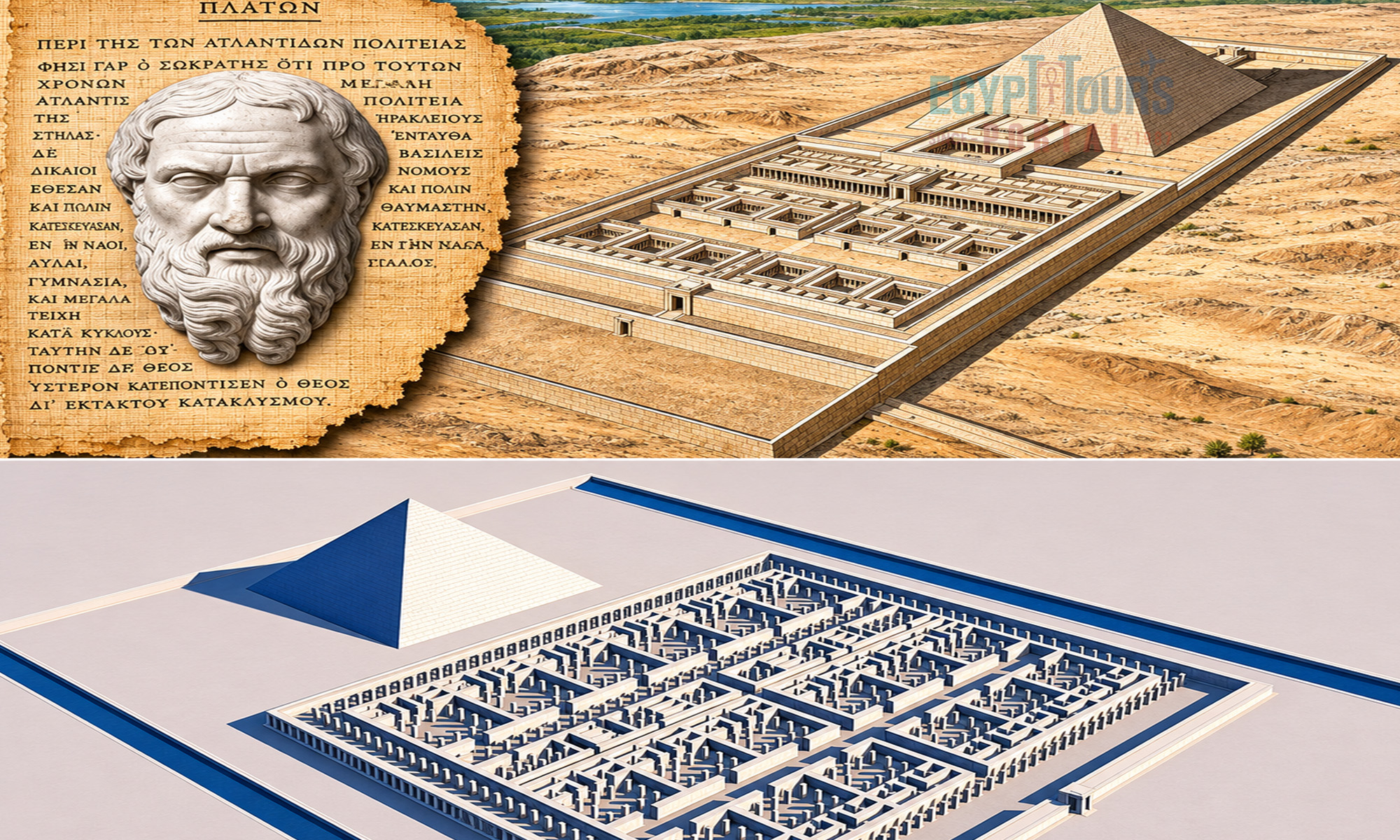
Everything we imagine about the Labyrinth begins with the visitors who walked through it while it still stood. Their accounts disagree in the details, partly because some writers saw a building already in decline and others never saw it at all.
Herodotus (5th Century BC)
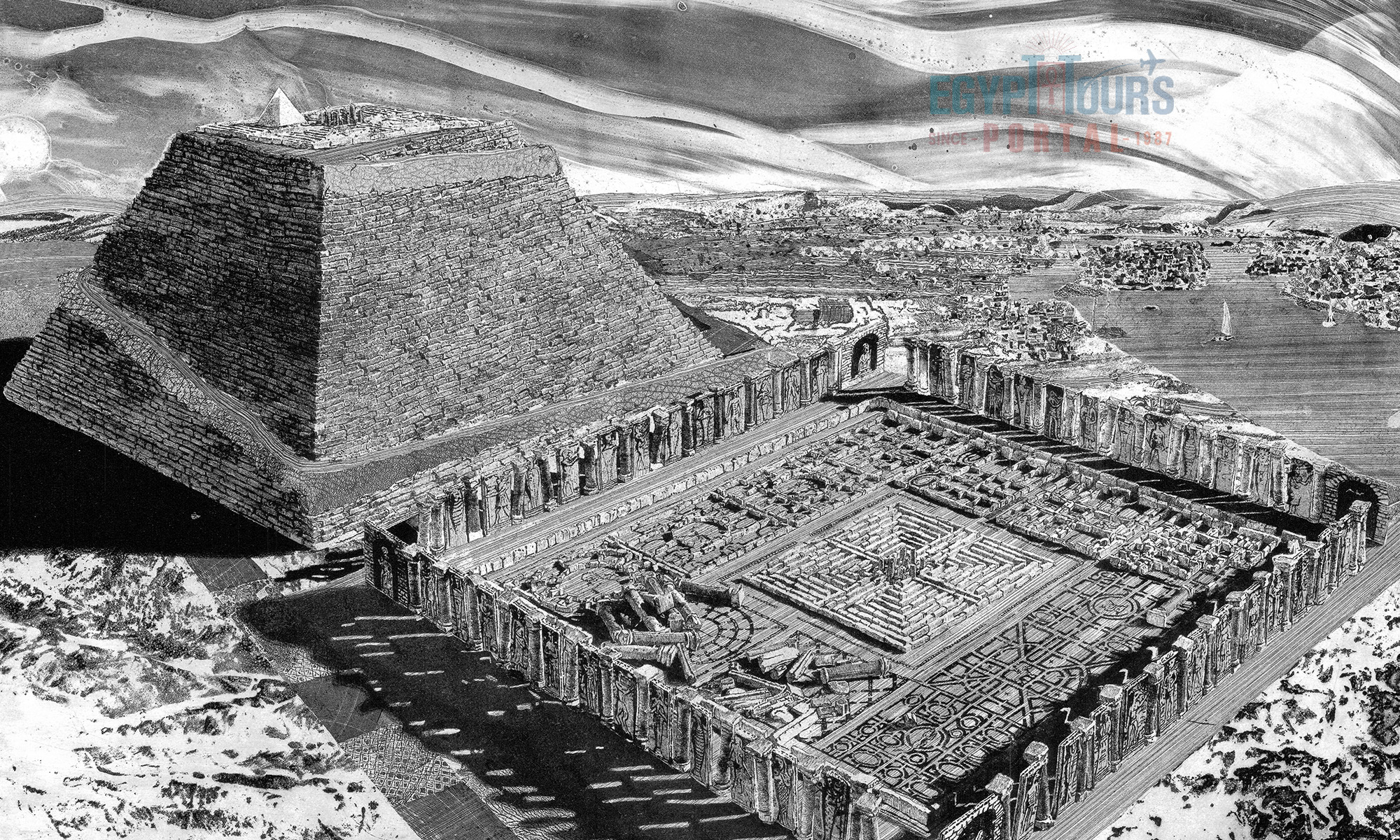
The Greek historian Herodotus visited Egypt around 450 BC and wrote that the Labyrinth surpassed even the pyramids. He described twelve roofed courts with doors facing each other, six opening to the north and six to the south, all inside a single outer wall.
He counted 3,000 rooms, 1,500 above ground and 1,500 below. He walked through the upper rooms and admired their carved walls and endless passages, but the caretakers refused to show him the lower level. They told him it held the tombs of the kings who built the Labyrinth and of the sacred crocodiles of the god Sobek. That refused visit is the root of almost every modern theory about Hawara.
Strabo, Diodorus, and Pliny
- Strabo (1st century BC) described "a large palace composed of as many palaces as there were formerly nomes," and placed it beside the tomb of a king he called Imandes.
- Diodorus Siculus (1st century BC) wrote that no visitor could find the way out without a guide, and claimed it inspired Daedalus to build the Cretan Labyrinth of King Minos.
- Pliny the Elder (1st century AD) described Parian marble and columns of red granite from Aswan, and said parts had already been damaged by later Egyptians.
The Roman emperor Septimius Severus is said to have visited around AD 200. After Roman rule ended, the building was quarried for its fine limestone, and its location slowly slipped from memory.
Hawara Labyrinth Excavation: From Lepsius to Petrie and Beyond
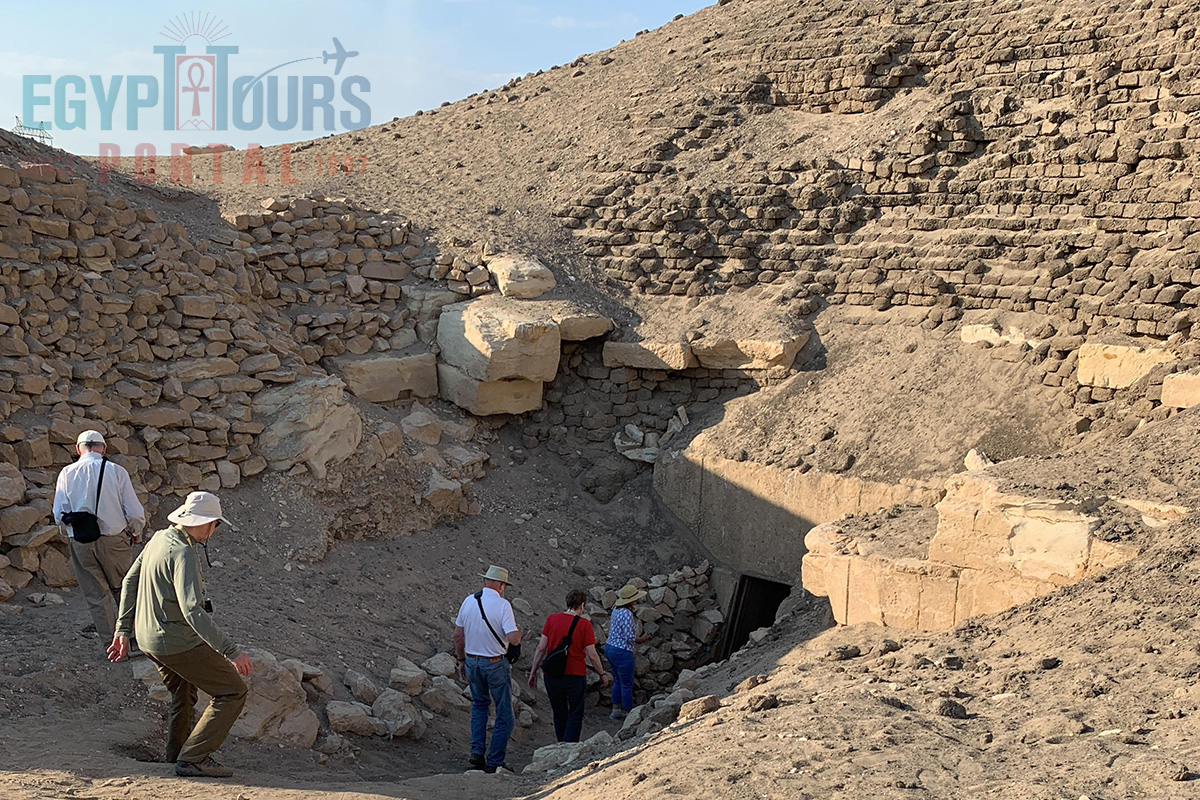
The search for the Labyrinth has run for almost two centuries, and each expedition has added a piece to a puzzle that is still unfinished.
|
Year |
Who |
What happened |
|---|---|---|
|
1843 |
Karl Richard Lepsius |
Excavated brick chambers south of the pyramid and announced he had found the Labyrinth |
|
1888–1889 |
Flinders Petrie |
Proved Lepsius's rooms belonged to a later Roman town; found the Labyrinth's foundations in a vast bed of limestone chips; entered the pyramid's burial chamber |
|
1900–1907 |
Irrigation works |
The Bahr Abdul Wahbi canal was dug across the site, damaging what remained |
|
2008 |
Mataha expedition |
Belgian and Egyptian geophysicists scanned the site for buried walls (see the scans section) |
|
2008–2009 |
Egyptian–Polish mission |
Cairo and Wrocław universities surveyed the area around the pyramid |
|
Recent seasons |
Fayoum Antiquities Area |
Egypt's Ministry of Tourism and Antiquities confirmed new fieldwork at the site |
What Petrie Found
Petrie worked in a "great bed of chips," the debris left after the building had been stripped for stone, and traced foundations covering a huge rectangle south of the pyramid. Later studies put the enclosure wall at 385 by 158 m and the temple floor at about 28,000 square meters.
His finds included statues of the crocodile god Sobek and the goddess Hathor, two granite shrines each holding a statue of Amenemhat III, and Greek papyri with lines from Homer's Iliad. From the Roman cemetery at Hawara he also recovered the famous Fayoum mummy portraits, painted on wood between the 1st and 3rd centuries AD.
Petrie concluded that the Labyrinth had been quarried almost to the ground. Funding ran out, rising water filled his trenches, and no large-scale excavation followed for more than a century.
Labyrinth of Egypt Hawara Pyramid Facts
The Hawara Pyramid is the one structure at the site that still dominates the skyline. Built of mudbrick around a core of earth and once cased in fine limestone, it has weathered into a rounded dark mound that visitors often compare to a hill.
|
Fact |
Detail |
|---|---|
|
Builder |
Amenemhat III, 12th Dynasty |
|
Date |
About 1850 BC, Middle Kingdom |
|
Base |
About 100 m per side |
|
Original height |
About 58 m |
|
Material |
Mudbrick core, originally faced with limestone |
|
Entrance |
On the south side, unusual for an Egyptian pyramid |
|
Burial chamber |
Carved from a single block of quartzite, sealed by a huge quartzite roof slab |
|
Also buried there |
Princess Neferuptah, the king's daughter, whose sarcophagus was found in the pyramid |
A Pyramid Built to Fool Thieves
The builders filled the pyramid with dead-end corridors, false passages, and sliding stone trapdoors meant to mislead tomb robbers. The real burial chamber could be reached only through a hidden opening in the ceiling of one passage, blocked by stones weighing many tons. Robbers still found their way in during antiquity and emptied the tomb.
When Petrie reached the chamber, it stood waist-deep in groundwater. He found the remains of two quartzite sarcophagi, one for the king and one for Neferuptah. A separate pyramid for Neferuptah stands about 1.5 km to the north. Today the inner passages are flooded and closed to visitors.
The design of the burial chamber, cut from one stone and lowered into place, is the same engineering tradition that produced the granite chambers of the Giza Pyramids Complex seven centuries earlier.

Ancient Egyptian Architecture
Explore the history, types & facts of Ancient Egyptian architecture, including pyramids, temples & more. Learn about their techniques, materials & achievements.
Hawara Labyrinth Scan: What the Egypt Labyrinth Scans Claim
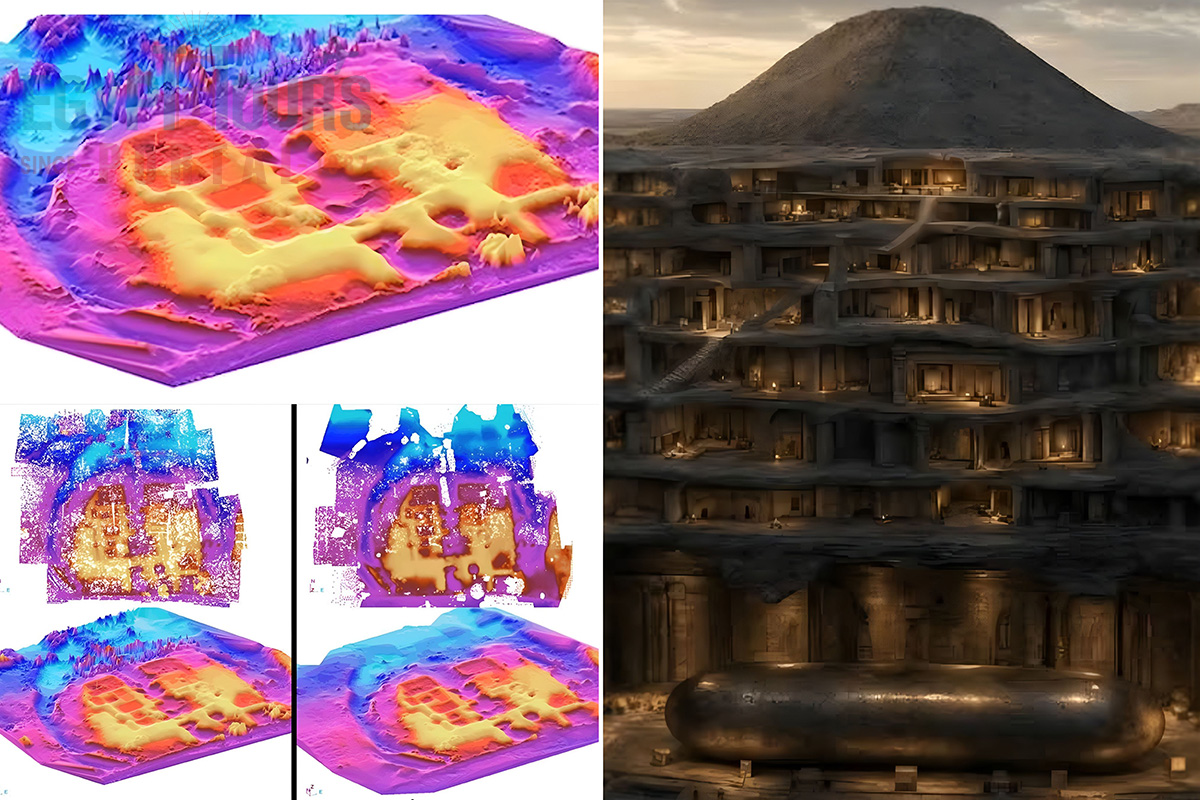
If Herodotus was right about 1,500 rooms below ground, some of them might still survive under the water table. Several teams have tried to look without digging, and their results range from peer-reviewed science to bold claims that have never been tested.
The Mataha Expedition (2008)
The best-known Egypt labyrinth scan came from the Mataha expedition, organized by Belgian artist and researcher Louis De Cordier with geophysicists from Egypt's National Research Institute of Astronomy and Geophysics (NRIAG) and Ghent University. Their electromagnetic and radar surveys reported high-resistivity features, read as walls, at roughly 8 to 12 m below the surface, south of the pyramid.
The team presented the results at Ghent University, but no follow-up excavation was approved at the time. De Cordier has said that publicizing the results without official approval led the authorities to stop the project.
Peer-Reviewed Surveys
- Khalil and colleagues (2010) used very low frequency electromagnetic (VLF-EM) scanning and electrical soundings, and reported buried anomalies that may be walls and rooms of the complex.
- Elshazly and Massoud (2024) used electrical resistivity tomography and found possible subsurface remains, while stressing that only excavation can confirm them.
The Merlin Burrows Satellite Scans and the "Tic-Tac" Object
In 2015, the British satellite-scanning company Merlin Burrows shared images claiming four underground levels, a central hall about 40 by 100 m, and a 40 m long, capsule-shaped "metallic" object at the center, which online forums nicknamed the "tic-tac." Louis De Cordier published these images on his own blog years later.
These claims have never been published in a scientific journal, the scanning method has not been explained in a way others can test, and no Egyptian authority has endorsed them. They are best read as an intriguing hypothesis, not a discovery.
Where the Science Stands
Most Egyptologists agree on three points: the Labyrinth was real, its foundations lie south of the Hawara Pyramid, and the high water table has damaged whatever survives. Whether rooms remain intact far below, as Herodotus described, is still an open question.
The Latest Hawara Labyrinth Excavation
In a recent season, Egypt's Ministry of Tourism and Antiquities confirmed that new fieldwork had begun at Hawara under the Fayoum Antiquities Area, with Supreme Council of Antiquities inspectors on site. The Mataha Foundation and the US-based Archaeological Rescue Foundation had campaigned for years for this work and proposed draining groundwater with diversion channels, planting, and controlled pumping.
Archaeological Rescue Foundation updates report a megalithic wall uncovered during the work, but no official finds have been announced yet. Any confirmed discovery will come through the Ministry, so treat social media headlines with care until then.
Visiting the Labyrinth of Egypt and the Hawara Pyramid
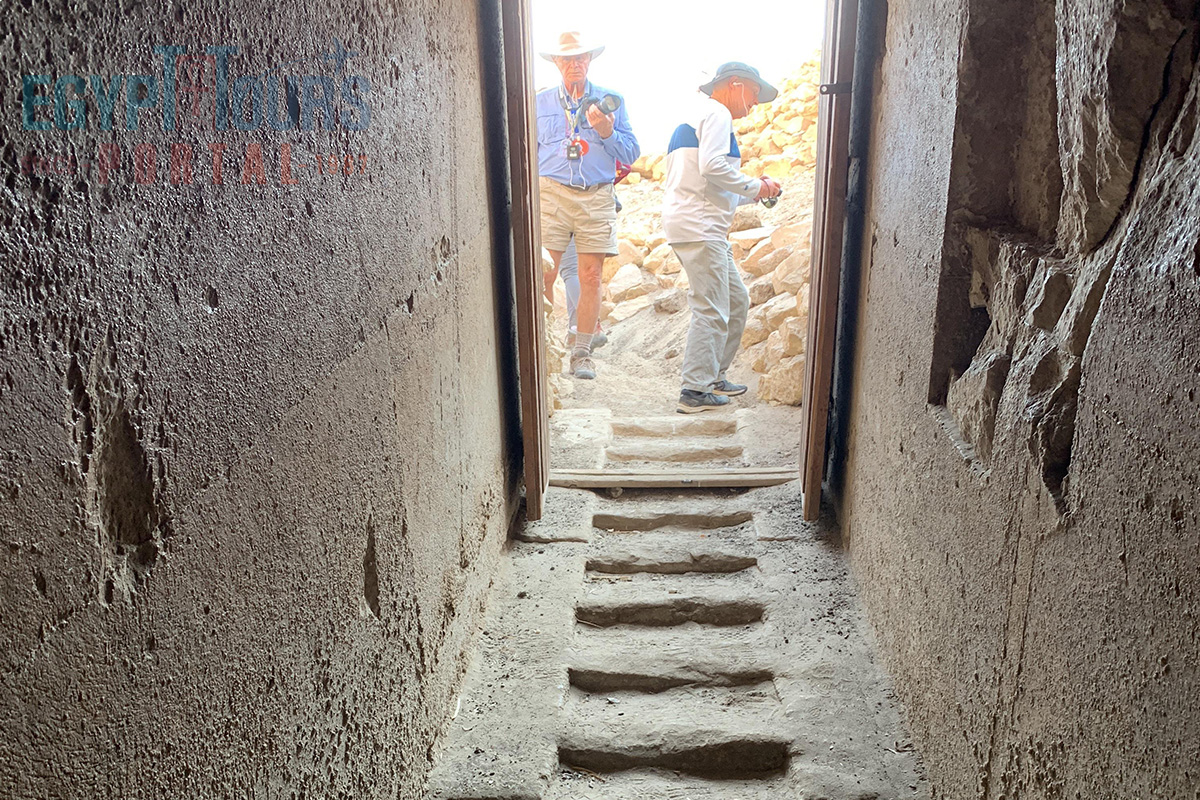
Hawara is an easy day trip from Cairo and one of the quietest pyramid sites in Egypt; on most days you may share it with only a handful of visitors.
|
Detail |
Information |
|---|---|
|
Ticket |
From EGP 150 for foreign adults, from EGP 75 for students |
|
Opening hours |
8:00 AM – 5:00 PM |
|
Distance |
About 100 km from Cairo, 9 km from Medinet el-Fayoum |
|
Time needed |
1 to 1.5 hours at the site |
What You Will See
You can walk around the base of the pyramid and see the sunken southern entrance, though the flooded interior is closed. South of the pyramid, the Labyrinth area is a wide field of limestone chips, broken columns, and granite fragments, with the canal running along its edge. A guide helps you picture the courts that once stood there.
Nearby, the ruins of the Roman-era cemetery that produced the Fayoum portraits stretch to the north. Several of those portraits, along with statues of Amenemhat III, can be seen at the Egyptian Museum in Tahrir.
Combine It With the Fayoum
Most travelers pair Hawara with the Lahun Pyramid of Senusret II, the Greco-Roman town of Karanis, Lake Qarun, and the waterfalls of Wadi El Rayan. Our Fayoum Oasis tour from Cairo covers the oasis in one day, while the Wadi El Hitan desert safari adds the UNESCO-listed Valley of the Whales.
If pyramids are your passion, you can also follow the story backward. The Step Pyramid of Djoser at Saqqara shows where pyramid building began, and our Saqqara and Memphis tour visits it alongside the ancient capital of Memphis.
The Fayoum is most comfortable from October to April; our guide to the best time to visit Egypt has the month-by-month detail.
Frequently Asked Questions
Is the Labyrinth of Egypt real?
Yes. Its foundations were excavated by Flinders Petrie in 1888, and statues and shrines of Amenemhat III were found among them. What remains uncertain is how much of the lower level described by Herodotus still exists.
Can you go inside the Hawara Pyramid?
No. The passages and burial chamber are flooded by groundwater and closed to the public. Visitors can walk around the outside of the pyramid and the Labyrinth field.
Why is the Labyrinth called a labyrinth?
Greek visitors compared its maze of courts and corridors to the legendary labyrinth of King Minos at Knossos in Crete. Some scholars think the word itself may come from an Egyptian phrase for a temple at the mouth of the lake.
Was the Labyrinth bigger than the pyramids?
Not in footprint. The temple floor covered about 28,000 square meters, roughly half the Great Pyramid's base of about 53,000 square meters. The difference is inside: the pyramid is almost solid stone, while the Labyrinth was filled with courts, halls, and rooms, which is why Herodotus judged it the more impressive of the two.
Why has no one fully excavated it?
The main obstacle is water. Irrigation canals and farmland around Hawara keep the water table close to the surface, so any deep trench quickly floods, and pumping must be done carefully to avoid collapsing what survives.
Discover One of Egypt's Most Magnificent Structures With Our Grand Trips
The Labyrinth of Egypt is part history and part open question. We know who built it, where it stood, and what Herodotus saw there, and we know that stone robbers and groundwater took most of it. What still lies under the Hawara fields is being tested, slowly and carefully, by scans and new fieldwork.
Standing beside the dark mound of Amenemhat III's pyramid, with the Fayoum's palms on the horizon, you can almost hear the footsteps of travelers who once lost their way in its twelve sacred courts. If you would like to see it for yourself, our team can book a magical holiday to Egypt & the finest Nile cruises and build Hawara into a tailor-made Egypt tour alongside the other great sites of ancient Egyptian civilization.