Summary
- The Temple of Horus at Edfu is the best-preserved example of Ptolemaic temple architecture in Egypt, built between 237 BCE and 57 BCE and dedicated to Horus of Behedet.
- Its construction reflects the contributions of several Ptolemaic rulers over nearly 180 years, while also preserving evidence of much older sanctuaries that once stood on the same site.
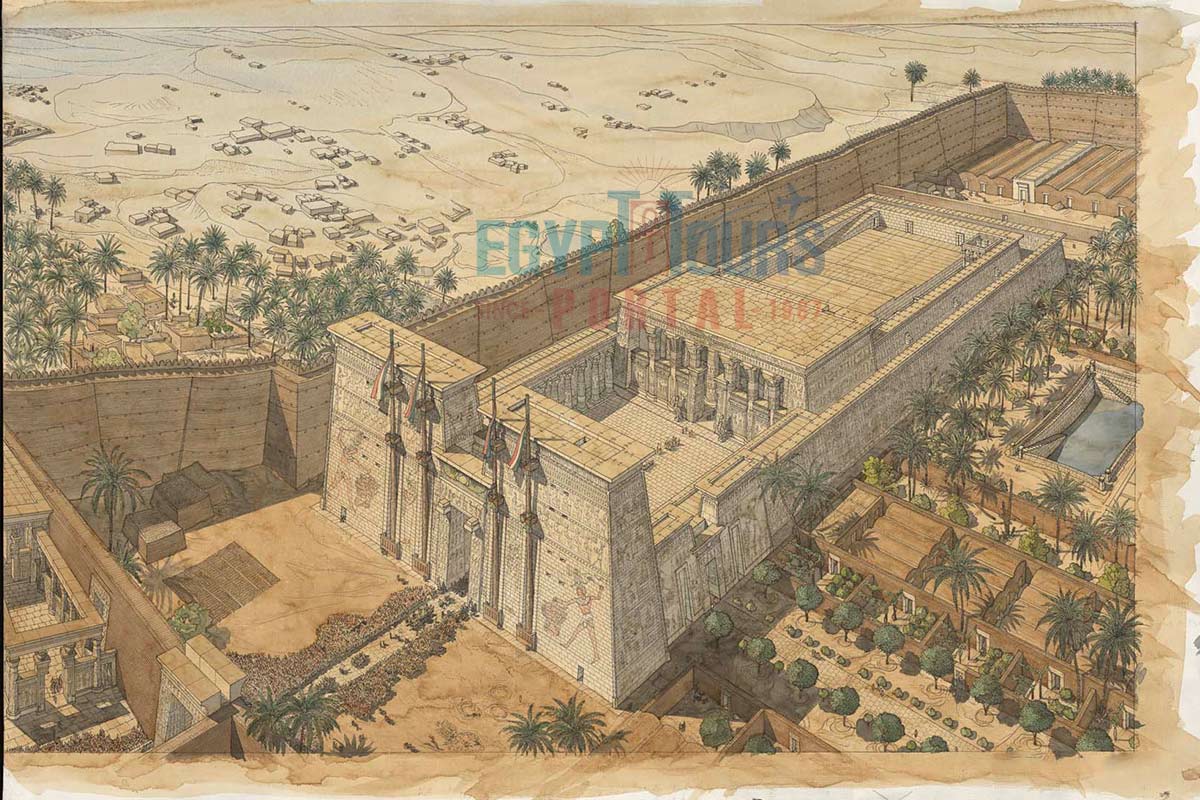
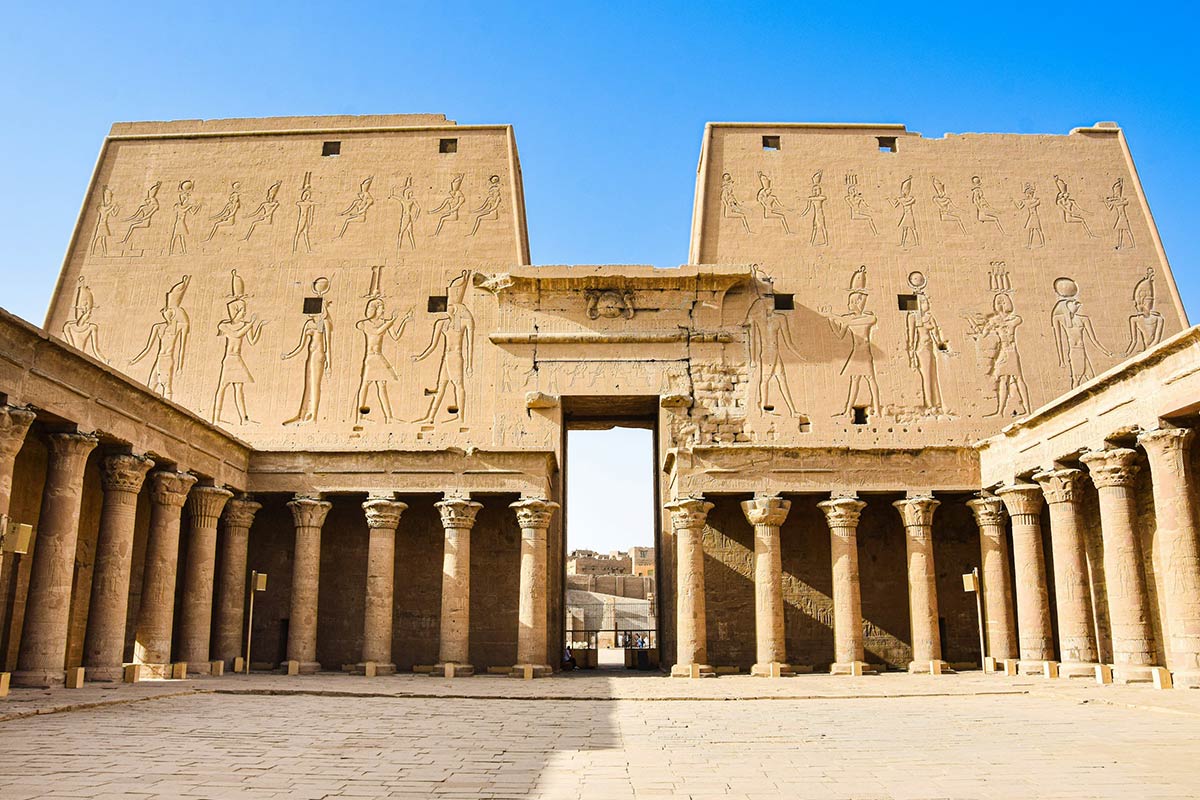
- The temple features major architectural elements such as the 36-meter-high pylon, the forecourt with 32 columns, the outer and inner hypostyle halls, the Court of Offerings, the Vestibule, and the Sanctuary.
- It functioned as a major religious center, hosting important rituals and festivals including the Festival of the Living Falcon and the Feast of the Joyous Union, celebrating the sacred union of Horus and Hathor.
- The complex also includes key sacred and functional spaces such as the 13 chapels, the black granite shrine of Nectanebo II, the House of Books, purification rooms, and the Nilometer, linking temple life to the annual Nile flood.
The Edfu temple represents the pinnacle of ancient Egyptian architecture that sheds light on the true spiritual spirit of the ancient Egyptian civilization from the perspective of the Ptolemaic dynasty. The highly preserved Edfu temple was built on the land believed to have witnessed the greatest battle in the history of ancient Egyptian Mythology between the powers of good and evil in the image of the ancient Egyptian gods, Horus and Set. It is the most preserved temple in all of the Temples of Egypt and one of the last temples to ever be built in the history of ancient Egypt, which stands as a final symbol of the ancient Egyptian heritage. Edfu is not only an architectural treasure but also one of the most important written sources for understanding the religion, language, and sacred symbolism of late ancient Egypt.
The Prosperous Location of Edfu Temple
The Edfu Temple is located in the city of Edfu in Upper Egypt, on the west bank of the Nile River, approximately 60 kilometers north of Aswan and about 110 kilometers south of Luxor. This strategic location placed the temple at the heart of an important ancient settlement known as Behdet, which served as one of the main cult centers of the god Horus. Positioned along the Nile, the temple was easily accessible by river, the primary transportation route of ancient Egypt, allowing priests, pilgrims, and goods to travel between major religious centers such as Dendera Temple Complex and Philae Temple.
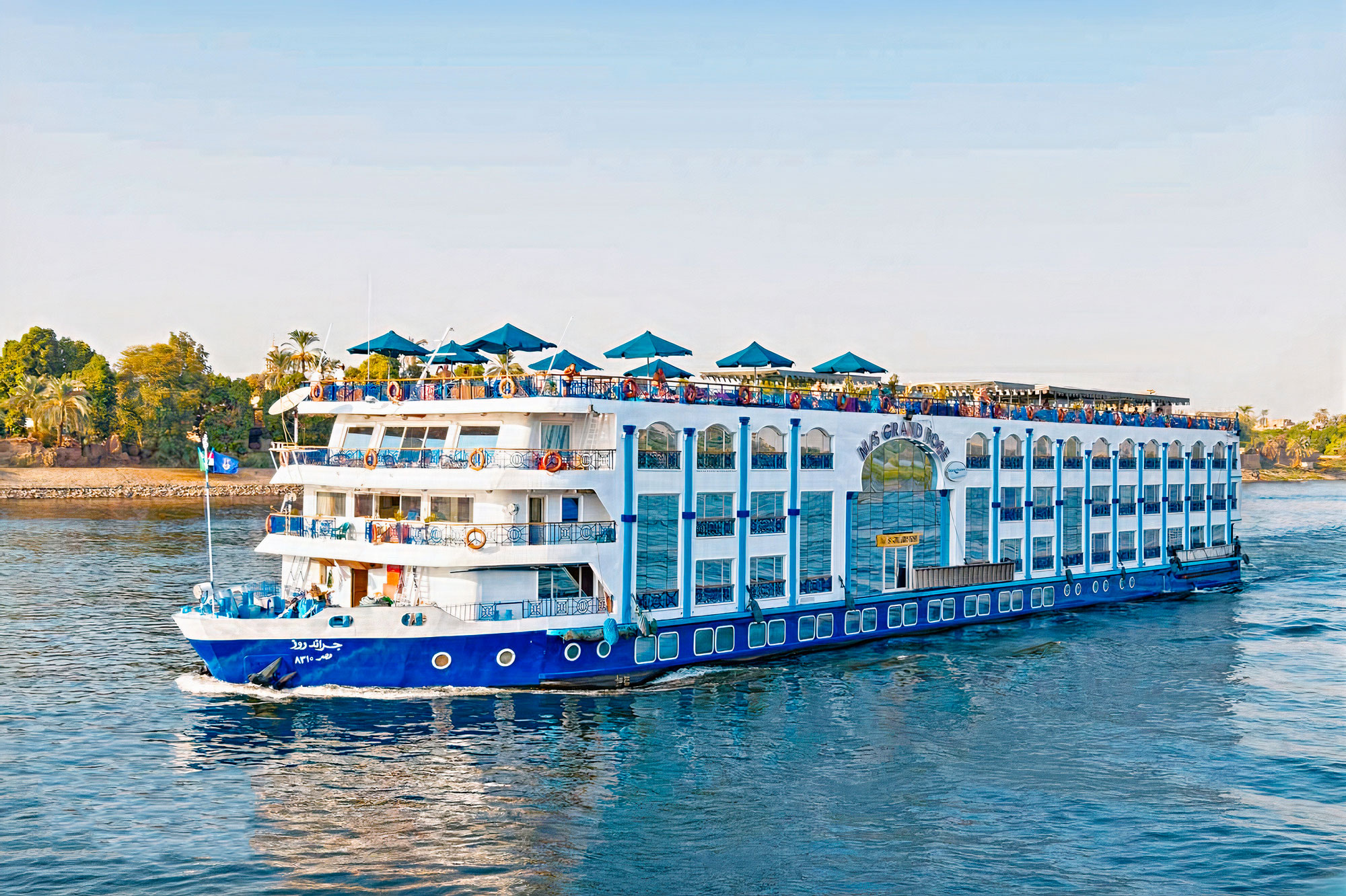
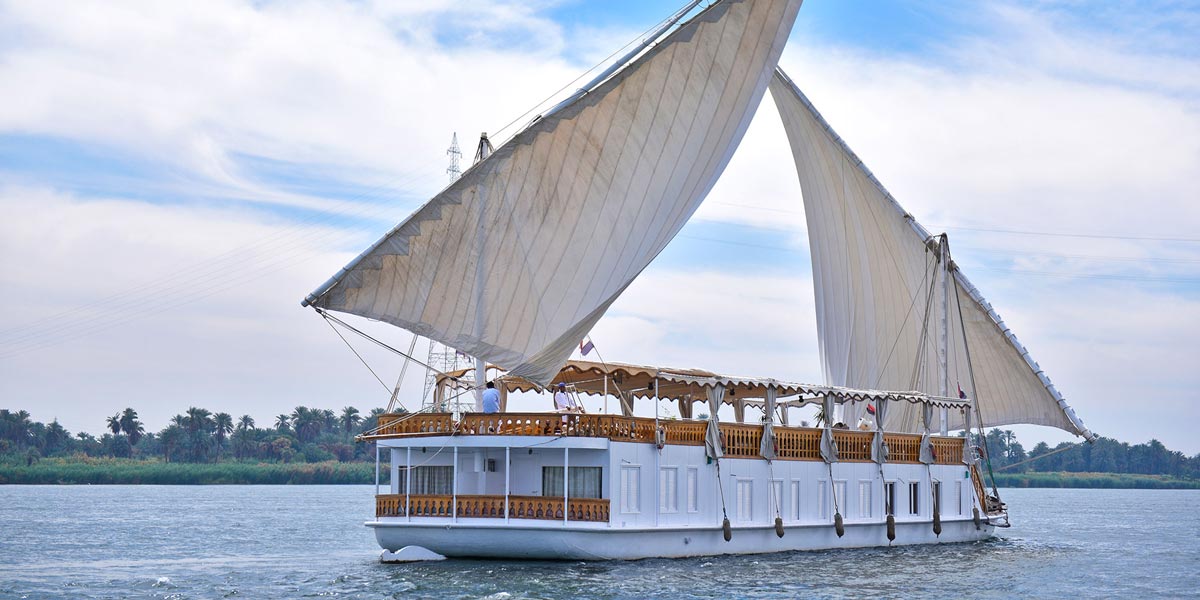
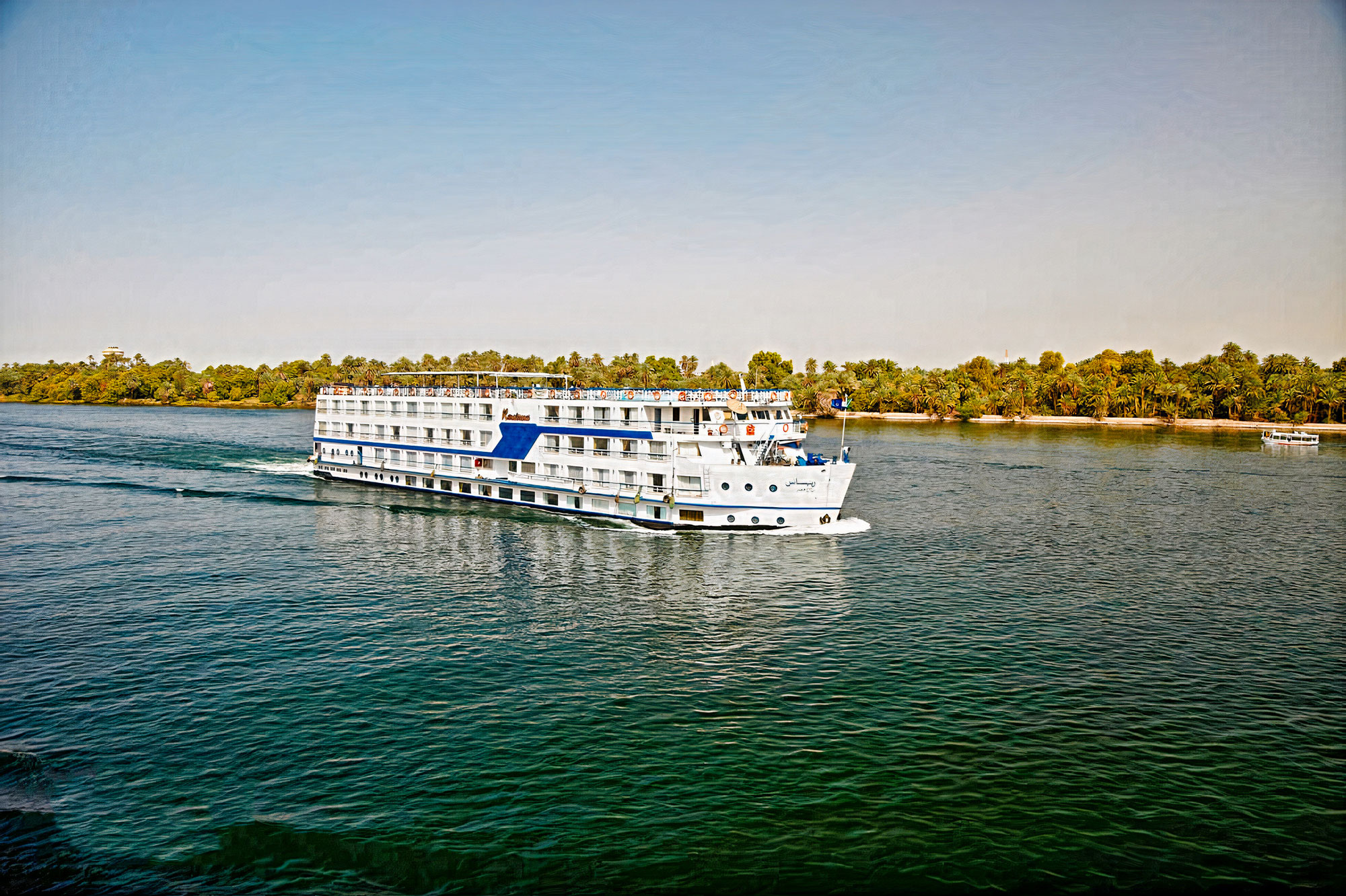
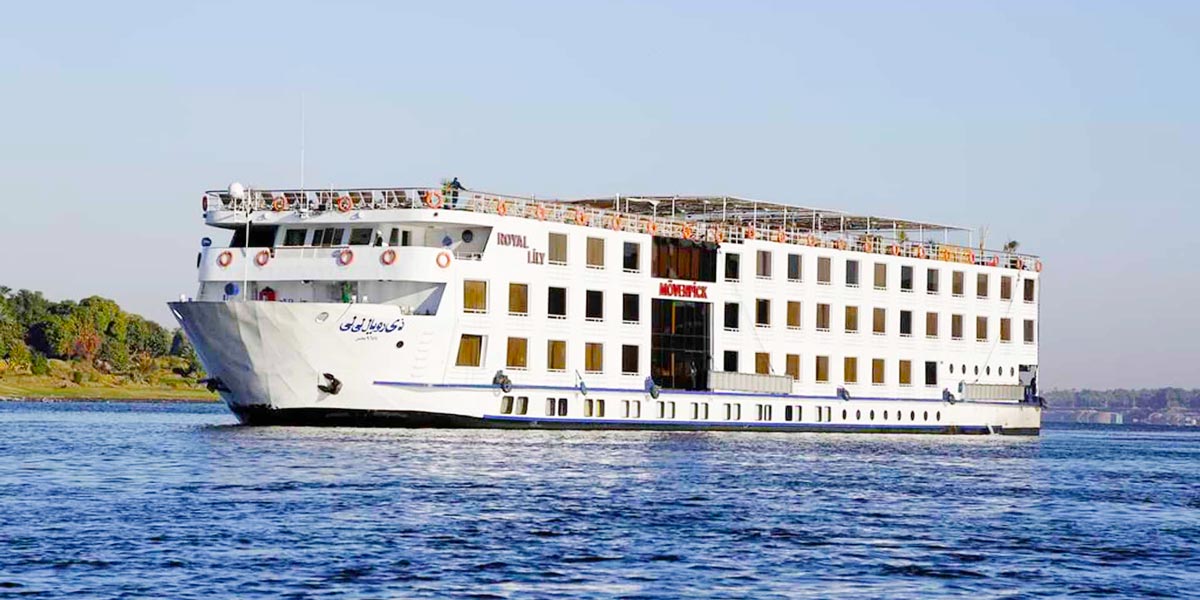
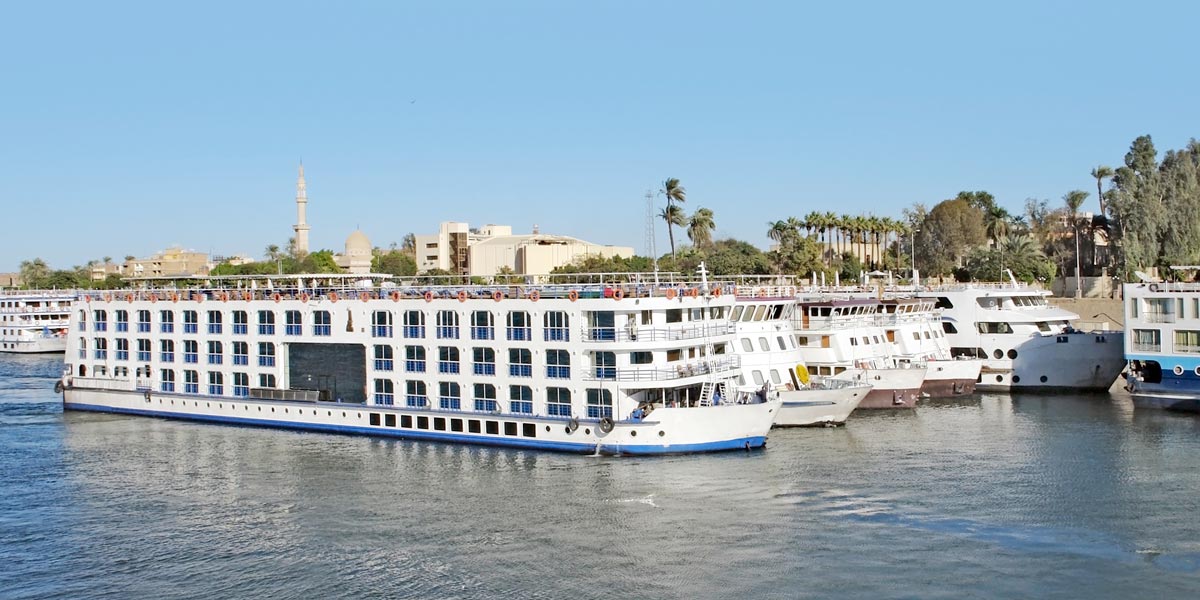
The surrounding fertile land, nourished by the annual Nile flood, supported the local population and the temple economy, while the temple itself stood slightly elevated above the floodplain to protect it from rising waters. Today, its location remains a key stop on Nile cruise itineraries, making it one of the most accessible and frequently visited temples in Egypt, perfectly situated between Luxor and Aswan.
The Grand History of Edfu Temple
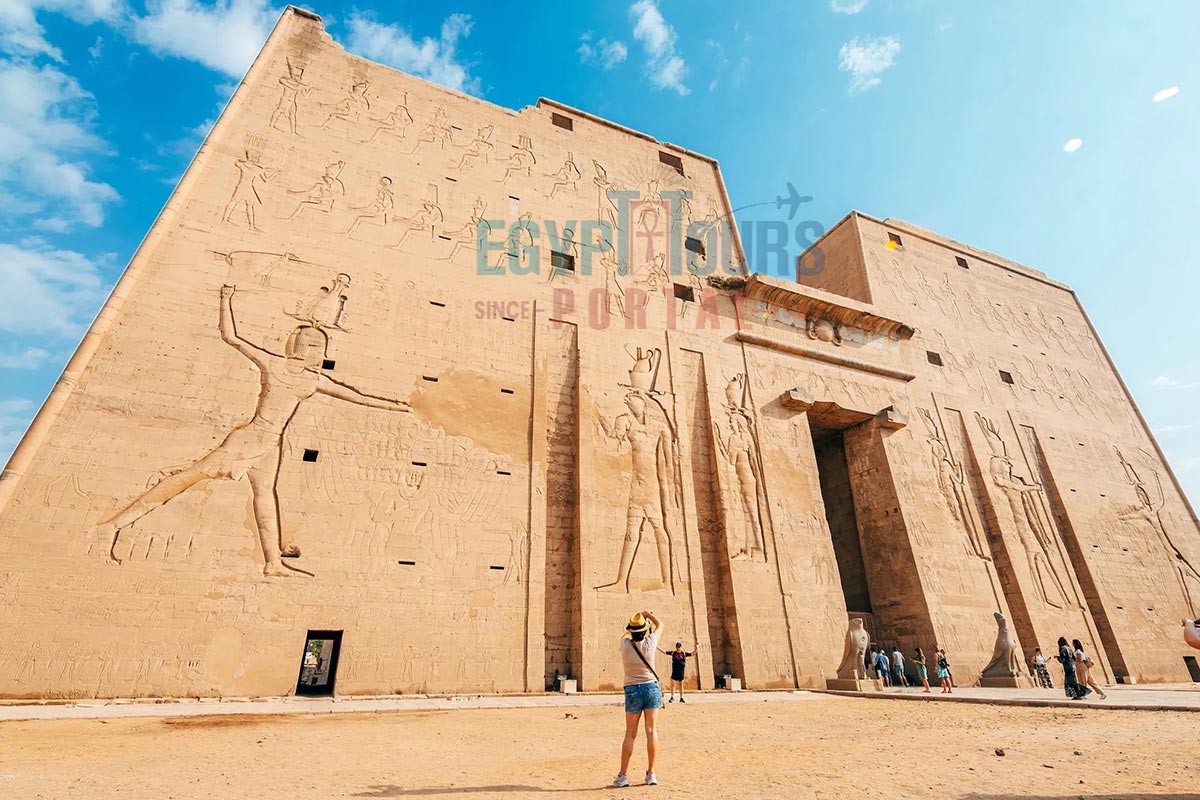
The Temple of Edfu, also known as the Temple of Horus, has a unique history, as it is one of the most important and best-preserved temples in all of Egypt, and it offers one of the clearest windows into religious life during the Ptolemaic period. It was constructed between 237 BC and 57 BC, beginning on 23 August 237 BC under Ptolemy III Euergetes I and reaching completion under Ptolemy XII Auletes, meaning the temple took nearly 180 years to build and decorate. It rose on the site of earlier sanctuaries dedicated to Horus, including remains linked to older Egyptian rulers from the New Kingdom and later periods, showing that Edfu had been sacred long before the present structure was erected.
The city itself, known in antiquity as a major cult center of Horus, became one of the most important religious cities in Upper Egypt. Over the centuries, after the spread of Christianity and the decline of temple worship, the complex gradually fell out of use and was eventually buried beneath drifting desert sand and layers of Nile silt to a depth of around 12 meters, with local houses later built over the site.
By the time European explorers saw it in the late eighteenth century, only the upper parts of the pylon were visible. In 1860, the French Egyptologist Auguste Mariette began clearing the buried temple, revealing one of the most complete sacred monuments in Egypt. Because its walls preserve detailed inscriptions on construction, ritual, mythology, and temple theology.
Why Was the Temple of Edfu Built?
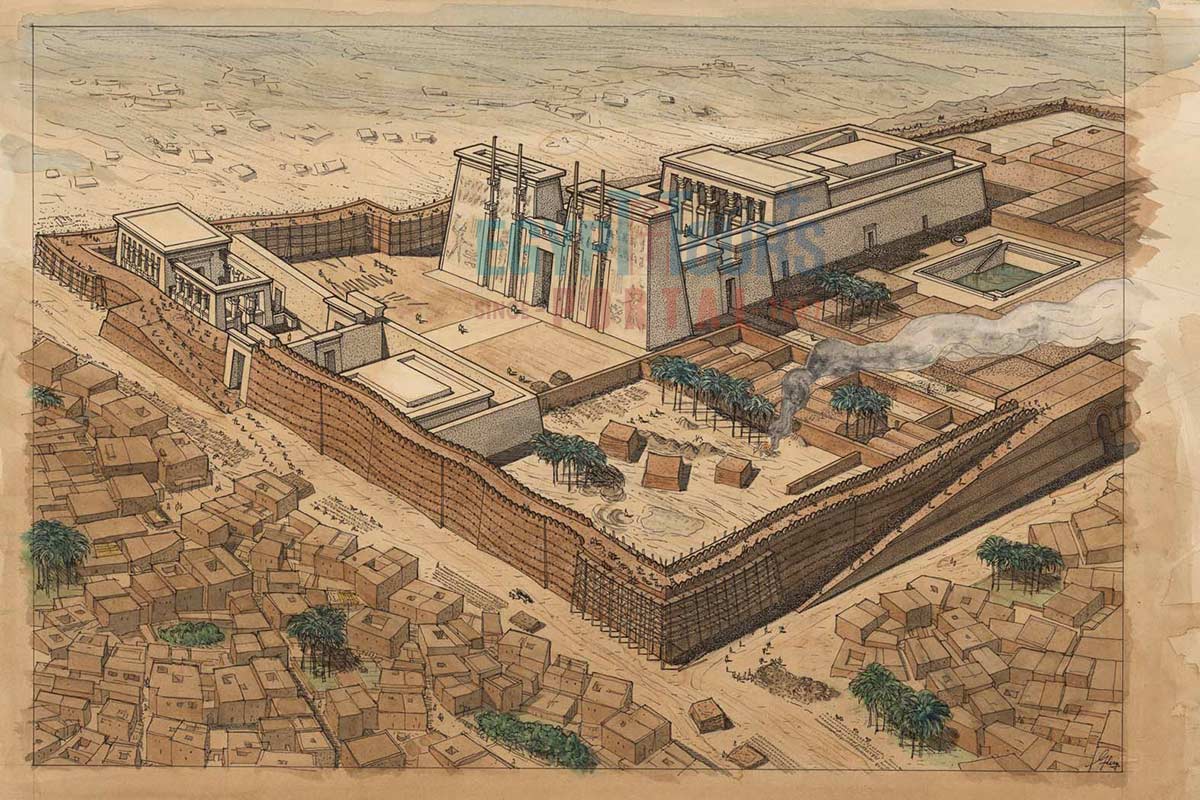
The Temple of Edfu was built as the principal sanctuary of Horus of Behdet, one of the most powerful forms of the falcon god Horus, and its purpose was far greater than simply housing a sacred statue. It functioned as a major religious, ceremonial, theological, and political center where ancient Egyptian priests performed the daily rites needed to sustain the divine presence of Horus and maintain cosmic order.
In ancient Egyptian belief, temples were not public worship halls in the modern sense, but sacred houses of the gods where offerings, purification, hymns, incense, and ritual performances renewed the bond between the divine world, the king, and the land of Egypt. Edfu also carried powerful mythological significance because it was associated with the place where Horus defeated Seth, symbolizing the triumph of order over chaos and legitimate kingship over disorder. This made the temple especially important in royal ideology, since every reigning pharaoh was understood as the earthly representative of Horus.
The complex was also the setting for great annual festivals in Ancient Egypt, including the Festival of the Sacred Marriage, when the goddess Hathor of Dendera traveled to Edfu to unite with Horus, and ceremonies such as the Festival of the Living Falcon, which renewed royal and divine power. In this way, the temple was built not only to honor a god, but to serve as a ritual engine of the universe, a place where myth was re-enacted, kingship was renewed, sacred time was maintained, and the divine protection of Egypt was continuously affirmed.
The Epic Architecture and Design Plan of the Edfu Temple
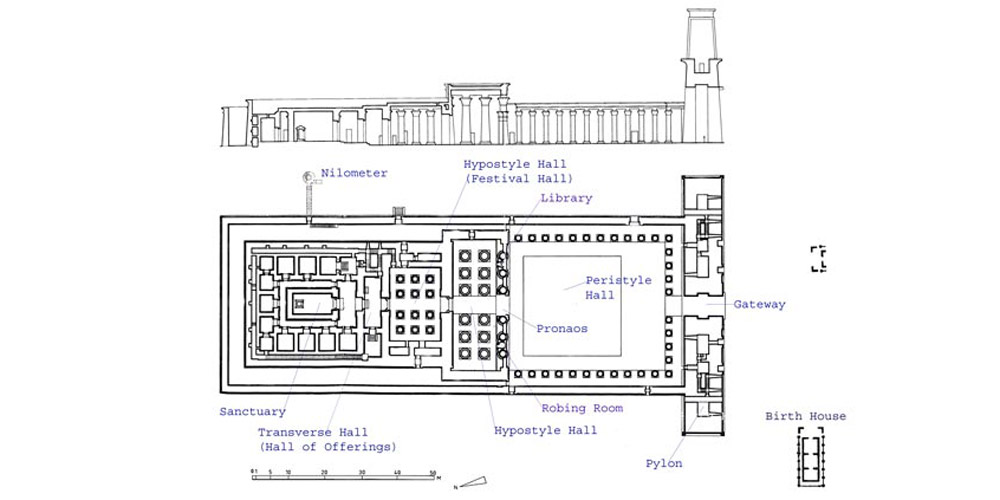
The design of the Temple of Edfu represents one of the finest surviving examples of Ptolemaic temple architecture in Egypt, preserving the classical Egyptian temple plan with exceptional completeness while also reflecting the cultural world of the Hellenistic age. Here are all the architectural elements that made the Edfu Temple stand the test of time:
The Pylon
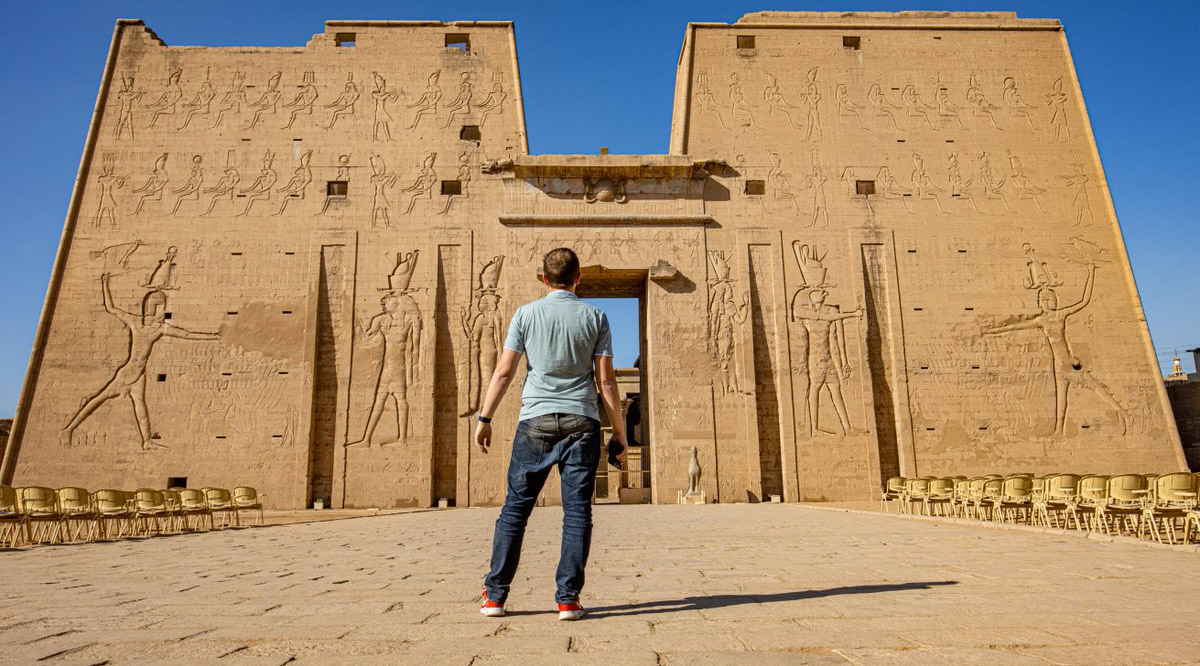
The pylon is the monumental entrance of the temple and one of its most imposing features. Its two great towers rise to about 36 meters high, and the entrance once held Lebanese cedar doors installed in 57 BCE by Ptolemy XII Neos Dionysos. The façade also preserves traces of the four huge wooden flagpoles that once adorned the entrance, while the towers themselves contain several storeys of chambers and stairways leading to the roof.
The Festival of the Living Falcon
This was an annual ritual celebrating the crowning of the sacred falcon and the renewal of the pharaoh’s authority. During the festival, the statue of Horus was taken from the sanctuary to the Temple of the Sacred Falcon, where a living falcon was chosen through an oracle as the rightful representative of Horus and kingship. The sacred bird and statue were then displayed to the public from the top of the monumental gateway before the coronation rites were completed.
The Forecourt
The forecourt is the large open courtyard immediately beyond the pylon, paved and surrounded on three sides by 32 columns. Its walls preserve scenes of the Feast of the Joyous Union, which celebrated the sacred marriage of Horus of Edfu and Hathor of Dendera. This 15-day festival included processions, feasting, and public ritual activity, making the forecourt one of the main ceremonial spaces visible to the wider population.
Evidence of Older Temples
The forecourt also preserves evidence that earlier temples once stood on the same site. Archaeologists found remains of a monumental entrance from a New Kingdom temple and inscriptions naming Ramesside kings of Dynasties 19 and early 20. Below the pavement, reused sandstone blocks bear names from even earlier periods, including King Djehuty, Psamtek II, and a Kushite king of Dynasty 25, proving that Edfu had been sacred long before the current Ptolemaic temple was built.
The Outer Hypostyle Hall
The outer hypostyle hall is the first roofed hall inside the temple and is fronted by two large granite statues of Horus from Aswan. Its ceiling is decorated with astronomical imagery, and side rooms flanking it served practical priestly functions. These included the House of Morning for purification and the House of Books, which acted as a library containing religious, scientific, and ritual papyri needed for temple ceremonies.
The Inner Hypostyle Hall
The inner hypostyle hall is smaller and more sacred than the first, marking the beginning of the naos, or innermost holy area of the temple. Here, the floor rises, and the ceiling lowers, creating a stronger sense of approaching the divine center. Its side rooms included the Room of the Nile for storing purification water, the Laboratory for making ritual oils and perfumes, and the Treasury for storing precious objects and adornments used for the divine statues.
The Court of Offerings
This narrow chamber was used for the burning of food and oil offerings for the god. In Egyptian ritual belief, the deity was nourished not by physically eating the offerings, but through their aroma and smoke. The decorated walls emphasize offering and purification scenes, reinforcing the sacred duty of sustaining the god eternally.
The Vestibule
The vestibule, also called the transversal hall, functioned as a transition space before the most sacred core of the temple. It served as a buffer between the more accessible halls and the sanctuary with its surrounding chapels. Staircases on either side led to the roof, which was used for important religious ceremonies.
The Sanctuary
The sanctuary was the holiest part of the temple and the spiritual center of the entire complex. It housed the sacred barques of Horus and Hathor for processions and contained the permanent shrine of Horus, probably in the form of a wooden falcon statue. At the rear stands a black granite shrine made by Nectanebo II (360–343 BCE), one of the few surviving elements from an older temple. The inscriptions around the sanctuary doorway include hymns used to ritually awaken the god each morning.
The Chapels
Around the sanctuary is a group of 13 chapels and additional side chambers dedicated to other gods and goddesses associated with Horus. The inscriptions on their doorways identify which deities inhabited each sacred room, showing that the temple functioned as a wider divine complex rather than a shrine to Horus alone.
The Nilometer
The Nilometer is a circular well located east of the temple outside the enclosure wall, reached by a stairway beginning inside the complex. It served two purposes: it supplied water for daily purification rituals and also measured the level of the annual Nile flood. Scales carved along the staircase walls allowed temple staff to track the water table, linking ritual life directly to the rhythms of the Nile
Religious Significance of the Golden Edfu Temple
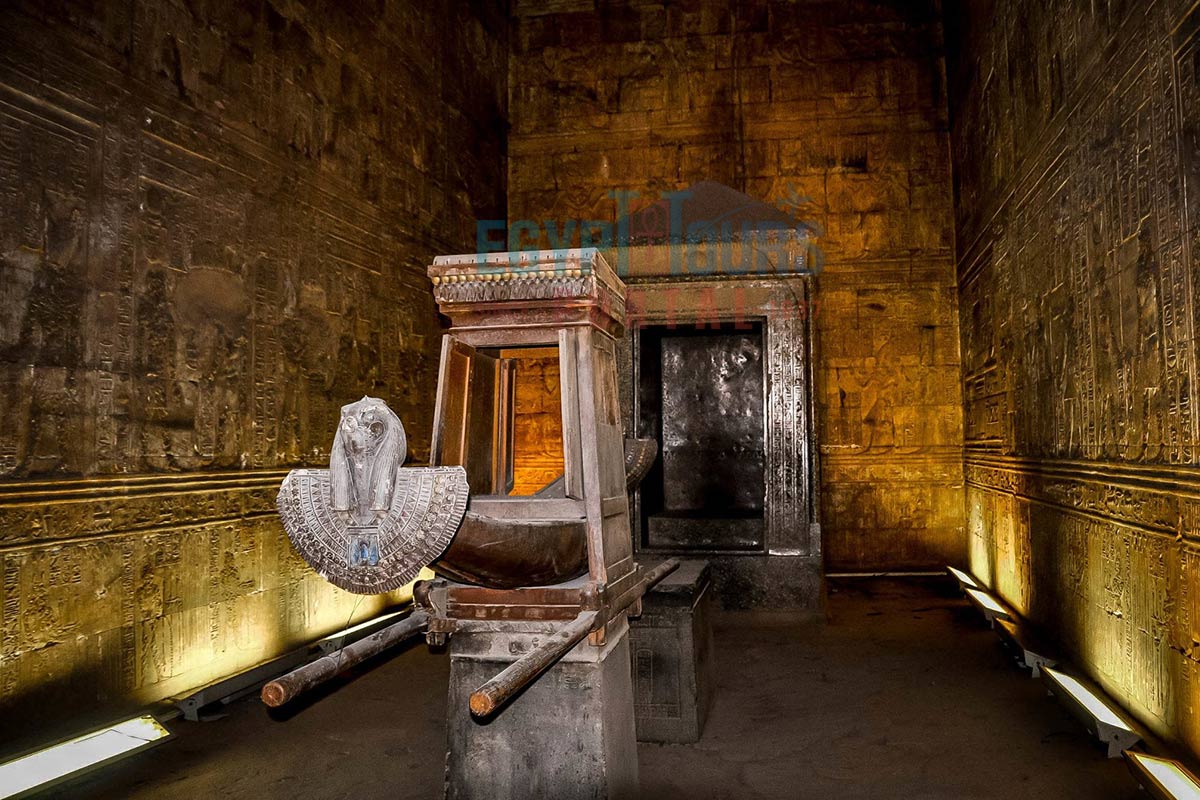
The religious significance of the Temple of Edfu lies in its role as one of the foremost cult centers of Horus, where divine kingship, cosmic order, mythic victory, and temple ritual were united in a single sacred space. The temple was not merely dedicated to Horus in a symbolic sense; it was regarded as his true earthly dwelling, where his sacred image received daily offerings, purification, clothing, incense, hymns, and ritual care from the priesthood.
This daily temple service was believed to maintain the power of the god and, through him, the stability of Egypt itself. Edfu was also the setting for major religious festivals that linked theology with public devotion, most famously the celebration of the sacred marriage between Horus of Edfu and Hathor of Dendera, a festival that involved a ceremonial river journey, public celebrations, and rites of fertility, harmony, and divine union. Another key ceremony was the Festival of the Living Falcon, in which a sacred falcon was selected and crowned, symbolically renewing kingship and divine authority.
The inscriptions at Edfu also preserve elaborate ritual texts, hymns, liturgies, and sacred dramas, making the temple an enormous theological archive. Because Horus was closely tied to the pharaoh as the divine model of rightful kingship, every ritual carried political meaning as well: to honor Horus was to uphold the legitimacy of royal power and the victory of order over chaos. In this sense, Edfu was one of the clearest places in Egypt where myth, kingship, liturgy, sacred space, and state ideology met.
The Creation Myth of this Legendary Edfu Temple
One of the most fascinating features of the Temple of Edfu is that its walls preserve a rich and unusually detailed creation myth, giving scholars a rare theological map of how the ancient Egyptians imagined the origin of the world and the sanctity of the temple itself. According to these inscriptions, the world once existed as a vast primeval expanse of water, from which the first land gradually emerged.
At the place where that first land rose close to the surface, reeds grew, and the site became the germ of sacred creation. It was there that Horus, in falcon form, descended and claimed the place as holy. At the same time, hostile forces such as the serpent-like Apophis attempted to prevent creation, but divine intervention in the image of Ptah, overcame chaos and allowed order to emerge. In the mythic logic of the temple, Edfu was therefore not just built on any ordinary ground; it was understood as an “Island of Creation,” a first sacred mound where the ordered cosmos began to take shape.
The myth goes further by describing how gods such as Thoth and Seshat laid out the first divine plan of the temple, while a godly master-builder executed that design, originally not in stone but in reeds, reinforcing the idea that every stone temple was the earthly continuation of a primordial divine prototype. The temple’s foundation ritual involved several sacred stages, beginning with the stretching of the cord ceremony, which was used to mark out the ground plan. After construction was finished, the king formally dedicated the temple to a triad of gods, and, in religious belief, 60 gods formed a protective living wall around the temple to guard it from external threats. This creation theology transformed Edfu into more than a building: it became a symbolic recreation of the beginning of the universe, where every ritual renewed the first victory of order, light, and sacred kingship over darkness and chaos.
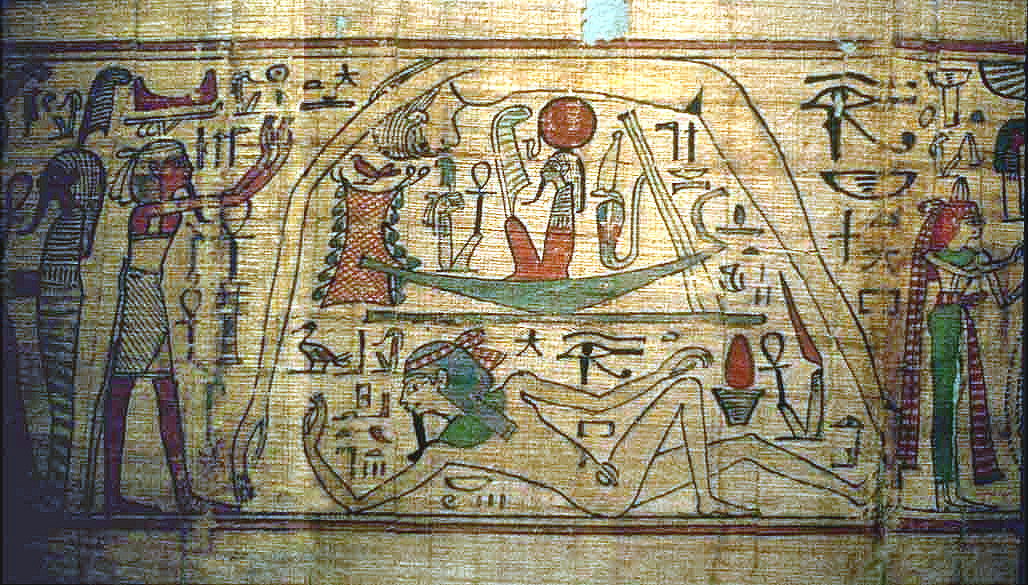
Egyptian Mythology Creation Story
Witness How the Creation of the world Came to Be According to Ancient Egypt
Edfu Temple Facts
- The Temple of Edfu is one of the most remarkable monuments in Egypt because it combines extraordinary preservation, monumental scale, theological richness, and architectural completeness in a way few other temples can match.
- It is widely regarded as the best-preserved Ptolemaic temple in Egypt, and among the last great temples ever built in the ancient Egyptian religious tradition.
- It is entirely dedicated to Falcon God Horus of Behdet.
- It was built between 237 BC and 57 BC and took roughly 180 years to complete.
- The temple is over 140 meters long, occupies about 7,000 square meters, and features a monumental pylon around 36–37 meters high, one of the tallest in Egypt.
- It contains a large forecourt with 32 columns, two hypostyle halls, a sanctuary with a surviving black granite naos of Nectanebo II, numerous chapels, storerooms, purification chambers, a library, a treasury, and a Nilometer connected by a stairway beneath the enclosure wall.
- Its wall inscriptions preserve invaluable information about temple construction, mythology, ritual drama, sacred festivals, the annual union of Horus and Hathor, and the eternal struggle between Horus and Seth.
- For centuries, the temple lay buried beneath sand and silt until Auguste Mariette cleared it in the nineteenth century, and today it remains one of the most visited and admired temples in Upper Egypt, especially for travelers on Nile cruises.
- In historical, religious, artistic, and archaeological terms, Edfu is not simply another ancient monument; it is one of the fullest surviving expressions of how a late Egyptian temple functioned as a house of the gods, a ritual theater, a sacred text in stone, and a final flourishing of ancient Egyptian civilization under Ptolemaic rule.
Tours to Edfu Temple
The Edfu temple is the crown jewel of a magical, mythical city of Aswan, where the legend of the past is awakened in the most incredible manner across a heavenly wonder. Egypt is filled with enchanting attractions all over Egypt, especially in Upper Egypt between Luxor and Aswan, through a marvelous Nile river cruise. So we have well-created, breathtaking Egypt tour packages to witness the Edfu temple with other Egyptian attractions.